Search This Blog

Showing posts with label TV. Show all posts

Saturday, October 31, 2015

'True Blood' TV series review


Yes, yes – it’s Halloween in Australia (which should be an oxymoron but: capitalism). I can’t bring myself to read any horror-anthologies let alone review any book to theme. But these past few weeks I have binge-watched all seven seasons of True Blood and have things I need to get off my chest, so I may as well capitalise and blog on the apropos Samhain.

I was moved to re-watch True Blood – and so soon after the last season aired in August 2014 – because it was only this month that I finally read the 13th and final book in Charlaine Harris’s Sookie Stackhouse series that True Blood was based on. Dead Ever After was okay, but it really reminded me how amazing that series was in the beginning, and how impressed I was with the early seasons of its HBO adaptation. So I took a little binge-watch down memory-lane …

Charlaine Harris’s Sookie Stackhouse series debuted in 2001 at a time before “urban fantasy” was a recognised genre and Harris’s strange mash-up of vampires, humour, romance and mystery-solving was all but unheard of (though she has credited Laurell K. Hamilton’s early 90’s series Anita Blake in helping to position the Sookie books).

Harris used the Sookie series to explore “otherness”, and that all her books are based in the Deep South of Bible-belt territory added a certain allegory to the explorations of a “disabled” telepath waitress encountering the world of outed vampires and shifters in Louisiana.

Charlaine Harris’s series was extremely popular, even before the HBO adaptation. The first book Dead Until Dark won the Anthony Award for Best Paperback Mystery, not to mention Harris had made a name for herself writing two previous popular and critically-acclaimed mystery series in Aurora Teagarden and Lily Bard.

But I think what really had Alan Ball (of Six Feet Under and American Beauty fame) and HBO sitting up and taking notice of Charlaine Harris’s series was that vampires were back in vogue … Stephenie Meyer’s Twilight hit shelves and made waves in 2005, with the film adaptation due for release in November 2008. But pop-culture was definitely ready for more grown-up explorations into bloodlust-as-regular-lust metaphors. Thus, True Blood premiered on HBO in September 2008 (the CW would release The Vampire Diaries TV series based on LJ Smith’s YA series the following year). And a couple of things happened in 2008 that were note-worthy for the series: one was the Great Financial Crisis, the worst since the Great Depression of 1929, and the 44th United States presidential election was won by Democrat Barack Obama over Republican John McCain.

True Blood definitely revelled in a post-George Bush era, even as the series’ timeline seemed to be set during his Presidency;


Alan Ball took Harris’s “otherness” explorations and more closely aligned them to the fight for marriage equality and gay rights in modern-day America. The series was always praised for this allegory, no matter how over-the-top and fantastical the subversion of using vampires to have the discussion was. This remains a powerful connection in the series, even upon re-watch in 2015 when the Supreme Court has declared same-sex marriage legal in all 50 States. I will say that real-life bigots like Kim Davis seem all the more caricature for how well I can imagine them living somewhere like Bon Temps, gossiping with the likes of Maxine Fortenberry at Merlotte’s about those damn “fang-bangers” and “vampire fuckers.” The only time the show’s gay rights allegory became problematic was in the final season, in a storyline about a vampire virus called ‘Hep V’, the spread of which was meant to mirror the AIDS epidemic. I think by the seventh season the show had become so blood-and-gore over-the-top, that it wasn’t the best place to have serious discussions about the devastation of AIDS, and the long unfair moral/social persecution of its sufferers.


But True Blood really was an exploration of general “otherness” as perceived by society too – and didn’t shy away from discussing race relations in America (a topic that is more relevant than ever before, sadly). Re-watching the show with Ta-Nehisi Coates’s Between The World and Me ringing in my heart was also really eye-opening, particularly this line: "But race is the child of racism, not the father. And the process of naming 'the people' has never been a matter of genealogy and physiognomy so much as one of hierarchy." Thus after watching all seven seasons I decided that Tara Thornton, played by the incomparable Rutina Wesley (next seen on the new season of Arrow as Liza Warner/Lady Cop – OMG!) was one of the show’s best creations.

Tara was a minor character in Charlaine Harris’s book series, but Alan Ball not only gave her a meatier role in the HBO show, he also changed her from white to black – a bold and brilliant move that gifted audiences one of the angriest and most brilliant women on TV. It was just a shame that as the series went on (and indeed, Alan Ball left as showrunner after season five) Tara’s character was left to fall by the wayside in a particularly clumsy vampire-turning arc. I really agree with this Autostraddle article on ‘The Trials, Tribulations & Turning of True Blood’s Tara Thornton’, particularly this assertion: “But as the seasons progressed, and we got to know Tara more and more, a disturbing pattern emerged: the more complex her character became, the more she was punished. As her insecurities were revealed one by one, a supernatural creeper would show up to take advantage of her based on whatever weakness had just been revealed.” That’s very true and was so disheartening that by the end I completely understood why Wesley maybe wanted to leave the series early, or at least have her role drastically reduced.

Ball also chose to veer from the book series by not killing off a minor character by the name of Lafayette (played by Nelsan Ellis – one of the best talent finds of the whole series) by instead giving him a much bigger role and making him Tara’s cousin. Lafeyette would go on to not only explore race relations, but seriously subvert clichés about gay men. Lafayette also had a seriously interesting arc and one of the best, most tragic romances with Jesus Velasquez (Kevin Alejandro) not to mention slowly discovering he was a spirit-medium … but, again, by the last season his character was seriously reduced and his sole arc came down to being part of a love triangle between vampire Jessica (Deborah Ann Woll) and her lover, James (Nathan Parsons) – after being such an interesting and subversive presence, Lafayette was left in the last season to be defined by his sexuality and a half-baked romance. Ugh.


Another minor book character who was given a more integral role in the TV show was Terry Bellefleur (played by Todd Lowe) – as in the books, Terry was a war veteran ravaged by PTSD. He was always an interesting character for Sookie’s being able to see the kindness in his heavy heart. That he also got to play most of his role opposite Carrie Preston’s Arlene, was nothing short of spectacular. She was evil in the book series, but turned into a surprisingly well-developed character in the show, eventually coming full-circle by the finale. Preston was another real great talent find of this series, and she’d go on to make impacting guest appearances in shows like The Good Wife (as the brilliant lawyer Elsbeth Tascioni … and I’m not alone in hoping for a spin-off show with Elsbeth and Kyle MacLachlan’s Josh Perotti happens one day!)


The other characters to tip my hat to in the show are all the villains – the best of which had to be Steve and Sarah Newlin, played with gospel-goodwill enthusiasm by Michael McMillian and Anna Camp as religious anti-vamp campaigners. Denis O'Hare’s Russell Edgington was also a theatrical treat as a thousands-year-old anti-mainstreaming vampire with werewolf flunkies. And James Frain’s turn as the seriously creepy and lonely vampire Franklin Mott was inspired casting. And perhaps one of the downfalls of the finale season was the lack of real bad guys to give the season direction – especially after we’d been so spoiled for core baddies in all other seasons, right from season one’s human serial killer, René Lenier (Michael Raymond-James).


So now I’ve come this far and have yet to mention the “core” characters of book and TV series. *Sigh*. Okay, let’s do this – Sookie Stackouse, played by Anna Paquin.

It’s always the case that the main character of a series inevitably becomes the most annoying, right? Like, there’s an algorithm that proves this I’m pretty sure. They’re the person we spend the most time with, and every new season-arc depends on them doing repeatedly stupid shit to keep finding themselves in perilous situations. The one good thing about Sookie Stackhouse in True Blood though, was that the show seemed painfully self-aware of how annoying she was. I mean, they gifted audiences with this line from Pam De Beaufort (played by the goddamn glorious, Kristin Bauer van Straten): “I am so over Sookie and her precious fairy vagina and her unbelievably stupid name. Fuck Sookie!” She was speaking for all of us then.


Basically Sookie was as problematic in the TV series as she became in the books – and it’s important to note that ‘Dead Ever After’ was released in 2013, while True Blood finished in August 2014 – so by that time the TV audience were as frustrated with Sookie’s trajectory as the book audience were and perhaps fed one another’s displeasure.

Certainly Sookie started out as a bit of a contradiction – she was at once a busty blonde Southern belle, but also a serious outsider in her own community for her telepathic powers. A 20-something virgin wise beyond her years, partly for having a window into the minds of those around her, she was outwardly the archetypal (even quite boring) heroine, but below the surface there was a lot more going on which was a recurring theme of the series as a whole, which also featured shifter characters who were so far from what they seemed.

But Anna Paquin’s Sookie did suffer just as book-Sookie did when her genealogy was revealed to be fairy. This was a confusing storyline, not exactly helped by the conflicting-Disney connotations of faeries that audiences (and Sookie) had to contend with, so different from the Gothicism of vamps and werewolves.


And just as in Charlaine Harris’s books, the faerie storyline rarely worked – but where it was convoluted and just plain lame in the books, in the HBO show it became tacky and laughable;


Sookie’s love-life also became a sore point for book fans, who were all rooting for tall, blonde and Viking Eric Northman (played – deliciously – by Alexander Skarsgård in True Blood) to somehow win Sookie’s heart … even though that was never, ever going to happen with the Sookie Charlaine Harris had consistently presented.

The show found a real winner in Alexander Skarsgård as Eric, not least because he is of Swedish descent and Alan Ball struck gold with the actors’ chemistry opposite Kristin Bauer van Straten’s Pam (Eric and Pam were, in my mind, the ultimate power couple of True Blood, the one true love story of seven seasons).


However; a lot of Eric’s brilliance was a little undone by seventh season showrunner Brian Buckner – right down to a 1980s flashback that suggested for all of Eric’s wonder and astonishment at having developed feelings for the human Sookie, he’d actually had a similar relationship with another human woman called Sylvie. Ugh. The nicest thing I can say about season seven is that it gave us 80’s Eric (plus 80’s Eric and Pam running a videostore). But that’s it … well, and possibly his throne-romp with Fangtasia staffer, Ginger (Tara Buck).

The other vampire vying for Sookie’s heart was Bill Compton (Stephen Moyer, who would go on to become Anna Paquin’s husband in 2010). Look, Bill was always going to be a hard character to portray … he was a dubious first boyfriend in the books, and when his true motivations in loving Sookie were revealed fans pretty much wrote him off. Moyer was given a lot more material to work with in True Blood but as with so many characters in the show, his role became ever more ridiculous – to go from a genuinely interesting Civil War soldier with a tragic turning (and a brilliant evil maker in Lorena, played by Mariana Klaveno – who should be in more, better things) to a vampire-God reincarnation of Lilith (leading to endless Bilith jokes) just covered in fake goo blood. Ugh. It’s weird that his end on True Blood was so tragic, when in the books (according to Harri’s coda) Bill actually became … cool? – a successful video-game developer and King of Louisiana.

Speaking of Lilith … contrary to popular belief, I don’t think the show started going seriously downhill after Alan Ball left. Rather, I think it was Alan Ball’s fifth season Swan Song that left the writers with a heaping mess. This season went seriously off the rails, and probably partly because the show completely diverted from Sookie’s storyline in the book series. As such, Sookie was taken out of vampire politics, just as the vampire politics was bought to the fore by letting viewers see behind the Vampire Authority. Fifth season also seriously dropped the ball by not having more of a focus on Tara’s turning into a vampire, at Sookie’s bequest. That should have been the whole pivot-point for Sookie, but instead became a footnote in the wider political arc.


But back to Sookie’s “precious fairy vagina” … season six saw her paired with a vampire/faerie hybrid who killed her parents, called Warlow. Now, when I first watched this season I remember thinking Warlow was kinda the perfect solution for Sookie – she could become a vampire who walks in the daylight and still gets to eat food, plus Rob Kazinsky is fairly easy on the eyes. But upon re-watch it’s hard not to resent Warlow for taking up a lot of Sookie’s time (that probably should have been spent repairing her relationship with Tara, tbh) and also Warlow’s belief that he somehow owns Sookie is a serious exploration of intimate partner violence, and men who think that what they’re doing is somehow a sick form of love. I really thought Sookie’s parting line to Warlow – “I do not complete you!” – was spot-on too.


Alcide Herveaux was always a step out of time with Sookie in the books, but True Blood became the show that launched Joe Manganiello’s thousand abs and finally saw this fictional pairing happen. But it was pretty “meh” by the time Alcide and Sookie got round to hooking up (and it was so brief). Overwhelmingly what I’m left thinking about the whole shifter storyline (and this goes for Sam, played by the oh-so-loveable Sam Trammell too) was something that Kelly Link and Holly Black mused on at Brisbane Writers Festival this year … that vampires have traditionally read as “aristocracy”, while werewolf/shapeshifters have always been interpreted as “blue collar/working class”. That was so painfully true throughout True Blood – and how all the freakin’ werewolf scenes took place in either a barn or a dive-bar … both True Blood and Twilight (the whole Team Edwards VS. Team Jacob can totally be read as class-warfare) have succeeded in imbedding this unspoken “rule” further into the supernatural lexicon … which is kinda boring. Especially for a show that used vampires to discuss gay rights, they didn’t think to subvert discussions around class divide with these characters who have always been lumped into the same role?

Which brings me to some final thoughts on True Blood … while Charlaine Harris’ book series went a long way to helping create the urban fantasy/paranormal romance genre, there really wasn’t a whole lot of new ground trod in True Blood, though the series started out with the potential to do so much. I still maintain that it was a good show, and the first three or four seasons bought injections of fun back into the horror/slasher TV genre. But in the end it was more the sum of its parts that stand out in memory – characters like Tara and Lafeyette who were more unique and special than the show itself. Even the finale episode, which sees heroine Sookie stake and kill her first true love, Bill – you can’t say that was original either (since Buffy had once done the same to her true love, Angel – though nowhere near as gory).

I’ve heard Alan Ball summarise the show as “the horrors of intimacy”, and that is true. Admittedly, sometimes that intimacy was so ludicrous that it (literally) turned heads, and towards the end it did feel like the show was trying to out-do itself in the extreme-sex stakes … but at the end of the day it was a show about love, and getting your heart ripped out. Sometimes literally. And that’s kinda awesome.


... did I forget to mention Jason Stackhouse? (played by Vinnie Patterson ... I mean Ryan Kwanten!). Look, loveable fool Jason was pretty one-note, but by-golly did Ryan Kwanten play that note exceptionally well! 


Monday, October 5, 2015

'Ready For This' - new ABC television series


Six teenagers, all elite within their own field, have come to live at Arcadia House to pursue their dreams. For some it's the opportunity of a lifetime. For others it's a last chance. 
 All are strangers, some a long way from home, and the last thing they expect to find is family. 
 Far from home, they must find a path through the new challenges and adventures that the big city offers while dealing with all the trials of growing up.

‘Ready for This’ is the new teen drama airing Mondays on ABC-3, an Australian co-production between Blackfella Films and Werner Film Productions.


The show follows six indigenous teenagers moving to Sydney to pursue and hone their talents in sport and music. There’s sprinter Zoe (Madeleine Madden) who has Olympic dreams. Levi (Aaron McGrath) is a talented AFL player, while Dylan (Liam Talty) has interests in electronic music and graffiti art. Ava (Majeda Beatty) comes from a close-knit family and struggles to find her singing voice as she feels lonely and isolated in the city. And the mysterious Lily (Leonie Whyman) is battling some serious aggression and bottling secrets. All six kids move to Sydney hostel, Arcadia House – and find themselves under the watchful eye of caretakers Vee (Christine Anu) and Mick (Lasarus Ratuere).


With the first episode we’re introduced to these teens, and hints are dropped about what will be in store for them as they get settled into their new environment. Zoe finds herself butting heads with the blonde-haired, Lorna Jane-clad crowd of established athletes at her new school, one of whom labels her a “blow in” and rattles her nerves. Ava’s homesick and particularly uncomfortable in the concrete jungle of Sydney, at one point musing to Dylan that it seems even the stars have stayed behind rather than come to this place … her upset is compounded by a haunted bedroom, while Lily thinks the spirit may be more of a message for her. Zoe and Levi have an initial attraction, which is thrown off kilter when they realise their families have a Darwin history and ongoing feud that cannot be overlooked …


There are just enough breadcrumbs dropped in this first episode to seriously hook viewers – characterization and the tentative establishment of relationships were particularly nicely done in this introduction. I especially loved that ‘Ready for This’ really does feel like an ensemble – meaning all of these fascinating tales will get their time in the spotlight.


I also do love this cast – many of the younger actors are new and clearly impressive talents to have been uncovered. Others are a little more familiar, like Aaron McGrath who has recently starred in another brilliant ABC production ‘Glitch’, but also in another favourite Blackfella Films production, ‘Redfern Now’. I remember McGrath in particular, because he appeared in my favorite episode ‘Stand Up’, about an indigenous scholarship kip attending a prestigious private school who keeps refusing to sing the Australian national anthem, for deeply personal and cultural reasons … it was such a powerful episode and McGrath so impressed me, and I’m beyond thrilled to see him appearing more and more on our TV screens! I particularly love the little touches to his character that definitely hint at the larger, important context of a TV show like ‘Ready for This’ … like the photo on Dylan’s wall, of Nicky Winmar’s famous protest (FYI, read the book ‘Black and Proud: The Story of an Iconic AFL Photo’) or the fact that he does sport a Sydney Swans jersey after a year of utterly disgraceful racism lobbed at (now retired) AFL star Adam Goodes.


‘Ready for This’ is the dream-time melding of two seriously impressive production companies in Blackfella Films and Werner Film Productions. Blackfella being the creators of the aforementioned ‘Redfern Now’, a series that really did change the Australian TV landscape at a time when our local content was dangerously whitewashed. Werner Film Productions, meanwhile, was the creator of international success ‘Dance Academy’ – another Aussie teen TV series that I absolutely fell in love with. That these two have come together to create Australia’s first Indigenous teen drama is happy news indeed – even while there is a fair amount of sighing involved to realize it is the year 2015, and we’re only just reaching this milestone.


‘Ready for This’ is an impressive and welcome new addition to the Australian TV landscape, particularly for teen audiences coming to this coming-of-age drama which focuses on indigenous characters. The first episode has absolutely hooked me (and if you missed it, it’s currently up on ABC iView!) I’m so excited to have a new ABC drama series to obsess over.

5/5

Wednesday, September 19, 2012

'Switched at Birth' - TV series


I’m getting that familiar urge to climb aboard my TV soapbox and preach what I think everybody should be watching. My latest television crusade is the (American) ABC Family show, ‘Switched at Birth’ which has been airing since June 2011 in a seriously long (and still going) first season, that’s concluding in November after a huge 32 episodes.


Now, I’m going to summarise the basic premise of the show (sparknote version: the title pretty much tells you all you need to know) but I feel the need to warn you that while the basic plot sounds a lot like an over-the-top soap opera, it’s totally not. Just, trust me, and go with it.


Bay Kennish has always been the black sheep of her wealthy Kansas family, literally. Her dark hair colouring has always been attributed to a long-ago Spanish ancestor, but her penchant for explosive art experimentation isn’t so easily explained away. 


And then a school biology project has Bay questioning her entire life. After taking blood samples from both her parents, Bay makes the unsettling discovery that she shares no DNA with the people who have raised her. But the truth is just as much a shock to Kathryn (Lea Thompson) and John (D. W. Moffett) as it is to Bay, and her brother Toby (Lucas Grabeel) who certainly is his parents’ son. The family seek further genetic testing and realize that the first tests were not a fluke: Bay is indeed not their daughter.  


An investigation is launched that leads them back to the hospital where Bay was born, where it’s discovered she was ‘Switched at Birth’ with one Daphne Vasquez (Katie Leclerc). 


Daphne grew up in a rough neighbourhood in Riverside, Missouri. She is raised by her single-mother, Regina (Constance Marie) and Puerto Rican grandmother (Ivonne Coll) – Daphne is also deaf. 


When the Kennish’s seek Daphne and Regina out, the girls are reunited with their biological mothers for the first time – but that’s really only the beginning of the story.


I love ‘Switched at Birth’. Like I said, the basic premise sounds rather outlandish – but this show is wonderful because it has real heart. And if you think the switched at birth plot is complex, wait till the series unfolds and even more tangled webs are woven.


The show deals with parent’s guilt, Kathryn, Regina and John come to terms with the fact that they didn’t recognize that their baby daughters were not their own. They also deal with the guilt of finding connections with their biological daughters, that they don’t necessarily have with the girls they raised. For instance, Regina was a great painter in her youth, and Bay certainly inherited that artistic streak, while John is a retired baseball star who is thrilled to find that Daphne is sport-obsessed and a stellar basketball player for her deaf team. Of course, the show also explores how Daphne and Bay feel about making connections with their biological parents – while finding that the gap with their ‘switched’ parents grows with every newfound link. One wonderful episode involved the Kennish matriarch coming to meet Daphne for the first time, and deciding to all but sever connections with Bay (not least of all due to her newfound Puerto Rican roots). 


The show really becomes about how these two families fit together in the wake of their discovery. Because, certainly, the Kennish’s still think of Bay as their own, and likewise the Vasquez women feel the same way about Daphne. But the parents don’t want to step on each other’s toes in the raising of either their daughter, while still desperate to get to know the biological daughter they were denied. 


Some may say that Bay got the shorter end of the stick with finding her biological family – because she also discovered that her biological father, Angelo (Gilles Marini) left Regina and Daphne shortly after Daphne lost her hearing. Angelo had doubts early on, about Daphne’s paternity; but that he left shortly after she lost her hearing has always made Daphne assume that he couldn’t handle having a ‘disabled’ child. So while Bay is desperate to find and meet her biological father, establishing a connection with him dregs up old hurts for Daphne. 


The show throws spanners in the works in subtle but fascinating ways. For instance, in the socioeconomic discrepancies between the Kennish wealth and the Vasquez’s ‘wrong side of the tracks’. When it’s discovered that Regina is also a recovering alcoholic, Kathryn and John think that makes them somehow more entitled to raising Daphne. 


But perhaps the most fascinating aspect of the show is its exploration into deaf culture. 


Daphne was not born deaf; she lost her hearing after a terrible bout of meningitis. This, in itself, is a problem for the Kennish’s who want to link Regina’s single-motherhood and low-earning income to Daphne perhaps not receiving proper medical care in her youth? But the fact that Daphne is deaf also presents another barrier for her hearing biological family – who do not know American Sign Language (ASL). 


The show is amazing for having such an emphasis on the deaf community. It’s fascinating the way they explore what it is to be deaf in today’s society, and especially what it means to be deaf in a hearing family. Daphne really has to train her biological parents – and likewise, viewers – and induct them into the deaf community. Daphne attends Carlton, a school for the deaf, and has a deaf best friend called Emmett (Sean Berdy), whose mother in the show is Oscar-winning deaf actress, Marlee Matlin. 

The deaf focus of the show is perhaps my favourite thing about it. I’ve actually picked up on a bit of ASL from watching (the basics like ‘thank you’ and ‘don’t understand’ – but also some words that translate beautifully with hands, like ‘marriage’). But, really, the entire deaf focus is so interesting and handled so beautifully, and the hearing actors do a marvellous job with what I’m sure is a very unusual script.


There were a few episodes in which Daphne agrees to take cooking classes at Bay’s fancy private school, but she has to have an ASL interpreter with her. This proves an embarrassing inconvenience when none of the hearing students or teachers know how to speak to her through the middle-aged man tagging along, and even though Daphne can read people’s lips they just act like she isn’t there and address her interpreter instead. It’s these little things that were wonderful to experience through Daphne’s eyes – her rage and frustration, and being made to feel like a ‘freak’. And it’s no wonder she ultimately chooses to go back to Carlton. 


A big storyline (that I had to spoil – but need to talk about as another interesting aspect of the show) is the evolving romantic relationship between Emmett and Bay. 


When we first meet him, Emmett is very much of an ‘us’ and ‘them’ mentality with regards to deaf people and the hearing community. Emmett comes from a deaf family, but bullying when he was younger definitely left its scars, and whereas Daphne is comfortable speaking, Emmett is embarrassed by his altered speech and refuses to talk. That’s something I’ve never really thought about – how revealing it must be for a deaf person to share their voice and I loved how ‘Switched at Birth’ handled and explained this. Now big SPOILER alert – if you want to definitely, 100% be convinced to watch this show then you must click here and watch this YouTube clip. It’s my favourite scene from the show so far, and so darn romantic! And watching this, you’ll easily see why everyone who watches the show has developed a massive crush on Sean Berdy. 


Maybe it’s a little thing, but I think ABC Family portray scenes between the deaf actors wonderfully. These scenes often won’t have soundtrack music playing; they’ll just be about the two actors – no ‘hearing’ distractions, real emphasis on what they’re saying. And, really, it’s amazing to watch how emotional a language ASL is – and how beautifully and accurately they speak with their hands. And I’ve already been inspired to read one book with a deaf protagonist (‘Five Flavors of Dumb’ by Antony John) because ‘Switched at Birth’ had me seeking out more stories centred around this fascinating community. 


As much as child/parent relationships are a focus of this show (as well as some Nature vs. Nurture thrown in) I think what it keeps snapping back to is Bay and Daphne. They have this very odd relationship where they’re almost like sisters, but they’re not actually related. In another life, their paths would never have crossed but through a twist of fate they will be irrevocably linked. I feel like plenty of episodes have explored the girls’ burgeoning relationships with their biological parents and how they sometimes fracture the history they have with the parents who raised them . . . but in more recent episodes the girls have shared some nice moments, and I look forward to them figuring out where they stand in each other’s lives too.


The show has a weird first season, because it started with only ten episodes but after it launched as the highest original series debut in ABC Family's history for its target demo, the network decided to give the show a further 22-episodes in its first season. So while some people may think the episodes currently airing (after a March to September break in-between) are the second season, it’s actually just a stretched 32-episode first season. And there is a high likelihood that a second season will be commissioned. I certainly hope so, because in a very short time it has become a favourite show of mine.

Friday, April 27, 2012

'Dance Academy' - TV series


I have said it before and I’ll say it again - it’s very rare that I blog about anything other than books. So when I make an exception to this rule, you can guess that I have a new (worthy) obsession to spruik.

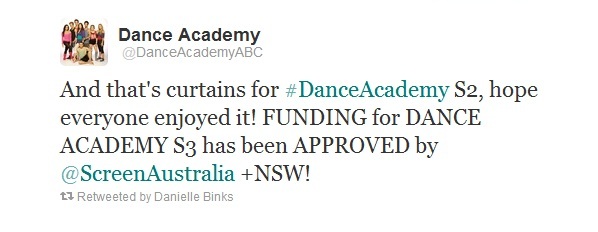
My new exceptional obsession is the Australian ABC3 teen drama, ‘Dance Academy’. To be fair, I am jumping on this band-wagon way too late. The first season aired in Australia in 2010, followed by a year-long gap when the show’s creators didn’t know if it would be picked up for a second season . . . which it (thankfully) was, airing this year between March and April. There are 26 episodes in a season, and the last one for 2012 aired on April 24. And, yes, a third season has been commissioned (no word on whether or not there will be another year-long gap between season 2 and 3, making for a 2014 release?).


The show follows fifteen-year-old country ballerina, Tara Webster (Xenia Goodwin) whose love of dance stems from a dream of flying. Tara gets one step closer to her dream when she is accepted into Sydney’s prestigious National Dance Academy. . .  but it doesn’t take long before Tara realizes that loving dance isn’t the same as being a good dancer.


Tara’s technique is not where it needs to be, and her fellow students at the Academy are cut-throat, with their eye on becoming principal dancers by the end of their three years. In her first week at the Academy, Tara is given the nickname ‘training bra’ by scholarship kid Christian Reed (Jordan Rodrigues) after an embarrassing changing-room incident with the beautiful Ethan Karamakov (Tim Pocock) who happens to be the half-son of an infamous Australian prima-ballerina and choreographer. Tara’s roommate is Abigail Armstrong (Dena Kaplan) the best and most ruthless first year dancer at the academy, and the one with the biggest grudge against ‘country bumpkin’, Tara.

Tara is ranked lowest in all of her dance classes and her teacher, the cold-blooded Miss Raine (Tara Morice) lets her know that she has a long way to go. . .  But Tara got into the Academy because she has something that no dancer can learn – she puts her heart and soul into every pointe and pirouette. She dances from the heart.

There are bright spots in Tara’s new life. Like Ethan’s half-sister, Kat Karamakov (Alicia Banit) a bubbly, bright and begrudgingly good dancer who struggles to be one of the ‘betty bunheads’. Kat’s best friend is Samuel ‘Sammy’ Lieberman (Tom Green) string-bean with a heart of gold, who is attending the Academy without his father’s support.  


Season one of ‘Dance Academy’ follows Tara and her friends through the highs and lows of first year. Second season shows the gang return for second year, and adds goofball Ben Tickle (Thomas Lacey) to the crew, as well as new prima mean-girl in Grace Whitney (Issi Durant).

‘Dance Academy’ is phenomenal. Created by Samantha Strauss and Joanna Werner, it is a fantastic series that combines a coming-of-age story with all the requisite heartbreak, love triangles and hiccups, with the backdrop of a competitive creative environment.

The show is shot in the heart of Sydney, literally. The National Dance Academy is situated near Circular Quay, while the boarding school lies in The Rocks (the most beautiful and expensive area of the city). There are lots of panning shots of the Harbour Bridge, and especially in second season the Opera House becomes the stage for a worldwide dance competition, the Prix de Fontayne.

I also love the show because it has a great, diverse cast. When so many Australian shows are lacking ethnic diversity in their casts, ‘Dance Academy’ shows a far truer Australian melting-pot and is more interesting for it. But the diversity is also in the storylines explored – the show had a wonderful plot about Sammy being attracted to his male roommate, Christian . . .  this plot, in particular, was handled beautifully with no over-dramatizing; it was treated as the coming-of-age it was, grounded in reality and with little flamboyance some shows sometimes want to give the ‘coming out’ storyline.


Other heavy issues have been touched on – such as eating disorders and bullying (in the form of teacher/student, to make for an especially interesting change). And, of course, the complications of love and relationships are also consistently touched on. From liking your best friend’s brother, to liking your best friend’s ex. First season has a mini love-triangle between Tara, Christian and Ethan while second season changes shape to explore a Kat/Christian/Tara love complication. The romantic up’s and down’s of these characters are a real draw-card for fans, and the writers do a brilliant job of spreading the drama out across 26, half-hour episodes. But my favourite couplings have been Sammy’s – the character with the most interesting and diverse love background, I have most enjoyed his romantic storylines.


I can’t go past a review of ‘Dance Academy’ without at least touching on the dancing in the show (even though I must confess, I have the dance skills of a one-legged robot). The choreography is beautiful, and tells a story in itself. From Tara’s obsession with ‘The Red Shoes’, to Sammy’s explosively heartbreaking season two solo, performed to the Jezabel’s ‘She’s So Hard’. The actors do a remarkable job, and the choreography is so good that while watching an episode I do find my feet pointing and hips shaking. God, I wish I could dance.


I fell into obsession watching the first season of ‘Dance Academy’, but it was really the second season that cemented this show as something truly remarkable for me. The second season storyline takes a dramatic and heart-wrenching twist towards the end. I refuse to give anything away, but save to say the writers outdid themselves and the actors broke my heart while watching a breathtakingly sad story unfold.

Dance Academy’ is one of the best Australian shows I have had the pleasure of watching in recent years. It’s a little bit ‘Centre Stage’ crossed with ‘Heartbreak High’, and with stories and dialogue that would do Aussie YA proud. The actors are phenomenal, the choreography sublime and I am happily addicted. For curious international’s, I believe ‘Dance Academy’ episodes can be downloaded on iTunes and through Amazon (don’t hesitate – just watch and get on the bandwagon!).

Season 1 DVD is now available

Sunday, September 18, 2011

SLiDE - Aussie TV

Dear Darling Readers,

It’s very rare that I blog about anything other than books. The exceptions to the rule are anything that captures my attention and makes me sit up and take notice. So, let me recommend my new obsession. . .

Has anyone else been watching the new Aussie YA TV show, ‘Slide’ (stylised as ‘SLiDE’?)
I honestly don’t have much love for Australian television. These days if it’s not another ‘Underbelly’ series, then it’s a sad attempt at recreating ‘Blue Heelers’ and ‘Water Rats’ (I’m looking at you, ‘Cops LAC’, ‘Rush’ and ‘City Homicide’!).

I had seen lots of posters for ‘Slide’, they were peppered throughout my tram route and I honestly didn’t know what to make of them. The actors in the posters looked really young, and the rainbow colours kind of screamed ‘tween’ to me. Still, I decided to give it a go and have a watch. . . and in doing so, I think I've found Australia’s answer to ‘Skins’.

‘Slide’ is about five unlikely friends living and running amok in Bris-Vegas (i.e: ‘Brisbane’).

There’s Scarlett (Emily Robbins) – the spoilt rich girl whose mum has hand-balled her to her hotelier father after a series of embarrassing escapades. But Brisbane hasn’t calmed the girl, and upon arrival in the city she throws a welcome party for herself and trashes her dad’s suite, but gains some friends amidst the mayhem.

Eva (Adele Perovic) is a graffiti artist who has a problem with authority. She relishes being anything but normal, but has family problems that are about to implode.

Luke (Brenton Thwaites) is the local heart-throb who has been with just about every girl in school and is rumoured to have a parole officer . . .

Tammy (Gracie Gilbert) comes from a wild family – a rocking mother and black jack father. But Tammy is the opposite, she likes lists and organization, and would never go for the obvious ‘cool’ guy – but she can’t help but be drawn to beautiful Luke.

And then there’s Ed (Ben Schumann). He’s a hopeless virgin with a girl-next-door stalker who has lusty urges at inappropriate moments.

Each episode follows the unlikely group through their various embarrassing escapades in the city by the surf. Some of their actions are plain ludicrous – like deciding to blackmail John’s from a prostitute’s phonebook. Others have a softer touch – like an impromptu trip to Luke’s house that introduces the gang to his frightening older brother.

The show is a little bit brilliant. The writing is fantastic with a keen ear for dialogue and there are enough love connections within the group to fuel much impressive angst. The show is also a wonderful Polaroid picture of what it’s like being a young Aussie. Hardly any of the storyline takes place in school – instead it’s all about the weekend, summer holidays and busting your gut at crap-paying part-time jobs. The show slowly lets family-ties creep into the character’s lives, but for the most part it’s a truthful rendition of what it is to be young and self-centred, letting home life hang on the periphery until it gets to a boiling point and can’t be ignored. Big issues like sexuality and promiscuity are explored but never preached.

It’s actually a bit of a cop-out to compare the show to the UK’s ‘Skins’. If anything, ‘Slide’ is what ‘Skins’ used to be – introverted storytelling about the quintessential youth unique to viewers in that country. In recent seasons (in my opinion) ‘Skins’ has become less about telling good, funny yarns and more emo-angst ridden rubbish trying to be high-brow vignette episodes.

I am loving ‘Slide’ and really hoping it gets picked up for a second season . . .

Thursday, April 28, 2011

TV obsession: 'Happy Endings' on ABC

Hello Darling Readers,

So, it’s not very often that I blog about anything other than books . . . because, hey! – book blog! But I feel like I have to pimp my new TV obsession (partly because the show is genuinely gush-worthy, but I'm also afraid it’s going to get canceled). So henceforth prepare for a total and utter TV gush-fest . . .

The show is all about what happens when a couple don’t get their happily ever after. Rather, their relationship crashes and burns in a fiery inferno of heartache and mutual disgust. Alex (Elisha Cuthbert) ditches her fiancé, Dave (Zachary Knighton) at the altar in a bout of truly heinous cold-feet bitchiness. Alex rubs further salt in the wound by going on the honeymoon by herself . . . while Dave goes on a one-night-stand slut crusade.

What follows is how Alex and Dave’s friendship group cope in the fallout of the breakup. Wanting to keep the group intact, Alex and Dave decide to put their hatred aside and just be friends. But while Alex is determined to ‘find herself’ by being by herself, Dave seems hell-bent on sleeping with anything in a skirt.


Happy Endings’ on ABC is amazing! I mean, where the heck did this show come from? It’s created by a guy called David Caspe who has no previous credits to his name. The only real ‘star’ of the show is Elisha Cuthbert (and where has she been since 24?). The writers are also relatively unknown. One of the writers is Josh Bycel, who did stints on ‘Psych’, ‘Scrubs’ and ‘American Dad!’, and another writer called Prentice Penny who worked on a bunch of shows I have never heard of before.


Despite a relative no-name cast and writers, this show kicks some serious butt. Dare I say, it’s a real contender as the new ‘Friends’? It’s full of contemporary wit and jokes that are so-wrong-they’re-right.

My favourite characters are Max and Penny – played by Adam Pally and Casey Wilson. Adam is a chubby gay guy and Penny is a gay man trapped in a 30-year-old woman’s body. DRAMAAAA!


I hardcore love this show. I love it like a fat kid loves cake, yeah!
| More