Search This Blog

Tuesday, March 4, 2014

'The Train Rider' Darian Richards #3 by Tony Cavanaugh

Received from the Publisher

From the BLURB:

One man pushed Darian Richards to the edge. The man he couldn't catch. The Train Rider.

As Victoria's top homicide investigator, Darian Richards spent years catching killers. The crimes of passion, of anger, of revenge ... they were easy. It was the monsters who were hard.

Someone was taking girls. At first he'd keep them a week then give them back. Darian warned that wouldn't last. It didn't. From then on, their bodies were never found. Girls kept disappearing. All they had in common was the fact they d last been seen on a train.

The ever-rising list of the vanished broke Darian. Forced him to walk away. Now, retired, watching the Noosa River flow by, the nightmares had finally stopped. Darian was never going back.

Then three girls go missing from Queensland trains. Darian knows that the killer is playing him. He has a choice to make. But when the decision means a girl will die, there is no choice. He has to stop this man once and for all. Forever.

He’s back. The man, the murderer, who forced Melbourne’s best homicide detective off the force and into the quiet serenity of Noosa in Queensland. The Train Rider abducts girls from train carriages – in the beginning he raped and tortured them, then dressed them in the rags of his previous victims and abandoned them in parking garages for the police to find. And then he stopped giving the girls back; they just started disappearing, dead and buried somewhere unknown. 

Melbourne’s top cop, Darian Richards pursued the Train Rider for years, with no success. Until he finally threw in the towel – turned his back on the case and the force.

But now he’s back, having followed Darian to Queensland. Girls have started going missing, from trains. And Darian gets a visit from the local priest who says he’s heard a murderer’s confession.

The Train Rider is back – and he wants Darian to play.

‘The Train Rider’ is the third book in Tony Cavanaugh’s ‘Darian Richards’ crime series.

I really, truly hope this isn’t the last Darian Richards book in Tony Cavanaugh’s gripping-gruesome crime series. Since first book ‘Promise’, when we first met Darian and learnt that he was plagued by his failure to find the Train Rider serial killer operating out of Melbourne, this third book has been the pinnacle of the series. The one in which Darian is forced to once again confront the one that got away. 

There is a lot in this book that sets up a longer-haul for Darian. Like his reconnecting with escort-turned-love-interest, Rose, who Darian used as bait to catch serial killer Winston Promise and whom he finally apologises to and woos back in ‘The Train Rider’. Darian, a self-proclaimed loner with a disastrous romantic track-record peppered mainly with prostitutes, lays his heart on his sleeve for Rose and raises the stakes for himself by making an emotional promise to her that’s linked to finding the elusive Train Rider. 

Then there’s his erstwhile ‘partner’, local policewoman Maria who helped Darian on his last two forays back into the world of homicide and who is dating his only friend, Casey, a 50-something retired criminal also living in the secluded North. Maria has been a focus in the series since reluctantly partnering with Darian and having her moral fibre come under scrutiny for helping in his vigilante justice campaigns. But she’s a tricky character in herself – and I would like to spend more time with her in the series. In ‘The Train Rider’ she’s lured into Darian’s “game” with the serial killer, and she’s experiencing serious doubts about her unlikely relationship with Casey, while also wondering if there is something to Darian’s own form of justice. 

There are plenty of loose ends and open-ended relationships in ‘The Train Rider’ that I hope means this isn’t the last we’ve seen of Darian Richards. The Dashiell Hammett-type cop who spouts deeply cynical zingers like; 

Nostalgia for me is like God: of no use.

It’s also wonderful that in this book Darian returns to his old Melbourne stomping ground. This setting is particularly fruitful for Cavanaugh’s noir-ish observations; 

Melbourne was a city of murder. That was the only way I could see it as the night pushed down on me.  
It was so great to be back. 

I also hope this isn’t the last we see of Darian for Maria’s sake. In this book in particular she’s given even more of a murky moral compass, and I can really see her holding her own if more books are planned. She has a really keen eye and a disgruntled spirit that I think has a lot more to offer this series; 

… male cops tended to follow the laws of being a tough guy set out by John Wayne and Clint Eastwood in the middle of a canyon, on a horse, in the 1850s. Somehow that image, from countless movies, set the role for cops in Queensland – all over the country, really – in the second decade of the twentieth century. In fact, for as long as she could remember. Maybe, she thought, the solo warrior with a rifle by his side and a horse below him, bathed in a harsh sun and squinting at dangers far away, was the image to aspire to for men in general. 

Like with the other books in the ‘Darian Richards’ series, we’re given a first-person narrative glimpse into the serial killer’s mind. It’s depraved, as usual. As is the grotesque murder-spree the Train Rider conducts. But one thing I thought was missing from ‘The Train Rider’ was mention of a serious ethical over-step Darian mentioned back in first book ‘Promise’. Part of the reason he retired from the force and turned his back on the Train Rider investigation in Melbourne was a broken promise he made to one of the victim’s mothers … who he then had a very close romantic encounter with. I remembered that little factoid about Darian (enough to make mention of it in my review at the time) and thought that the Train Rider’s reappearance in Darian’s new Queensland life would surely bring this indiscretion, and the woman, back to the fore. But she’s never mentioned and I found that to be an odd omission. 

This is a series full of machismo – and even while Darian chastises the redneck Queensland police officers he comes into contact with (particularly over their sexist treatment of Maria and women in general), Cavanaugh has written the two main women in Darian’s life with a misogynistic eye. Rose and Maria are young (20-something) bombshells with tiny waists, long legs and big boobs. Rose was the escort Darian started to fall for over a year of Tuesday meetings, and in the ultimate far-fetched daydream, Rose started to fall for Darian in return. She walks around like a middle-aged man’s wet-dream come to life: in Black Sabbath tank and white short-shorts. 

And since Maria helped find serial killer Winston Promise in a previous book she’s been given the nickname ‘Glamour Cop’ by her colleagues and her live-in partner, Casey, jokes that Playboy will come calling with the hopes that she’ll pose with a Glock between her breasts. Darian’s tech-man Isosceles has a serious Raquel Welch obsession, and for Maria’s resemblance he has developed a puppy-love crush on her. 

I actually found Rose to be quite boring – she really does read like a cardboard cut-out male fantasy and even with serious trauma now in her past (thanks to Darian) she’s nothing more than a vessel for his ardour, rather than an actual human-being. Maria, on the other hand, I find fascinating. She doesn’t seem to pay much attention to what she looks like, regardless of how much Darian and Isosceles make of her appearance. Rather, Maria has real conflict as a straight-laced cop who is becoming somewhat seduced by Darian’s vigilante justice. 

Then there are the other women Cavanaugh portrays – the victims. As they’ve been in the past two books, in ‘The Train Rider’ they are once again young and beautiful girls falling prey to the sick machinations of a serial killer. At one point in flashback to the Melbourne Train Rider case, one of Darian’s officers on the taskforce observes that the only thing connecting all these victims is their attractive appearance, to which Isosceles quips; “Well, he’s not going to take an ugly one.” Even the female victims in this series are treated like pretty props for male fantasy. Interestingly enough, the day I finished reading ‘The Train Rider’ I read an article that said actor Helen Mirren criticized the increasing number of TV murder victims who are young women as part of her Bafta honour speech. The same could probably be said for the female kill-rate (often linked with sexual depravity) in crime novels. 

I do enjoy this series, testosterone-fuelled it may be and with a problem in its portrayal of women. But I like Darian, and I’m fascinated by Maria. In this third book I can see real longevity for the series, and I’m crossing my fingers that it won’t be long before I can read another complex case headed by Darian Richards.

4/5 


Friday, February 28, 2014

'The One Plus One' by Jojo Moyes

Received from the Publisher

From the BLURB:

Suppose your life sucks. Your husband has done a vanishing act, your stepson is being bullied and your daughter has a once in a lifetime opportunity . . . that you can't afford to pay for.

So imagine you found and kept some money that didn't belong to you, knowing it would pay for your daughter's happiness.

But how do you cope with the shame? Especially when the man you've lied to decides to help you out in your hour of need . . .

Jess is in hell - Ed has saved her family - but is their happiness worth a lifetime's soul-searching?

Jess and Ed are two very different people, with vastly different problems – in fact, the only thing they have in common is a wicked streak of bad luck. 

For Jess, it’s that she’s a single mum whose unemployed husband left the family two years ago to go and live with his mother, after suffering from a bout of depression which left him unable to work or pay child support. Since then Jess has been looking after their young daughter, Tanzie, and teenage son (who is actually her husband’s from a previous relationship, but Jess now considers Nicky as her own). Jess works two jobs – barmaid at the local pub, and cleaning lady with her best friend. But she’s always skint and living pay-cheque to pay-cheque and just a smidge above the poverty line. When her maths-genius daughter Tanzie is offered a tempting (but still too expensive) scholarship at the local private school, Jess’s money woes start to really impact the family. There’s also extra pressure since Nicky’s recent run-ins with the local bullies, the Fisher family. Nicky dresses alternatively, all skinny jeans and black eye-liner which, in a small seaside town, means he sticks out like a sore thumb and sees him being physically and emotionally abused by the local hooligans. Both Jess and Nicky don’t want Tanzie to go through the same sort of suffering if she enters the local high school next year (her maths obsession will make her a target, absolutely). 

Ed Nicholls made a lot of money when he sold the app he and his best friend created. For a little while he was really successful, particularly when the company went public. And even though he’s divorced, and his model ex-wife keeps stealing from his London apartment (even after the settlement left her very comfortable) he was happy. What made him even happier was when the beautiful, unattainable Deanna from his college days reaches out to him and they start dating. It’s nothing short of a dream come true for Ed to be this successful and have the girl of his college dreams on his arm at the same time. But then Deanna starts showing her true colours – an unstable, clingy girlfriend with serious money woes and bad habits. When Ed decides to finish things with Deanna, she expresses a wish to get back on her feet and Ed stupidly gives her a tip about his company shares … which then leads to a charge of insider-trading, and a deadline for Ed to appear at the police station and be formally charged. 

Jess and Ed don’t know each other, not really. But Jess does clean Ed’s beachfront apartment, and is present on the night he decides to drink his worries away at the pub where she works. 

The next day their lives intersect again when Tanzie is offered a chance to win a cash prize at a maths Olympiad … in Scotland. Ed finds Jess getting ticketed by the cops on the side of the road – Tanzie, Nicky and their oversized hound, Norman, sitting in a beat-up and utterly un-roadworthy Cadillac. Feeling the need to put some good karma into the world, Ed suddenly pulls over to offer them a lift to the Olympiad. 

What follows is a road trip unlike any other.

‘The One Plus One’ is the new novel from British author Jojo Moyes.

I adore Jojo Moyes. ‘Me Before You’ and ‘The Last Letter From Your Lover’ are two of my favourite books, and I just think she’s fabulous – I hate to see her described as “chick lit” or a “beach read” author because I think that fails to take into account how layered, impressively paced and utterly heart-hurting her novels tend to be. ‘The One Plus One’ is another gem, coming in at 528-pages with a multiple point-of-view storyline that is at once emotionally exhausting and completely engrossing.

I can’t think how else to explain this book, other than to say it’s basically Jojo Moyes presenting these two characters and then just heaping shit on them. I mean, seriously, both Jess and Ed go through the ringer (Jess more than Ed because, as is a big point Moyes is trying to make – being poor means you’re more likely to suffer longer and harder whereas, somehow, mud doesn’t seem to stick to rich people no matter how hard it’s thrown). This is a book of spiralling – just when you think it can’t get any worse for poor Jess, Moyes manages to dig her deeper and deeper into debt and heartache. But Jess is one of those rare, magnificent individuals who’s perpetually optimistic – she’s a wonderful mother and feels the need to keep on keeping on with a smile on her face for Nicky and Tanzie’s benefit. 

Nicky, meanwhile, has a really bleak outlook on life. His mother was a drug addict who left him with his dad, the same guy who abandoned the family two years ago and who Nicky hates to think he shares DNA with. Nicky is being beat-up at school by the local hooligans (the kind of kids who, when the cops come calling round for witnesses, nobody saw anything) and Nicky is just down. Jess and Tanzie are both so worried about him, because life just keeps knocking him down. The first person to really break through to Nicky is Ed, a computer programmer who can sympathise with Nicky’s displacement in life; 


Here it comes, Nicky thought. He wiped at his shoulder, where Norman had left a drool. ‘Everyone I’ve ever met who was worth knowing was a bit different at school. You just need to find your people.’ 
‘Find my people.’ 
‘Your tribe.’ 
Nicky pulled a face. 
‘You know, you spend your whole life feeling like you don’t quire fit in anywhere. And then you walk into a room one day, whether it’s university or an office or some kind of club, and you just go, “Ah. There they are.” And suddenly you feel at home.’ 
‘I don’t feel at home anywhere.’  
‘For now.’ 

The road trip to the Maths Olympiad in Scotland takes a few days because Tanzie gets carsick, so Ed can’t drive over 40MPH. Pretty soon Ed regrets his decision to help this family out and rack up his karma good-points, but the trip becomes an epic experience for all involved. 

‘The truth?’
 
‘That people like us never get on. We never move upwards. We just rattle around at the bottom, scrabbling over the other people at the bottom like rats in a cellar, everyone trying to keep out of the wet.’

Like with all of Moyes’s books I’ve read thus far, she likes to throw out really outlandish plots that are dependent on chance and circumstance. But as the story twists and turns she brings the story back to the heart of the matter – this is really about two people in vastly awful circumstances who find their way to one another. It’s a very human story that feels very grounded in the present – Jess struggles being from a low socio-economic background as she now sees how her children are being impacted by what they’re lacking, and Ed is a businessman who’s being investigated for a white-collar crime. These are two stories of our times, but I loved how they intersected and crossed over one another. ‘The One Plus One’ is a rewarding, heartfelt read and another gem from Jojo Moyes.

5/5

Tuesday, February 25, 2014

Graphic novels and ‘reluctant readers’


My new piece for Kill Your Darlings is Graphic novels and ‘reluctant readers’ in which I talk to the wonderful Adele Walsh (from Persnickety Snark) about how awesome graphic novels are, and why they should be embraced in the modern classroom. 

Giveaway: 1 of 3 copies of 'The Last Shot' by Michael Adams

From the BLURB: 
I glance at my fellow fugitives in the glow of the fire: black-streaked, white-eyed, faces fearful but fierce. Whoever any of us were a week ago, we've now become people we could never have imagined. 
After facing the heartbreaking truth in Shadow Valley, Danby is determined to have her revenge on Jack.
With Jack dead, her little brother Evan and hundreds of other Minions will be free of his control. With Jack dead, she and her friend Nathan will be able to revive thousands more from the millions of catatonic Goners.
But what if she's wrong - about everything?
After Danby confronts Jack on a dying stretch of highway, all of her beliefs are turned inside out. Not only are his feelings for her real, he's working against the clock to save lives and rebuild society. To Danby's horror, it's Nathan who appears to threaten the new order.
With her emotions raging and blood on her hands, Danby has to take a side in a deadly battle that'll decide the future of the world. And as allies become enemies and foes turn into friends, she'll have to embrace methods so dark that the price of survival may be her very soul ...
⚀⚀⚀

The very kind people at Allen & Unwin have given me 3 copies of the second book in Michael Adams' 'The Last' trilogy to giveaway! 


How to enter:

⚀ Become a follower of my blog (if you aren't already)


⚀ Leave a comment on this blog post


⚀ Include a way to contact you (e-mail addy is fine)


⚀ One post per entrant


⚀ This is a giveaway for AUSTRALIAN resident’s only!


⚀ Contest closes March 12
I will announce the lucky winner on August 17 

Friday, February 21, 2014

'Grasshopper Jungle' by Andrew Smith

Received from the Publisher

From the BLURB:

Sixteen-year-old Austin Szerba interweaves the story of his Polish legacy with the storyof how he and his best friend , Robby, brought about the end of humanity and the rise of an army of unstoppable, six-foot tall praying mantises in small-town Iowa.

To make matters worse, Austin's hormones are totally oblivious; they don't care that the world is in utter chaos: Austin is in love with his girlfriend, Shann, but remains confused about his sexual orientation. He's stewing in a self-professed constant state of maximum horniness, directed at both Robby and Shann. Ultimately, it's up to Austin to save the world and propagate the species in this sci-fright journey of survival, sex, and the complex realities of the human condition.

Austin Szerba read somewhere that “human beings are genetically predisposed to record history.” So that’s what he’s doing – recording everything that happened leading up to the night he and his best friend, Robby, broke into the From Attic to Seller thrift store and witnessed a few Hoover Boys unwittingly release a plague strain that could destroy the world as we know it. 

Austin is not lying when he promises that within the pages of ‘Grasshopper Jungle’ there are; “babies with two heads, insects as big as refrigerators, God, the devil, limbless warriors, rocket ships, sex, diving bells, theft, wars, monsters, internal combustion engines, love, cigarettes, joy, bomb shelters, pizza, and cruelty.”

But it’s also a book about a third-generation Polish-American boy who’s in love with his girlfriend, while being confused about his feelings for his gay best friend. It’s about his mother who kayaks with little blue Xanax pills and what it’s like to grow up in the small town of Ealing, Iowa. Oh, and it’s about the “Unstoppable Soldier” and 6-foot-tall man-eating praying mantises. 

It’s a history of the end of the world, and a history of this boy’s life so far.

‘Grasshopper Jungle’ is the new contemporary/dystopian/sci-fi/coming-of-age … Kafka-esque young adult novel from Andrew Smith.

In a recent interview with Kirkus, Smith summarized his new book thus; “I think it was my singular intent to write a book that nobody could ever write jacket or flap copy for.” Well, he’s certainly succeeded there. 

I find it really hard to talk about this book without first name-checking the authors Andrew Smith reminds me of. With ‘Grasshopper Jungle’ in particular, Smith has echoes of Kurt Vonnegut, Douglas Coupland even Bret Eastn Ellis and you can’t deny the Kafka ‘Metamorphosis’ connection for explorations into homosexuality alongside larger-than-life insects. But I don’t want to imply that ‘Grasshopper Jungle’ reads like a poor imitation of any of those authors – especially when it’s only in certain moments that I got a whiff of them. Like Bret Easton Ellis, Smith has perfectly captured a generational voice for his unsettling examinations of our society’s ugly-glam; 

My mother took an antianxiety drug called Xanax. It was a little blue pill that looked like a tiny kayak. Robbie’s mother took it, too. Our moms were like Xanax sisters, except they didn’t know much more about each other than first names, who their baby boys’ best friends were, and Ealing gossip. 
Kayak and Xanax are palindromes. 
Robby’s mother was named Connie, too. 
It was always fascinating to me how perfect things could be if you just let all the connections happen. My history showed how everything connected in Ealing, Iowa.

Look, ‘Grasshopper Jungle’ won’t be everyone’s cup of tea. There were times when I struggled with it – reading Austin’s incredibly detailed, often waffling but always fascinating first-person interiority alongside this larger-than-life story about larger-than-life man-eating praying mantises … ‘kooky’ doesn’t even begin to describe this book. But I did enjoy it, for the sum of its parts.

I liked that, alongside a rather dystopian ‘end of the world’ storyline, Smith has also written about Austin’s tender-confused feelings for his openly gay best friend. 

Shannon kissed me on the lips at the door of her new old house. 
She kissed Robby on the lips, too. 
Shann always kissed Robby on the mouth after she kissed me. 
It made me horny. 
I wondered what she would say if I asked her to have a threesome with us in her new old, unfurnished bedroom. 
I knew what Robby would say. 
Duh. 
I wondered if it made me homosexual to even think about having a threesome with Robby and Shann. And I hated knowing that it would be easier for me to ask Robby to do it than to ask my own girlfriend.

I liked that Smith so thoroughly, disarmingly, captured the voice of a horny teenage boy while also writing him with infinite nuance in his conflicted feelings. I also really enjoyed his musings about the small town of Ealing, Iowa that anyone who comes from concrete-suburban-small will recognise and smile/shiver over the setting and descriptions of community.

For better or worse, I also got a kick out of the “Unstoppable Soldier” storyline that skyrockets this novel into the stratosphere of WTF? weird. There’s poignancy in that sci-fi tale playing out alongside Austin’s small-town musings; particularly about his older brother who had his leg blown off while fighting in Afghanistan and the casual violence of the local Hoover Boys who call Austin and Robby “faggots” for doing nothing more than hanging out together. 

The storyline is all over the place though, literally. In his recounting of history, Austin goes up, down and sideways – making ‘Grasshopper Jungle’ read more like a history essay that’s written with last-ten-minutes-to-go panic where Austin continually says “oh, yeah, and *this* happened before *that* but to understand you have to go all the way back to *then*…” It’s endearing and authentic, but I occasionally got frustrated. Particularly when Austin also thinks to include things like the bowel movements of his golden retriever in the recounting. 

I tip my hat to Andrew Smith. ‘Grasshopper Jungle’ is an ambitious, out-there mind-tripping young adult novel. It has traces of some wonderful authors, but Andrew Smith is clearly in a league all his own with this one. For some people it will be a revelatory YA-read. For others, it might read like a convoluted genre-mashing mess. For me, Austin’s voice carried the story – in all its tender, banal glory – and I was more than willing to stick with him through confusing sexual feelings and man-eating praying mantises. 

4/5 

Tuesday, February 18, 2014

'Ms. Marvel' #1 Written by G. Willow Wilson, illustrated by Adrian Alphona.

From the BLURB:

Following the epic events of INFINITY, a 16-year-old Muslim girl from New Jersey discovers extraordinary body-morphing powers and follows in the footsteps of her idol, Captain Marvel, to become the new Ms. Marvel.

‘Ms Marvel’ is the first issue in a new comic series from Marvel Worldwide, Inc. Written by G. Willow Wilson, illustrated by Adrian Alphona. 

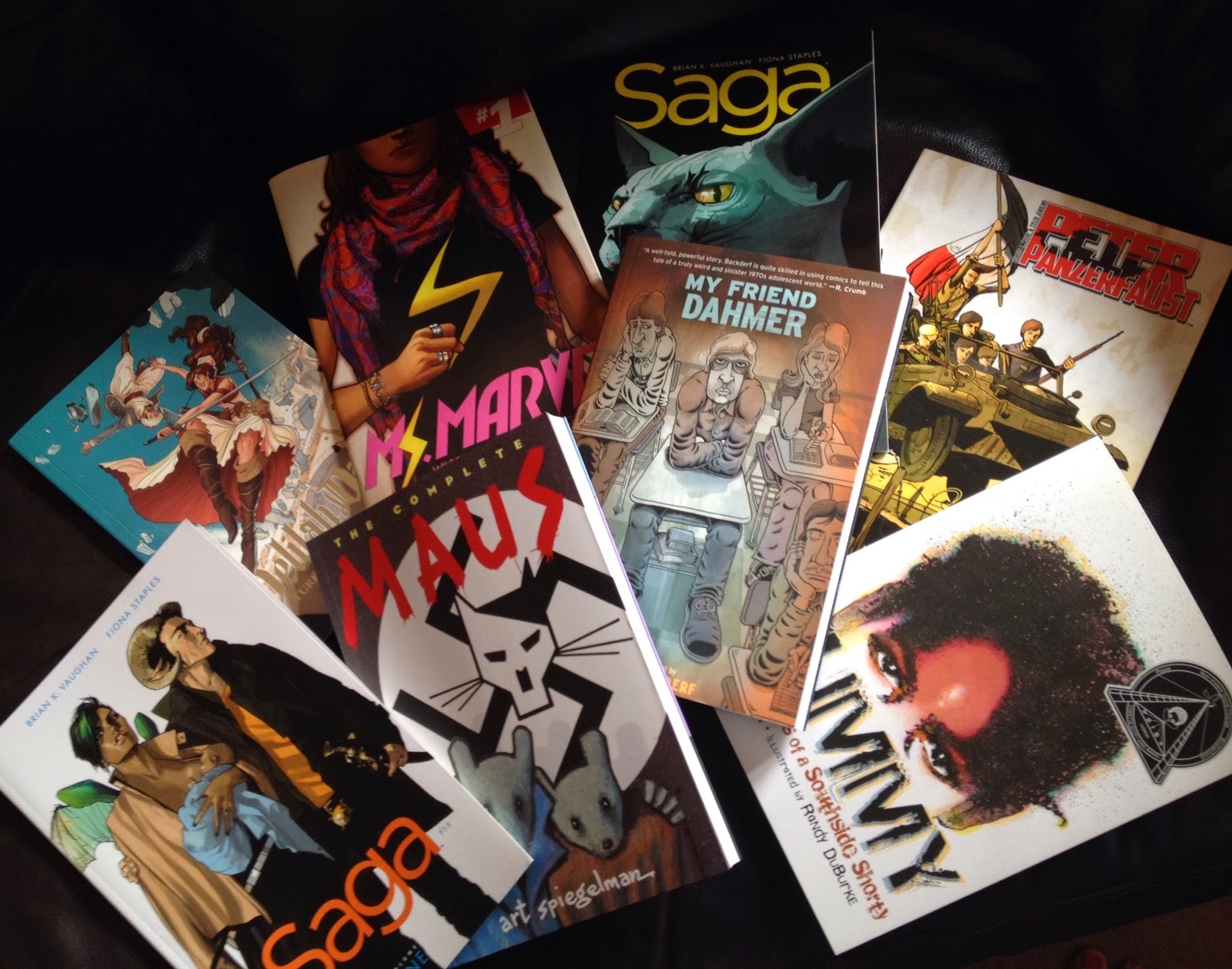
It’s only in the last 2-3 years that I’ve started reading comics and graphic novels. Now I’m invested (okay, obsessed) with the Brian K. Vaughan ‘Saga’ series and willing to read any graphic novel recommendations people want to throw my way. I’ve enjoyed everything from a poignant and dark biography of Jeffrey Dahmer, to charming young adult ghost stories and a swashbuckling tale set in Istanbul. But I don’t read Marvel comics and, until recently, I’ve had no interest in reading anything from the most famous publisher of comics. 

I used to watch the X-Men cartoon as a kid, and I’ve enjoyed those various movie adaptations. But everything else is pretty much over my head. ‘Iron Man’ movies got a chuckle out of me, but I have no patience for the various ‘Spiderman’ reboots and Scarlett Johansson’s photo-shopped poster for the latest ‘Captain America’ movie leaves me seriously unimpressed. I’ve been aware of the Hawkeye Initiative (whereby the pornographic “strong female character pose” full of boobs and butt is replaced with a male superhero character doing the same pose to highlight the sexism) and it’s just made me even less inclined to read the more traditional (macho) Marvel comics.

But then Marvel took a big step forward for diversity in comics, after the aforementioned misogynistic character representation was put in the spotlight, as well as the serious lack of female creators working in the industry. Marvel kicked off the women’s “Characters and Creators” initiative – bringing more women into the industry to portray positive female characters in comics. As part of this initiative, Marvel announced a new addition to the Marvel family, with ‘Ms Marvel’ – aka, Kamala Khan – a sixteen-year-old Pakistani-American Muslim superhero. 

Now, I’m interested. And having read ‘Ms Marvel’ … you should be too. 

Straight up, going into the first issue of this new series I had no previous knowledge of the Ms Marvel legend (Kamala is taking over the mantle from Carol Danvers who was, apparently, the hero of the Captain Marvel series). Doesn’t matter though – I went in cold and didn’t miss anything. 

That Kamala is Muslim is actually secondary to the fact that she’s sixteen-years-old. Don’t get me wrong; it’s amazing that a minority (let alone Muslim!) character is stepping up as superhero in a Marvel comic. And the importance of this was beautifully touched on in a Washington Post article by Sabaa Tahir (a Pakistani-American herself) who said: “As a kid living in an isolated desert town, the most diversity I saw in my media was Claudia Kishi, the Japanese American girl from ‘The Baby-Sitters Club.’ At age 10, or even 15, it would have meant the world to me to see a Pakistani girl portrayed positively, let alone as a comic book superhero.”

But Kamala being Muslim really isn’t a central focus of the story. Actually, author G. Willow Wilson has written some of Kamala’s fellow high school classmates as spitefully “well-meaning”, who seem to only know the stereotyped narrative of Muslim women as oppressed creatures to be pitied. “Your headscarf is so pretty, Kiki. I love that color,” blonde-haired classmate Zoe says to Kamala’s friend Nakia, “But I mean … nobody pressured you to start wearing it, right? Your father or somebody?” Kamala’s friends aptly name Zoe “the concern troll.” 


In the same Washington Post piece, ‘Ms Marvel’ editor Sana Amanat (who is also Pakistani-American) said of Kamala; “She’s imbued with great power and she learns the responsibility that comes with it. That’s a universal story. The fact that she’s female and first generation American, continuously struggling with the values and authority of her parents, gives the story extra nuance, but it’s a universal human story.”

That’s what really makes this new ‘Ms. Marvel’ story so compelling – that Kamala is a young woman who is going to be coming into great power and great responsibility, while also living through the struggles, firsts and wonders of being a sixteen-year-old girl. Well, that’s just marvellous.


Even better is that this ‘Ms. Marvel’ series is a self-aware one. Kamala is a fan of comics – she idolizes the fictional heroes Iron Man, Captain America and Captain Marvel (Carol Danvers) – and this comes to fruition in a rather funny, if bizarre-o, scene in the first ‘Ms. Marvel’ issue, when Kamala is visited by her comic book idols. 

There’s still plenty of fleshing-out that needs to happen in upcoming issues (2 of which I’ve pre-ordered already) particularly with secondary characters. But readers are given a tantalizing cursory glance at a boy called Bruno who has a crush on Kamala, while she is totally oblivious. And her friend Kiki who insists on now being called Nakia and whose father hopes her wearing a headscarf is “just a phase”. Then there’s Kamala’s brother, Aamir, whose commitment to Allah their father thinks is a poor excuse to live at home and not get a job. Kamala’s family and friendship circles are truly interesting and, superhero antics aside, this alone will provide plenty of tension for young Kamala and help in creating a heroine of true emotional depth and conflicting loyalties. 


I only had one complaint about my ‘Ms Marvel’ comic – and that was the Marvel foldout adverts throughout the issue. They’re just really annoying … that is all. 

Kamala Khan was a much-needed addition to the Marvel superhero family. But she’s no token Muslim female for the sake of the publisher’s new gender diversity campaign. With author G. Willow Wilson and editor Sana Amanat directing this new series, Kamala Khan is a fascinating hero in her own right; less for her religious leanings and more for simply being a young woman who is growing up in modern America, who is about to be imbued with incomprehensible power and responsibility. Basically, she’s like every other superhero and this first issue is probably like many Marvel origin stories … that she’s a girl and Muslim both means everything and nothing, but for what it’s worth I’m hooked.

5/5 

Friday, February 14, 2014

Interview with David Metzenthen, author of 'Tigerfish'


ΘΘΘ 

I recently had the great pleasure of reading David Metzenthen’s latest book, since the release of his 2009 award-winning ‘Jarvis 24’.  
‘Tigerfish’ is a grand book to be reacquainted with Metzenthen, one of the best young adult authors writing male voice today. When Penguin offered me the chance to ask him some questions and pick his brain, I couldn’t very well refuse; 

ΘΘΘ

Q: How were you first published – agent or slush pile?
I was first published through the slush pile and that first letter of acceptance made for a happy day! Like, really happy.

Q: Are you a ‘plotter’ or a ‘pantser’ - that is, do you meticulously plot your novel before writing, or do you ‘fly by the seat of your pants’ and let the story evolve naturally?
I both plot and then see what turns up on my walk with my dog. I always have a beginning, and I always think about possible endings as I go.... I think about books for up to a year or two before starting, and that helps plan in my mind!

Q: How long did it take you to write ‘Tigerfish’, from first idea to final manuscript?
It took about three years to get Tigerfish up and about – but the publishers had it for over a year, so normally it doesn’t take that long! I was growing old waiting for it, I will say.

Q: Where do story ideas generally start for you? Do you first think of the character, theme, ending? Or is it just a free-fall?
I think of characters first – no, places! No, anything that seems like a skyrocket of an idea that suggests more and more things... and the idea has to have a meaning to me, like a serious underlying reason to write the thing... a reason that says something about how people live.. or try to live .

Q: So many of your books are grounded in nature – the beauty of the Saint Helena Bay setting in ‘Boys of Blood & Bone’ and Tiff Porter’s love for her country town in ‘Tiff and the Trout’. But ‘Tigerfish’ is very much about characters living in the urban jungle, so far removed from nature (like Ariel who works in a surf shop but has never seen the sea). What prompted you to write something so urban and gritty, and such a departure from your other books?
I wrote about Melbourne because I love it and I fear for it; as it is developing in a typical political style where people are not always looked after first – but political spin is....
I  see Melbourne as a great city of many parts, not all parts wonderful, but many interesting – like shopping centres, because for some people they are refuges, and I wanted to look at what they are, and how they seem to operate....


Q: Melbourne feels like another character in ‘Tigerfish’, and you capture the city so beautifully. I particularly liked, “the wind blows through the place like a vampire spirit on the hunt for body heat.”. You live in Melbourne, so you obviously know the city well – but what suburbs were you most inspired by? Did you go on Melbourne writing excursions to capture the city just so?
 I find the Melbourne of my imagination the most inspiring – when I mix the past with the future and try to drill into its character. I invented this suburb of Templeton, and it’s not any suburb really – but it might be like some. I am a tree hugger and I like trains and things – so Melbourne speaks to me...coffee, of course! The river/docks/Collins Street... the people... the footy... the winter!!!!!!!!!!!!

Q: You write teen character so well - in 'Jarvis 24' and now 'Tigerfish' it strikes me that your dialogue rings very, very true. What's your secret to portraying teen character so authentically? Do you do a lot of eavesdropping on public transport?
I’m not an intentional eves-dropper, but I like to hear how other people do speak so... but most of my dialogue I just sound out in my head, fast, and then see how it stands up... I don’t worry about too much about slang as it dates everything, and I’ll get it wrong anyway. I look for rhythm and nuance – maybe sometimes I find it!

Q: What’s the appeal in writing for young adults?
I like writing for young people because they’re people I care about; and for some reason I seem still to be able to do it, as I hope story is the essence, and not knowing which jeans are now cool. And for some reason, the stories flow for me, but for adults, I struggle... but I hope to improve.

Q: What are you working on right now, and when can we expect it to hit shelves!?
I have completed a MS on Australians in combat in Vietnam that is at two publishers, I have a picture book coming out with Allen and Unwin called, One Minute’s Silence, and I am working on an outrageous adventure for younger readers that sees my character, George, travel around the world, sometimes by private jet. Dates to be announced!!!!!!!!!


Q: Favourite author(s) of all time?
I like Jack Kerouac; especially On The Road and Lonesome Traveller. Henning Mankell is really good, Hemingway can be great... there are a hundred and fifty (thousand, probably) brilliant writers, but naming them gives me a headache...

Q: Do you have any advice for budding young writers?

Advice to young writers: read/imagine/think...tell a story that matters to you about things that matter to you. Develop your style/listen to yourself, and when your writing looks as good as it can be, go on... then re-write. I like to write slowly and carefully... travel far or near, spend time thinking... walk... listen to everyone  including yourself (hard!)  Only write if you want to do it... because you need energy to finish stuff, and you won’t finish unless you like the story –  writing can feel like torture. Get a part-time job! Find someone really intuitive to read your stuff and make gentle suggestions. Don’t just listen to anyone you don’t trust. Keep your big ideas private until you’ve done the work! Hang in there.


 Tigerfish is now available at all good bookstores.
| More