Search This Blog

Sunday, September 26, 2021

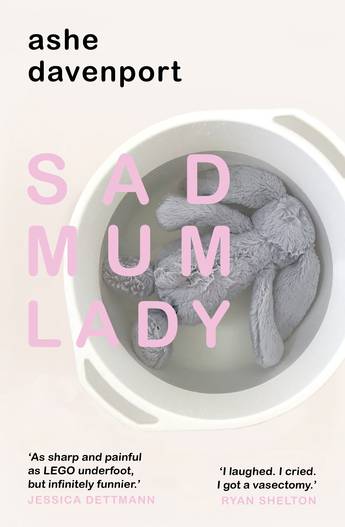
'Sad Mum Lady' by Ashe Davenport


From the BLURB: 

If David Sedaris and Sheila Heti had a baby… well, there'd be a lot to unpack there. But the ensuing stories would be brutal and hilarious and endlessly readable. And they'd look a bit like Sad Mum Lady. 

'If people knew how bad this was,' I said to a friend two weeks after the birth, nipples flashing red like emergency lights under my dressing-gown, 'they would be sterilised on their thirteenth birthdays.'

It sometimes feels like there's a rule for parents: if you're going to say anything mildly unhappy about parenting, you must also be at pains to stress that it is all worth it. What joy! What wonder! How lucky we are! 

But then there's the crying. And the body horror. The tearing and the leaking. And the crippling isolation. And the sleep deprivation. And somehow a dead rat in the cubbyhouse and the endless judgement of peers and neighbours and the internet. 

But fear not. Ashe Davenport is here. And she's not afraid to say it's fucked. 

Unapologetic and frank, Sad Mum Lady navigates the joys of motherhood in ways that will be familiar, hilarious and essential reading for parents and non-parents alike. Savage, true and deeply relatable - finally, a book that resists the sanitised, acceptable face of parenting. You might not feel better, but at least you'll feel less alone.

‘Sad Mum Lady’ was the humour non-fiction book from Ashe Davenport, released in 2020. 

Right. So. This book came out in June 2020 and it actually first pinged on my radar because of the most painfully ‘releasing a book in 2020’ way – the online book launch. Which I remember, loads of my friends on Instagram were talking about on the evening it happened. Lots of my mutuals and follows were saying something to the effect of; “OMG, if you’re not watching Ashe Davenport’s live book launch right now GET ON IT!” and lo – it appears that Davenport accidentally deleted the whole thing so I can’t direct you to watching the most hilarious and genius launch I’ve ever seen. I think … did it involve Ashe dressing up as a banana and letting her two kids climb all over and distract her at will? While she tried reading excerpts from the book? I am either remembering that accurately or the banana bit is just a lockdown fever-dream but either way – it was fantastic. 

And it was one of those 2020 moments where I said to myself; “I must remember to read that book.”

And then imagine that clapping monkey from ‘Rebel Without a Cause’ replacing my brain. 

Yeah. 

Fast-forward to 2021 and I have so many pregnant or just-gave-birth friends and being me, I want to gift them books. My go-to has been ‘The Motherhood’ edited by Jamila Rizvi because it’s fabulous, but I am not (nor do I ever want to be) a mother – but part of me wonders if I shouldn’t give my friends more varied and caustic, tender and honest portrayals of motherhood. Because everyone comes to motherhood differently. Aspirational or worriedly. I am not one, but even I know that.

Suddenly ‘Sad Mum Lady’ and the faded grey/baby-pink cover pops in my mind. Not the title or author, mind – just the cover and vague memories of a banana reading an excerpt in a livestream. Luckily I am someone with many bookselling friends so I did the DM rounds – providing my hazy recollections based on cover and online launch and OF COURSE, Em (@em_isreading) came through and I purchased the book from the stunning store she works at; Neighbourhood Books. 

But then I wondered if I shouldn’t read this book myself, before gifting it to some fragile pregnant and new mothers – a book called ‘Sad Mum Lady’ with a loving note saying, “thinking of you!” Don’t judge a book by its cover and maybe don’t gift it before reading it? 

And so I started … and then I couldn’t stop.

The important thing to know is; Ashe Davenport is the Melbourne-based author and family columnist for The Design Files (fab blog!). This book began as a personal blog called Sad Pregnant Lady, which would become ‘Sad Mum Lady.’ So it reads very much like a personal diary, a thought-stream and confessional, very much for fans of ABC show ‘The Letdown.’ 

But it’s interspersed with Ashe’s individual flare and experience (like her above-stairs neighbour whose ice habit and in-denial mother become a weird obsession in the uncomfortable final weeks of her pregnancy). 

Ashe writes with such stark honesty about the myths of motherhood – compared to the ‘earth mother’ Insta-filter holistic “sell” of it all. And she does examine her own childhood and young adulthood within this context too, particularly as she unravels her history of growing up with a surly single-mother, a more honest baby-boomer whose outlook on mothering and parenthood jars with Ashe’s attempts at a more progressive context – but is still beautiful, in its own way; 

She told me once that the role of a parent was ‘a short-term caretaker’ and I said it was the bleakest thing I’d ever heard. She said it wasn’t bleak at all, because it meant we were on separate pathways that intertwined, and we got to be in each other’s lives because we wanted to be. At last she felt the sun on her skin again, as the travelled along, parsley sprig in hand. 

There’s a lot in here that’s very personal – her personal relationships and the relationship with her own fraught mind and mental health. The relationship with her in-laws, and her partner Sam; 

We kissed and I remembered that I’d also made a central nervous system out of a drop of semen, and an entire human was about to burst through my body like a showgirl out of a cake. You’re welcome, I thought, brushing an eyelash from his cheek. And I forgive you. 

There’s some writing in here that is cosmically good and true. And sharp. My gosh is Ashe Davenport sharp; 

It was midnight, and Kristy suggested Sam take a nap on the hard square birthing mat in the corner. She offered no blanket or pillow, just the square, fit for a family dog. It wasn’t that he as being punished, because that would imply he had some kind of significance in her mind. It I was a passenger in the birth, Sam was a tin can by the side of the road we’d burned past several towns ago.

I’ve never been a mother, and I have no wish to. I can safely say reading Ashe Davenport’s ‘Sad Mum Lady’ left me neither regretting that decision, or embracing it overly – it just … is. And I so appreciated her frank, funny, and full spectrum of experience. It was a window for me – someone looking in – but I can also see this book being a doorway for so many, a secret passage where people get to admit the parts of being a parent that they don’t like, the disappointments and resentments they harbour, the joy and love of it too. All soaking in this big tub of life before getting mixed up in the tumble where it’ll all come out in the wash. Eventually. For better or worse, but mostly in the funny.

5/5   


Sunday, September 19, 2021

'The Heart Principle' The Kiss Quotient #3 by Helen Hoang


From the BLURB: 

A woman struggling with burnout learns to embrace the unexpected - and the man she enlists to help her - in this heartfelt new romance by the bestselling author of The Kiss Quotient, Helen Hoang. 

When violinist Anna Sun accidentally achieves career success with a viral YouTube video, she finds herself incapacitated and burned out from her attempts to replicate that moment. And when her long-time boyfriend announces that he wants an open relationship before making a final commitment, a hurt and angry Anna decides if he wants an open relationship, then she does, too. Translation: She's going to embark on a string of one-night stands. The more unacceptable the men, the better. 

That's where tattooed, motorcycle-riding Quan Diep comes in. Their first attempt at a one-night stand fails, as does their second and their third, because being with Quan is more than sex-he accepts Anna on an unconditional level that she herself has just begun to understand. 

However, when tragedy strikes Anna's family, she takes on a role that she is ill-suited for, until the burden of expectations threatens to destroy her. Anna and Quan have to fight for their chance at love, but to do that they also have to fight for themselves.


‘The Heart Principle’ is the third and final book in Helen Hoang’s loose contemporary romance trilogy, that started with ‘The Kiss Quotient’ and continued with ‘The Bride Test’. 

Hoang is also Actually Autistic, and each of her books features a neurodiverse hero (especially refreshing that in 2 of her books, it’s the female protagonists at various stages of their neurodiversity diagnosis that she explores). She also writes a full cast of API (Asian and Pacific Islander) characters, which sees these books having really full and rich focus on family and community that’s complimentary to the main romance plot. We see complicated daughter roles in ‘The Heart Principle’ in particular (and the most heartfelt author’s note from Hoang on this too, which had me in *tears*!), we’ve seen the immigrant experience explored, the working-woman narrative stress striving to “have it all,” and the pressure of body-image anxiety on men, as well as a character grappling with recovery after illness. 

For anyone who thinks romance as a genre doesn’t have these big, thoughtful discussions *anyway* - let Hoang be a gateway to your awakening because she does is extraordinarily well.

But you do stay for the romance - the heat and swoons, they’re all here. Tenfold. Hoang is one of the fastest rising stars in US-romance not just because she’s offered a breadth of experience and new viewpoints, but because she also writes exquisite build-up, focus on female pleasure and wonderfully frank discussions about sex and desire.

I do think 'The Kiss Quotient is still the stand-out greatest of the series, and 'Bride Test' is a slight dip in the middle - but 'Principle' brings it all back around and shows again why Hoang is one to watch in romance and will be an automatic-buy author for me, forevermore. 

She’s amazing. Read these books. Highly recommend.

4.5/5


Wednesday, August 25, 2021

'Uptown Girls' trilogy by by Joanna Shupe


Joanna Shupe’s ‘Uptown Girls’ is a historical romance (now concluded) series that began in 2019, and the third book was published last year in 2020. The books take place largely in 1891 New York City, and focuses on the three Greene sisters and uptown heiresses – three very different women whose bull-headed businessman of a father intends only the best for his daughters, but times they are a-changing and the girls are witnessing the suffrage and union movements unfold … and with these changes come their own ideas of how their lives should go, and it rarely correlates to what their parents want for them. 

First book ‘The Rogue of Fifth Avenue’ focuses on eldest sister Mamie, who is promised to be promised to the upper-crust son of her father’s oldest friend. But Mamie has been delaying signing the marriage papers, and instead she’s turned her mind and idealism to helping the city’s poor and working-class families – and the way she helps is by gambling with her sister in exclusive clubs (clubs that are also barred to them) and giving their winnings to the needy. But this Robin Hood behaviour has caught the attentions of her father’s busy-body lawyer, Frank Tripp – and he’s not impressed with Mamie’s wild and reckless after-hours behaviour, even if it makes her even more intriguing and tempting in his eyes. 

Second book ‘The Prince of Broadway’ is about second-sister Florence who has ambitions of opening her own (and exclusive) ladies’ gambling club – but to do that she needs a mentor in all things gaming; and that’s where the delectable and reclusive, elusive Clayton Madden comes into her schemes. He agrees to mentor her but the fire between them soon turns combustible.

Final book is ‘The Devil of Downtown’ about youngest sister Justine the “do-gooder” of downtown who has taken it upon herself to help track down wayward husbands walking out on their needy families, and making sure the City’s workers are not being exploited. It’s in her noble pursuits that Justine is forced to cross paths with notorious Bowery criminal King Pin, Jack Mulligan … and what follows is several deals with the devil that wind these two opposite souls closer and closer to one another, with delectable results. 

Right. So – can you tell that it’s Lockdown No. 6 in Victoria and I just need good, wholesome comfort-reads and that to me is historical-romance. The reliable, old faithful genre that without fail can lull me into compulsive reading habits and ensure I have something to look forward to when I dive into a series, or find a new author to explore their backlist. This week in lockdown that remedy for me has been Joanna Shupe; a his-rom author I’ve heard plenty about, but never read before but now I can’t seem to stop! 

Shupe is very much writing modern twists on historical-romances with wonderfully progressive heroes and heroines (where virginity is not a big deal, many female characters have already had previous sexual partners, crave their own careers and lives separate from the men they’re attracted to, and speak openly about welcoming the suffrage movements and the changes they herald! Not to mention a real upstairs/downstairs socio-economic outlook to the books, where the upper-class women don’t care for their status and gravitate towards working-class pursuits and men from all walks of life). If you like what Sarah MacLean is doing in the genre and similarly updating old tropes, then Joanna Shupe is the author for you!

I will say that in all of her books I found that she’d often go *one story-beat too many*. There’d often be one twist overboard, and an additional speedbump in the plot that the protagonists had to overcome that detracted from the rising tension of the climax and just meant that it dragged too long in the final act. That was a pretty common problem in all three books, but a relatively minor quibble. 

I’ll also say that I felt like the first book - ‘The Rogue of Fifth Avenue’ – was the most boring and disappointing, and didn’t seem to gel with the next two … Frank Tripp is more middle-class equivalent here (as a prominent attorney) and while there are secrets to his background, they’re not all that scandalous. Compared to the far better Books 2 and 3 featuring Madden and Mulligan as criminal underworld figures who capture the hearts of the Greene sisters – these books felt much more assured in their thematic purpose and promise, and were both the far more scintillating of the series. Even if the M/M of Madden and Mulligan and both men running gambling halls kinda confused me for a hot-minute in Book 2, it might have been nice to change up the underworld figures slightly – but I can’t deny I ended up loving both of them. So – yes – fair call, Book 1 is a bit of a snooze-fest but the next two are well worth the slog to get through. 

I also loved reading a historical romance set in New York City – something I don’t actually come across that often, but features prominently in Shupe’s backlist is the American industrial and just post-industrial era as settings, which I find really fascinating. It has this kind of ‘Gangs of New York’ feel to it, a lot of social mobility and recognisable places I so appreciated learning the history of. Really nice change from typical England/Scotland. 

All in all; loved these. I’m diving headfirst into Shupe’s whole list and loving it! 

4/5

Tuesday, July 27, 2021

'Victorian Rebels' series review, by Kerrigan Byrne

From the BLURB: 

A young woman kidnapped by the villain who may be her long-lost love.

The actress who falls for the assassin hired to kill her.

The English governess who tames the wild Highlander widower.

The Victorian Rebels are most dangerous blackguards of society. They answer to no one and relish in their rebellion. But for the women who lay claim to their souls, their stoic fierceness is what makes these heroes so dark, and what makes their heroines want them like no other, in these three stunning historical romance novels from Kerrigan Byrne.

‘Victorian Rebels’ is a historic romance series written by Kerrigan Byrne and consisting of seven instalments (the last of which triggered a spin-off series called ‘Goode Girls Romance’). The series began in 2015, and there’s rumours of another instalment to come – but so far the last official book released in 2019, at which point Byrne began work on the spin-off and a new his-rom trilogy, ‘Devil You Know’. 

I started reading ‘Victorian Rebels’ at the start of my state, Victoria’s (ha!), fourth lockdown and I finished by the time we were coming out of our fifth. And I totally reached for these books because I needed comfort-reads, and that for me is dipping into a good historical-romance backlist with plenty of books to sink me into. I also gravitated towards Byrne’s ‘Victorian Rebels’ because I really loved her (now completed) ‘Devil You Know’ trilogy, and something about her writing notorious “villain” heroes reminded me of Sarah MacLean’s ‘Bareknuckle Bastards’ series, which I’ll maintain is a good similar-read to Byrne. 

I will say the main difference between MacLean and Byrne’s books though, is that while MacLean enjoys playing around with class and social stratification in her historical romance, and has been working hard at writing more nuanced male characters (something she speaks about with brilliant clarity; ‘How Trump killed off my romantic lead’), Byrne is not doing that. And that’s okay! She’s stuck to writing fairly brutish, thuggish Victorian-era men who also totally have layers, injuries, trauma, and deep affection to boot – but they do read *slightly* outdated for the conversations romance authors and readers have been having of late (and – totally worth acknowledging that Byrne’s series began pre-Trump, in 2015!). I’ll just say, the romance reading community has been having these long conversations about how we’re no longer into bodice-rippers and kidnapped heroines (there’s even a book about this; ‘Beyond Heaving Bosoms’) but that’s a recurring plot-point in ‘Victorian Rebels,’ to the point that it’s eventually spoken about with some joviality and in-joke repartee. 

All that aside; I still found this to be an enjoyable series, with more ups than downs! We start out the gate strong with London underworld figure Dorian Blackwell – ‘the Blackheart of Ben More’ – kidnapping the Scotland yard clerk, Farah, presumably for nefarious purposes that eventually unravel to reveal that Farah and the Blackheart actually have a past that unites them … that past is what the series hinges on; as we learn that Dorian Blackwell was in Newgate Prison as a teenager, and befriended a ragtag group of abused fellow young inmates, until they formed a kind of gang to protect each other. This gang become the leading adult men of the series, with two deviations. 

I’ll admit that book two ‘The Hunter’ dipped for me because the male lead – Argent, an assassin – had a really traumatic backstory in Newgate that I found really hard to read about, even as his romance with a London stage-actress he’s sent to kill (but ends up – yup! – kidnapping and saving) ended up in a decent place. 

I was a much bigger fan of ‘The Highlander’ which is the first kind of deviation from the Newgate Prison group, and instead a tenuous “bastard half-brother” story is interjected to loosely connect them … this was by far my favourite book in the series, even as the male lead, Lieutenant Colonel Liam MacKenzie totally exhibited gross alpha behaviour on occasion – I liked this one for the heroine, ‘Mena’ – who is from the aristocracy but thrown into an “insane asylum” by her peerage husband (as an aside; Kate Moore has just written a fantastic biography about this subject; ‘The Woman They Could Not Silence’) and there’s a lot more progress for the female character in this instalment, partly spun around how much more progressive the Highlands are when it comes to things like; women’s sexuality, at least as it’s presented in this world. Liam and Mena were totally my favourite couple in this series, and the ones that I’m constantly looking out for as secondary characters making surprise appearances in subsequent books. 

‘The Duke’ was a low point in the series, for me. Just … random characters, convoluted stories and all-round “meh”. ‘The Scot Beds His Wife’ was also surprisingly so-so (again; convoluted back-story and an annoying American plant for the heroine). But things really tick up again in ‘The Duke With the Dragon Tattoo’ – another favourite for me, and again because the heroine is more progressively written. 

All in all – I really loved this series, I’d totally recommend it to Sarah MacLean fans and historic-romance aficionados who don’t mind slightly thuggish heroes who’ll come around to a gentler and more attractive place, eventually. 

4/5   


Tuesday, July 6, 2021

'Malibu Rising' by Taylor Jenkins Reid


From the BLURB: 

A lifetime holding it together. 

One party will bring it crashing down. 

Malibu: August, 1983. It's the day of Nina Riva's annual end-of-summer party, and anticipation is at a fever pitch. Everyone wants to be around the famous Rivas: Nina, the talented surfer and supermodel; brothers Jay and Hud, one a championship surfer, the other a renowned photographer; and their adored baby sister, Kit. Together, the siblings are a source of fascination in Malibu and the world over-especially as the offspring of the legendary singer, Mick Riva. 

By midnight the party will be completely out of control. By morning, the Riva mansion will have gone up in flames.

But before that first spark in the early hours before dawn, the alcohol will flow, the music will play, and the loves and secrets that shaped this family's generations will all come bubbling to the surface.

‘Malibu Rising’ is the new book by American author Taylor Jenkins Reid, her seventh novel and the third in what is a loose “Cinematic Universe” of a part-fictionalised timeline of American fame … her first foray into alternate-Hollywood was 2017’s ‘The Seven Husbands of Evelyn Hugo’ which is where readers first fleetingly met Dean Martin-style crooner, Mick Riva – whose four abandoned children are the protagonists of ‘Malibu Rising’. 

I’m not 100% sure if Jenkins Reid’s big breakout success, the 2019 novel ‘Daisy Jones & The Six’ (which looked at an alternate 1970s American music-scene, written as an oral history of one band) has character cameos feature in ‘Malibu Rising’ too … making this the third book in a loose Taylor Jenkins Reid Cinematic Universe? But I wouldn’t be surprised. In ‘Evelyn Hugo’, Jenkins Reid gave us 1960s Golden Age glamour of a claustrophobic Hollywood, ‘Daisy Jones’ was all about the love revolution of the 70s music-scene, and ‘Malibu Rising’ spins around the technicolour 80s – making a pretty neat trilogy of fame, fortune, and how fleeting it all is. 

‘Malibu’ spins around one night in 1983 that is about to become infamous – at the annual party of Nina Riva, the oldest daughter of American singing sensation Mick Riva. By the end of the night her house will have burned down, and multiple celebrities will be arrested for various hedonistic acts – the book takes us through the hour-by-hour play-by-play of the day and introduces us to Nina and her three siblings. 

There’s Jay – the eldest son of Mick Riva and a surfing sensation whose star is on the rise. Next there’s Hud – a few months younger than Jay – a talented photographer whose romantic optimism may be about to get the better of him. And youngest sibling is Katherine ‘Kit’ who has never been kissed and is determined to not examine too closely why that is, and also correct the situation at her sister’s big party this year. 

Then there’s Nina herself – a talented surfer who has found uncomfortable fame via a modelling career she’s embarrassed by, but needed in order to pull herself and her siblings out of near-poverty following the death of their mother and abandonment by their famous father. As a teenager, Nina became the head of her family and surrogate parent to all three of her siblings – and she now finds it hard to shake loose the shackles of responsibility, and finally examine what a lifetime of placating and keeping her head above water has done to her.

Amidst all this is the flashback unfolding romance of Mick Riva and their mother, June – a slow-moving car-crash we read unfold alongside another inevitable blaze burning across Malibu … 

Jenkins Reid in her other two books in this loose universe, has kept the children of famous people pretty firmly on the sidelines. They’ve quite literally been passive observers to the tale of their famous family, bit-players on the stage of someone else’s life. So it’s really interesting that Jenkins Reid has decided to take a secondary side-character from ‘Evelyn Hugo’, and give his kids the limelight … to tell a story of being on the periphery, the discarded backstory of someone else’s biography. Mick Riva is clearly a throwback to Desi Arnaz, crossed with Eddie Fisher, with the croonability of Dean Martin – and it’s the Eddie Fisher feel of the character that I found most interesting (he had five wives, was in a messy love triangle with himself, Debbie Reynolds and Elizabeth Taylor) and that’s because of his most famous child, Carrie Fisher.

Look, none of the Riva children are facing down the same mental and substance abuse battles that Carrie Fisher was (though there is an observation of alcoholism in the Riva family) – but there’s something about Carrie writing her semi-autobiographical Postcards from the Edge in 1987, the same time-period that Jenkins Reid has also thrown the Riva children into, to come into their own and reconcile with their larger-than-life and absent father, that is delicious in its crossover.

I really do love that Taylor Jenkins Reid is treating American fame as their modern mythology. This is something that I think she owes a lot Ryan Murphy who started playing with this idea of showing Americans their true modern genesis when he made American Crime Story and the first season ‘The People v. O. J. Simpson,’ in which he really posited that this was an impactive cultural moment for a whole generation, and one that largely shaped the future (this was an early version of modern reality-TV, from the car-chase to the courtroom; and Murphy hammered this home by alluding to the Kardashian family being hugely influenced by these events.) I do think Jenkins Reid has tapped into this observation beautifully – and many more have since followed; from ‘The Marvelous Mrs. Maisel’ giving us an imagined female stand-up trailblazer (and now Jean Smart is showing us that progression and stagnation in ‘Hacks’), to David Fincher bringing us the true-story of ‘Mank’ and retroactively looking at the making of ‘Citizen Kane’ (commentary-within-commentary about the blurred lines of politics and Hollywood). 

This is also to say – Jenkins Reid has never written about the lives of imaginary famous people, their trials and tribulations, to say “woe is me” about their too-tight glass slippers. She spins these stories of fame and fortune to make bigger commentary. ‘Evelyn Hugo’ was brushing up alongside the commodification of women and femininity, touched on abuse against women within Hollywood – but more broadly; was revealing the queer history within Hollywood, and the ways it was kept hidden so as to project and protect a desire for heteronormative, nuclear family political aspirations to the general public. ‘Daisy Jones’ was a lot about the creative process, and what happens when a woman dares to not be cast as the ~muse~ but puts herself, her desires, front and centre in her art. Similarly, ‘Malibu Rising’ isn’t just about a dead-beat Dad flaming out on his family – rather, it’s about how much is just surface-level illusion. Mick Riva may be able to sing pretty, but he’s left a trail of destruction in his life. The Riva kids were able to bandage and paper-over their crumbling home-life after the death of their mother so as to go under the radar of social-services. And all of them as adults may be starting to look like success-stories; but it’s mostly just another façade, and what’s front-facing is not what is making them happy. These larger themes all have tendrils in today; whether it’s the #MeToo movement or living in a social-media age and the lies that brings … Jenkins Reid knows very well throughout all these books, that fame is just a distortion and amplification of reality. And if she has any over-riding message in all her works it’s to tell readers not to be fooled into worshipping False Gods. No matter how pretty and alluring their lives and exteriors may be. 

I really enjoyed ‘Malibu Rising’ – and I’m thrilled to learn that it’s been optioned for a TV series (even as I’m a little iffy on how that’ll work … I would have thought it was a slam-dunk for a movie adaptation?) and all I know for sure is that I’d love to see George Clooney cast as Mick Riva! Please! Make it meta by head-nodding to George’s old playboy persona in the media! 

I also think it’d be cool, since many real and imagined 80s celebrities are name-dropped (Jennifer Beals! Goldie Hawn! Rob Lowe!) and Nina as a model, reminds me of a cross between Brooke Shields and Cindy Crawford … so how cool if they played with the kids of those celebrities to appear in an adaptation? Pop Crawford’s daughter Kaia Gerber in there! Have Kate Hudson playing her mum! Go wild with tongue-in-cheek nostalgia! 

All in all though; this isn’t my favourite of Taylor Jenkins Reid’s book (it’s still ‘Evelyn’ for me, and always). I also think the ending was a little rushed and didn’t quite land the same way that the heart-in-throat revelations in ‘Evelyn’ and ‘Daisy’ hit? I also wondered if there was a dropped-thread toward the end; when much is made of Mick Riva not indicating as he turns into a driveway, just as a secondary character is also heading home in their car … I was expecting a crash; but maybe that was just a red-herring rather than an editorial hole? Maybe another reason this wasn’t as big a WOW book for me is that I do want more. Particularly youngest sister Kit’s story, which really felt like it was just getting started by book’s end and now I want more! 

4/5  


Wednesday, June 30, 2021

'In: The Graphic Novel' by Will McPhail


From the BLURB:

Nick, a young illustrator, can't connect with people. Whether it's the barista down the street, his own family or Wren, an oncologist whose life becomes painfully tangled with his, Nick can't shake the feeling that there is some hidden realm of human interaction beyond his reach. He staggers through meaningless conversations and haunts lookalike, vacuous coffee shops in the hope that he will find it there. But it isn't until Nick learns to stop performing and speak about the things that really matter that the complex and colourful worlds of the people he meets are finally revealed to him. 

Illustrated in both colour and black-and-white in McPhail's instantly recognisable style, In is poignant, fresh and hilarious. McPhail transforms the graphic novel with a heart-wrenching compassion uncannily appropriate for our isolated times.

‘In.’ is the debut graphic novel by award-winning ‘New Yorker’ cartoonist Will McPhail.

I have loved Will McPhail for the longest time, and have been following him on Instagram for years. He’s one of the smartest cartoonists around, who can flip you on a dime – from painfully accurate social commentary, to thoughtful introspection on humanity. One of my all-time favourite pieces of his is ‘Lady No-Kids’ which I yearn to own as a print, and hopefully will one day if/when he restocks! His ‘Bedtime’ cartoon is another fave; but just generally I’m always eyeing his online store and hope to own a print one day! 

I was thrilled when I heard that he had a debut graphic novel coming – even more that it would be an original work, not a collection of his cartoons. So excited was I, that I didn’t even wait for the August ANZ-release, but nabbed myself a UK copy from Foyle’s because it’s also signed with one of his signature drawings! I die! 

‘In.’ is somehow exactly what I expected from McPhail, and at the same time so reverently surprising and arresting. It tells the story of Nick Moss, an artist much like Nick himself – he’s playing at being a sad man in a sad bar, where he meets young woman Wren who catches him entirely off-guard. What follows is Nick going about his life – helping his Mum fix a fixer-upper apartment, avoiding his neighbour whose sex-life he knows far too much about, juggling seeing his nephew and having deep-and-meaningful’s with his sister, spontaneous sexual encounters with Wren … until one day when he stops pretending and avoiding and just – confronts. He tells a little truth to the plumber who comes to fix his toilet, and gets a little truth right back. He’s honest with his young nephew, and is gifted openness in return. And with each exchange comes a surrealist exploration of a foreign land – intercut with the black-and-white line-drawings of Nick’s real life, are these full water-colour depictions of familiar-but-not, grand landscapes and dreamscapes. 

At the heart of this story – more than just a magical realist New Yorker cartoon come to life – is a very human story of connection, and time running out. A call to throw off the social mores and just … be.

This story was … phenomenal! I cannot believe how much I laughed, and then at the end how much I cried and was so deeply moved – not least because the story took an acutely personal turn for me, and it just hit beautifully hard. 

McPhail excels at highlighting the atrocious awkwardness of life – it’s in the wide-eyed, slack-jawed horrified facial expressions of his characters. The ‘Bob’s Burgers’-esque storefront vignettes told entirely in signage. Awkward naked bodies, arms flung high in a bad dance move, and self-conscious inner-monologues alongside snappy speech-bubbles. It’s all here in ‘In.’ – magnified and personified by Nick and this snapshot of his life when he feels like he’s circling something bigger than himself … like his memories of being “a slippery little penny of a boy,” at a childhood waterpark, with a slide like a coin vortex funnel. 

This novel was wonderful and painful. I laughed so much, and it got such tears from me too. It is one of the best reading experiences I’ve ever had, and as well as reminding me just how brilliant Will McPhail is (truly; even his ‘unboxing’ video was comedic gold) it showed me what graphic novels can be, and do. This is working on so many levels of sophistication and with such a feathery light touch, it will absolutely get under the skin and imprint on you. 

5/5


Thursday, June 24, 2021

'Two-Week Wait: an IVF story' by Luke Jackson, Kelly Jackson (illus. Mara Wild)


From the BLURB:

An original graphic novel based on the IVF stories of its husband-and-wife authors and the 1-in-50 couples around the world like them. 

Conrad and Joanne met in their final year of university and have been virtually inseparable since then. For a while, it felt like they had all the time in the world. Yet now, when they are finally ready to have kids, they find that getting pregnant isn’t always so easy. 

Ahead of them lies a difficult, expensive, and emotional journey into the world of assisted fertility, where each ‘successful’ implantation is followed by a two-week wait to see if the pregnancy takes. Join Joanne and Conrad, their friends, their family, their coworkers, and a stream of expert medical practitioners as they experience the highs and the lows, the tears and the laughter in this sensitive but unflinching portrayal of the hope and heartbreak offered to so many by modern medicine.

‘Two-Week Wait: an IVF story’ by Luke and Kelly Jackson, illustrated by Mara Wild is a graphic novel from Scribe.

So, this is a graphic novel in a genre that’s loosely termed “graphic medicine” about illness, chronic pain, medical study and the healthcare system generally – all in the graphic novel format. It follows the likes of ‘Kid Gloves’ by Lucy Knisley, ‘The Facts of Life’ by Paula Knight, ‘Can't We Talk about Something More Pleasant?’ by Roz Chast and ‘Marbles: Mania, Depression, Michelangelo, and Me’ by Ellen Forney. 

In ‘Two-Week Wait’ we get the story of Conrad and Joanne, loosely based on the real-life experience of authors Luke and Kelly Jackson. Conrad and Joanne at 34 decide they’re ready and prepared to become parents … but then 35 is creeping up and they’re still not pregnant. Thus begins their journey into infertility; chronicling their medical diagnoses and then the various specialty doctor’s plans to use in vitro fertilization (IVF) to combat Joanne’s previously undiagnosed endometriosis, and Conrad’s slightly-low sperm-count. 

This is an intimate quasi-memoir that tracks the emotional and medical journey through IVF, with illustrations by the Hamburg-based artist, Mara Wild. And I really did enjoy this, even as I was one-removed from the story; as a young woman who has always known she doesn’t want children, I do have friends who’ve struggled with infertility and gone through the IVF process and I suspect having that connection and grounding to the very real emotional arc will hit differently, depending on the experiences you bring to the reading.


That being said; I did read this and think it was fairly … prosaic? Maybe it’s that the Australian publishing landscape has been so painstakingly slow in taking up the graphic novel format for all readerships, but especially adult graphic novels. So it’s not surprising that something like ‘Two Week Wait’ is what gets up with one of our most prestigious small publishers – a fairly unassuming tale with broad general appeal to wary adult audiences unsure of the format, but responsive to the story generally. 

But for me I did find it a little one-note? Even as I thought it was very emotional, and beautifully told via Mara Wild’s cool-toned tenderness with pops or warmth, like the light of hope getting in. 


I couldn’t help but crave a story that goes deeper and more layered. I found myself latching and wondering more about the passing stories and experiences of Joanne and Conrad, and wanting a fuller investigation there. Like Joanne’s previously undiagnosed endometriosis, and maybe a tale about that medical journey – possibly with an ending that accepts infertility and childlessness, or adoption? And maybe the breakdown of, or overcoming in a relationship that comes with these new realities? Conrad begins getting weighed down by the medical costs of IVF, and a big part of me wondered what the journey is for those couples who simply can’t afford $10K per-round of IVF? What are the socio-economic barriers to fertility and family? 

All in all; I think this is probably a great graphic novel to introduce novice adult readers of the format to, and especially if the journey of infertility will be a personal and impactive tale for them. It delightfully reminded me of the British sitcom ‘Trying’, and I am always going to be glad to see more Australian graphic novels, especially for adult readers. But I also found it a little lean and ploddingly typical. 

3.5/5


| More