Search This Blog

Monday, October 18, 2010

'Death most Definite' Death Works #1 by Trent JAMIESON

Received from the Publisher

From the BLURB:


Steve knew something was wrong the moment he saw the dead girl in the Wintergarden food court. Nothing new, he saw dead people all the time, but this one was about to save his life…Steve works in the family firm. He is a Pomp – tasked with easing spirits from this dimension to the next after death. And he s kind of OK with that, until someone high up the corporate hierarchy makes a bid to be Australia s new Regional Death. This means killing all of the current Pomp necromancer he ever knew has been killed, Steve is left to make a reluctant stand.But to do this he must stay alive. Threatened at every turn, Steve and the dangerously attractive (and dead) Lissa go on the run to save what s left of their world.

Steven de Selby is a Psychopomp. No, he’s not British nor is he insane. He’s a Pomp – which means he helps ease ghosts into the afterlife. Steven ‘touches’ a ghost and they get pulled through him like a spiderweb through skin, off towards the light and the great beyond.
Pomping is a serious business, and Steven works for the big Australian Pomp agency, Mortmax in the Brisbane offices.

Pomping is a family business for the de Selby’s. Steven had a grandfather who Pomped during World War II and both his mother and father currently work for Mortmax. The de Selby’s take pride in what they do. . . except for Steven. He enjoys the danger and adrenaline, the pay check and the random hours. But he’s aimless, unmotivated and uncaring. . . Until an encounter with an attractive ghost called Lissa sets tragic events in motion. . .

Steven is attacked and he’s not the only one. Pomp’s are dying across Australia – first in Melbourne now in Brisbane. There’s a violent coup taking place and Steven doesn’t know who to trust – he’s one of the last Pomp’s left in the city and every ghost is coming to him for crossover.

‘Death more Definite’ is the first book in debut urban-fantasy series ‘Death Works’ by Australian author, Trent Jamieson.

Jamieson has created an intricate and fascinating supernatural world revolving around death. The ghosts, the Pomp’s and the ‘Stirrers’ – those things that want to travel the opposite way and come from the world of death to the world of the living. Brilliant! And even more wonderful for the juxtaposition of death with corporation. Mortmax is a unique business, offering a vital service to the community and working with the government to regulate themselves. ‘Death most Definite’ looks at the corporate side of death with some fascinating twists and take-overs.

The book reminded me somewhat of Stacia Kane’s ‘Downside’ series, which is also about ghost hunters (using pomps to dispose of spirits). But one of the wonderful distinctions between Jamieson’s book and Kane’s is that ‘Death Works’ is set in the real world. . . Brisbane, Australia to be exact.

The book is set in Brisbane’s CBD and I loved the Aussie setting. Jamieson uses it completely to his advantage – juxtaposing the mundane with the supernatural (like Steven seeing a ghost in a shopping centre food-court). I loved reading about all the familiar places; from Albion to Queen Street Mall. There’s not enough Australian urban-fantasy out there, so I really appreciated reading something with a hint of home-grown ocker. It meant that Jamieson’s subtle references were made and appreciated – like a Melbournian talking down to Brisbane-boy, Steven.

I also really liked the character of Steven de Selby. He’s not your typical hero – he’s an aimless twenty-something coasting along in life and entirely relatable. He’s thrown into the deep-end of an apocalyptic corporate takeover and the resulting fight for Australia is a hard character push for him. He’s so many blokes that I know and I loved the fact that Jamieson made a hero out of a slacker. And really, there’s no one less prepared for a Pomp-coup when the shit hits the fan;
Lissa flits around me. “As long as they keep coming to you, you do your job.” Her eyes are wide and set to ignite. “You didn’t want this? Well, neither did I, boy. But we chose this, none the less, when we chose to do what our parents did. Without us, without you, things are going to get bad and fast. So do your job.”
I will say that the romance in the book didn’t work for me, at all. Steven falls for Lissa too quickly and implausibly and the rush-job on their romance almost detracted from the book’s second-half. When Steven first meets Lissa he knows that she is a ghost. He knows she is dead, and as a Pomp he knows that she is half-way to the underworld. Yet he still finds her attractive (incredibly so) and begrudgingly falls for her. I’m not talking about a little infatuation – I mean that by page-71 he has decided that he loves her:
“I've fallen in love with someone I cannot have. Someone who isn’t really a someone anymore. How bloody typical. . .”
This revelation comes after he and Lissa have met about three times (with Steven knowing from the get-go that she is dead and a ghost) and I just wasn’t buying it. There wasn’t enough substance or heat to their banter, and it’s not helped by Steven repeatedly admiring Lissa’s hotness and ass – I read that as him lusting after her and being interested in her for purely superficial reasons. But love? No way. And I kind of resented the fact that Jamieson was really pushing the love angle – to the point that Steven was constantly mentioning his growing adoration and Lissa’s beautiful face.

Jamieson tries to explain away Steven’s speedy romance by occasionally dropping hints about an ex girlfriend called Robyn who walked out on him three years ago. Three years and Steven hasn’t dated since and still has her toothbrush and perfume in his medicine cabinet. Clearly, he isn’t exactly partaking of healthy romantic relationships. But even starving for love and being hung-up on an ex girlfriend wasn’t enough justification for his quick love for Lissa, I’m afraid.

I may have been willing to invest in the romance if Jamieson had backed it up with instantaneous chemistry – but Lissa and Steven’s banter wasn’t hot enough and there were too many big obstacles against them to justify their implausible love. Sorry. Their relationship reminded me a little bit of Chuck and Ned in ‘Pushing Daisies’. . . without the childhood romance to sweeten the deal.

I really enjoyed ‘Death most Definite’, a story about corporate death, impending Australian apocalypse and aimless heroes. The Australian setting is a breath of fresh air and the bad-guy is a curveball between the eyes. The romance didn’t work for me, but I’ll definitely be on the lookout for more books in the ‘Death Works’ series.

3.5/5

'Managing Death' Death Works #2 - December 2010

Sunday, October 17, 2010

'Alpha' Werecats #6 by Rachel VINCENT

From the BLURB:

Power, revenge, and justice - prepare yourself for the final battle! In the final chapter of "The Shifters Series", Faythe and her Pride must fight a tyrannical werecat intent on taking over the territorial council, and the south-central Pride in particular. It's down to Faythe to take on the role of Alpha before she feels completely ready for the job. Forced to rise to the occasion, Faythe must balance experience, advice, and the urge for vengeance. She must also finally choose between Marc and Jace... No decisions will be is easy, and not everyone will survive this epic fight to the death.

‘Alpha’ is the highly-anticipated (craved, salivated, desired) sixth and final book in Rachel Vincent’s ‘Werecats’ series. And it is good. . . so, so good.

‘Alpha’ picks up where the mess of ‘Shift’ left off. Faythe Sanders and her South Central Pride find themselves in a tangled web of deceit and corruption, woven by the power-hungry Calvin Malone. Faythe’s father and Alpha werecat, Gregory Sanders, is about to be out-voted in a political manoeuvre that will give Malone absolute power over the territorial council. Malone intends to introduce a werecat police force to keep order amongst the prides (and the officers will be, coincidentally, hand-picked by Malone). He also intends to introduce an Alpha voting system whereby an Alpha candidate may be deemed unfit to rule, and to impose restrictions on ‘strays’ within pride’s (look out Marc. . .)
All of these political upheavals are leading towards a coup; a civil war to bring Malone down and allow the South Central Pride to defend their land.

But amidst the lead-up to battle, Faythe Sanders has her own personal problems. In ‘Shift’, Faythe’s ex-fiancée/love of her life, Marc, discovered that she’d had a heated encounter with fellow enforcer, Jace. In ‘Alpha’, Marc is cuckolded and hurt. . . even more so when Faythe reveals her love for Jace and inability to choose between the two men. Now it’s up to Faythe to choose, remembering that whoever she marries will rule the South Central pride alongside her...

Let me just start by saying Rachel Vincent had a very hard-task in ‘Alpha’. This is the final instalment in the ‘Werecats’ series and a lot of fans had some very high expectations. . . which Vincent delivers, ten-fold.

For me, the politics in ‘Alpha’ was the stand-out storyline. For five books now Vincent has been writing dark, political foreboding. She’s created intricate plot-points and an outstanding over-arching theme concerning power, responsibility and good vs. evil via the werecat societal structure. And it all comes to a head in ‘Alpha’, brilliantly so. I've always loved the politics and power-struggles in the ‘Werecats’ series, particularly because they are close to home. Throughout the entire series Vincent has been world-building this American shapeshifter society, feeding us tidbits of anthropological information about their society, hierarchy and conventions – everything from the importance of dams in the werecat population to stray’s territorial fights. And all of Vincent’s finessing pays off in this final instalment. The stakes are high, the politics under-handed and the players devious. I've been invested in this storyline from the get go, and the political-thriller ending is marvellous, bloody and satisfying!

I went into ‘Alpha’ with a severe inkling that I would be crying throughout the book. . . and I was right. I won’t give anything away, but my fears were met and exceeded. I knew that going into civil war would be messy for the South Central Pride. I knew there would be casualties, and to a certain extent I correctly guessed who would be taken out. But no matter how prepared I was for heartache, Vincent still bowled me over and had me weeping into the book. She handles the death and carnage with equal-parts adrenaline and sympathy; my heart was racing throughout the battles, but when it came time to say goodbye to certain characters I loved that Vincent slowed the pace and drew out the emotional upheaval. I cried, a lot, but I can’t fault Vincent’s fantastic storytelling. . . and I do tip my hat to her for making tough decisions and killing-off beloved characters for the sake of story (unlike some precious authors, *cough* Stephenie Meyer, ‘Breaking Dawn’ *cough*).

One thing I was concerned about going into ‘Alpha’ was the protagonist, Faythe Sanders. I really struggled to like Faythe from ‘Stray’ through to ‘Pride’ – I found her self-centred, spoilt and selfish. Faythe started to rise in my esteem around about fourth novel ‘Prey’, when she became a hardened enforcer and started to see the end-game her father had in mind for her as successor to the pride. I was really impressed with Faythe’s leadership role in ‘Alpha’. I wasn’t sure if she had it in her to be anything other than a narcissistic whinger. . . colour me shocked when Faythe stepped up to the plate. In ‘Alpha’ she is 100% bad-ass, a changed person from her first appearance in ‘Stray’; in this final instalment she thinks of herself last and always puts the pride first. Not to mention the fact that she has balls of steel and faces down her worst enemies and darkest nightmares;

“Can I see it?”
He blinked, still scowling. “See what?”
“Your scar.” His expression darkened like a sudden eclipse, and I let my gaze grow cold. “You want to hear me scream? Give it your best shot. But until then, every time you take off your shirt, you may as well be handing out my business card. I shoved my blade deep inside you and loved every single inch of it. When I can’t sleep at night, the memory of you screaming like a little bitch is my lullaby. And everybody knows exactly what that scar means – that you got your ass handed to you by a little girl. Again.”
There were so many times throughout ‘Alpha’ when I was whooping and hollering for Faythe. She gets knocked down, but is never out and I applaud Vincent’s beautiful execution of Faythe’s character trajectory.

But one thing I've never been able to comprehend about Faythe is her love-life. I've always been a Marc fan, and I've never understood his devotion to Faythe after she repeatedly put him through the emotional ringer – by abandoning him at the altar, not speaking to him for years and finally when she cheated on him in ‘Prey’. But as much as Faythe’s infidelity stuck in my craw, I begrudgingly understood her predicament. Jace and Marc are both incredible Alpha men, and each is perfectly suited to Faythe. Jace and Marc both challenge and question her; they push her to be a better woman, fighter and leader. Not to mention the fact that they are both hunky-delicious. I empathized with Faythe’s love triangle, less because I felt sorry for her, more because of Marc and Jace’s likability. . .

However, for all that I loved ‘Alpha’, the resolution of the romance and love triangle between Jace, Faythe and Marc did not work for me. . .

**SPOILERS ahead. Highlight to read **

I loved the many romantic red-herrings Vincent peppered throughout ‘Alpha’. Referencing Faythe’s mother and father’s romance which was originally a triangle with Di Carlo – I thought that was a wonderful piece of trickery to keep reader’s guessing (because in that scenario Greg Sanders was Jace, and he ended up with the girl).

And I've got to say that for the bulk of ‘Alpha’, I was as clueless as Faythe as to who she should pick. I swung back and forth between Marc and Jace, Jace and Marc so many times that my head was spinning.

But in the end I don’t think Faythe was worthy of Marc’s love. . . She left him standing at the altar. She didn’t speak to him for all the years she was away at University (consequently shacking up with a human boyfriend). She cheated on him. . . and then the rubbed salt in the wound by considering carrying on her affair with the other man and refusing to choose between them. Marc was well and truly cuckolded, and for all that Faythe put him through I don’t think she’d earned his love by the end of ‘Alpha’.

Sure, she asked him to marry her. . . but they’d been engaged previously and she’d run out on him. I needed more than Vincent’s ending offered. I need a bigger declaration of love – more proof of Faythe’s changeability and reform. I also didn’t like the fact that Faythe’s romantic declaration came in the aftermath of battle, when adrenaline was stilling running high and euphoric. I’m not saying I wanted her to hold a boom-box over her head and serenade Marc outside his window. . . but I needed *more*. To balance out Faythe’s past acts of cruelty, she needed to really make it up to Marc and prove herself and her love for him, and I didn’t get that in ‘Alpha’. All I got was Faythe finally choosing him, without backing her decision up with evidence of her devotion.

**END spoilers**

‘Alpha’ was a befitting ending to a roller-coaster series. I am sad to see this series end – especially because the finale in itself offers such tantalizing possibilities. I think this series could have conceivably gone on for a couple more books, focusing on the aftermath of the werecat civil war. And if this truly is the end for ‘Werecats’, then I would have liked an epilogue to balance out the horror and death of the final chapter. . . even if an epilogue was just mush and romance, I would have appreciated one nonetheless.

Still, this was an admirable finale full of intrigue, destruction, and romance, with one kick-ass and reformed heroine at the centre. Brilliant.

4/5

Saturday, October 16, 2010

'Haunted Honeymoon' Casa Dracula #4 by Marta ACOSTA

From the BLURB:

THERE'S MORE THAN HER HEART AT STAKE. . . .As the only human to survive vampire infection, Milagro de Los Santos has become quite a celebrity among the blood-drinking elite. Too bad the perks of her condition - increased strength, super-fast healing - don't pay her condo fees. There are other complications too. She's feeling guilty about her fling with enigmatic Vampire Council member Ian Ducharme, and pining for her ex-fiancé, Dr. Oswald Grant . . . the fabulous man whose kiss changed her life. It's when Milagro - irked by Ian's attentions to his neighbor - travels to London and enjoys a sexy flirtation of her own, that the blood really hits the fan. Suddenly, those around her are dying gruesome deaths and Milagro's being interrogated. Who would kill to set her up as a murder suspect? Milagro just wants to turn back the clock and have another chance to make things right, but no sooner has she escaped to Oswald's ranch than an accident obliterates her memory. Will the murderer come after her now? And will amnesia spark a romantic do-over with Oswald - or will she make all the same mistakes before she ever gets to say "I do"?


Tabula rasa means ‘blank slate’, and is both a kick-ass season six episode of ‘Buffy the Vampire Slayer’ and the overarching theme of Marta Acosta’s fourth and final ‘Casa Dracula’ novel. . .

I have a kind of alacrity in sinking
- William Shakespeare

In this novel Milagro is dealing with the fallout of ‘happily ever after’. Following the heartbreakingly complicated events of ‘Bride of Casa Dracula’, Milagro de Los Santos made her bed and chose her man. Now she is discovering what happens after you ride off into the sunset with your prince charming. . .

In ‘Haunted Honeymoon’ Milagro discovers that the man she chose can promise her lust, but not love; adoration but not fidelity. She feels seller’s remorse for the man she gave up, and to nurse her broken heart (and make some mula off a fauxoir freak) she jet-sets to London and shacks up with a politically-minded surfer with a lush name.

When Milagro returns her problems are just as she left them – caught between the man she chose and the man she wants, and the vampire society who revere and vilify her. . . matters get even more complicated when the English surfer follows her home and gets himself killed. Suddenly Milagro is hunted by military contractors, and pissed off with Cockroaches and Pickles until her memory finally snaps and amnesia gives her a case of tabula rasa.

Women are made to be loved, not understood.
- Oscar Wilde

Marta Acosta’s ‘Casa Dracula’ series is not paranormal romance. Rather it is a comedy-of-manners; revelling in absurd non sequiturs, stinging social observations and hilarious juxtapositions. Any paranormal and romantic elements are fringe benefits. . . and I sort of love the way that in ‘Haunted Honeymoon’ Marta Acosta tramples a lot of paranormal romance conventions. She writes messy love, fucked-up characters, awkward situations and scathing diatribes. And I loved every word. . .

Ah! how annoying that the law doesn't allow a woman to change husbands just as one does shirts.
- Moliere

If you were ever under the impression that the ‘Casa Dracula’ series is paranormal romance, then Milagro’s bed-hopping should quickly dispel such misconceptions. It is very un-feminist and puritanical that in a lot of paranormal/urban-fantasy books the female characters are quite chaste. Screw that! Marta Acosta writes messy love – her heroine enjoys sex and flirting and she falls into bed for fun and forgetting. I loved reading about Milagro’s oozing sexuality – both the references to her chichis and male character’s reactions to her bazoombas. Sure, it’s funny, but on a more emotional level I enjoyed reading Milagro’s sexual armour. Acosta gets very Freudian in ‘Haunted Honeymoon’ and explores Milagro’s childhood as it impacts her current adult relationships, and it is fascinating. We all have 20/20 vision in hindsight, and I felt as though Acosta delving into Milagro’s past made the previous three books more profound and enriching.

A gentleman is one who never hurts anyone's feelings unintentionally.
- Oscar Wilde

The ‘Casa Dracula’ series is a comedy-of-manners, but some of the most powerful scenes in ‘Haunted Honeymoon’ came when manners were disposed of and characters didn’t pull punches;
Ian stared at me with his languid, hooded eyes and said, “You’re very conflicted about who you are, what we are, as you’ve always been. But what is amusing in a girl becomes tiresome in a woman. Grow up.”
“So says a man who spends every waking hour in pursuit of pleasure.”
“Remind me again, Milagro, what it is that you do to contribute to society, besides your decorative value, which is considerable.”
‘Haunted Honeymoon’ is very much centred on Milagro – deconstructing her personality, her past and her predicaments. She is an infuriating character sometimes – both hyper-aware and utterly ignorant of herself. In other words, Milagro is just like everyone else in the world. But I loved that in ‘Haunted Honeymoon’ a lot of dirty laundry was aired, and characters spoke their minds and had their say – often voicing criticisms and witticisms that had been on the tips of their tongue for three books. The amnesia plot is essentially a stripping down of Milagro’s defences; a way for her to take a cold, hard look at her life decisions and gain perspective. It may be a cliché soap-opera storyline, but with Ms. Acosta’s writing juju the amnesia plot becomes a deeply profound and funny character exposè, more in keeping with an Oscar Wilde comedy-of-errors than the Goldie Hawn movie 'Overboard'.

There is no praise to bear the sort that you put in your pocket.
- Moliere

‘Haunted Honeymoon’ does pack quite a punch. I cried, I laughed, I yelled at certain characters when they didn’t chase after the girl or made inappropriate marriage proposals. But overall I got a sense of hope from this final ‘Casa Dracula’ novel;
“I don’t believe in magic.”
“You are magic.” He put his fine-boned hand on my wrist. “You are Milagro de Los Santos, the Miracle of the Saints. You must trust in yourself, in the role that destiny has written for you. Even though others would put you in a cage, the one who watches you recognizes your true self and loves you still.”
I was surprised at the shiver that went through me. “I know you’re full of it, but damn if I don’t want to believe you.”
“Then do,” he said, and winked one of his big bug eyes.
This is the grand finale for Milagro de Los Santos – and her send-off is absurdly wonderful and befitting the unique ‘Casa Dracula’ series. Milagro’s love life is sorted out, once and for all. She accepts hard truths and her own limitations, and the book finishes on a beautiful note of Scarlett-esque proportions; ‘tomorrow is another day’. I would be over-the-moon thrilled if Marta Acosta wrote more books in the ‘Casa Dracula’ series. But if ‘Haunted Honeymoon’ really is the last then it’s a beautiful send-off for one fabulous señorita.

5/5

Friday, October 15, 2010

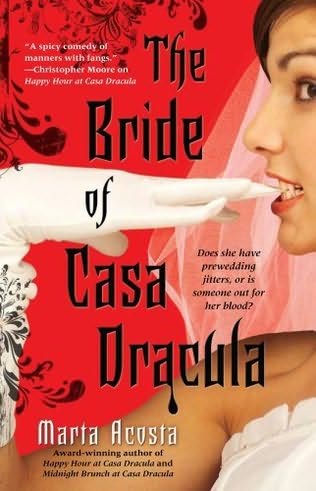
'The Bride of Casa Dracula' Casa Dracula #3 by Marta ACOSTA

From the BLURB:

Milagro De Los Santos is having serious problems planning her wedding to fabulous Oswald Grant, M.D. Her future in-laws loathe her, her dog just died, and Oswald's family has a genetic anomaly that makes them crave blood. Then her extravagant best friend hijacks the role of wedding coordinator, and the secretive Vampire Council assigns conniving Cornelia Ducharme to guide the couple through the ancient vampire marriage rituals.

To top it all off, Milagro's career is on the skids. She's reduced to ghost-writing the memoirs of a loony little man who claims to be a shapeshifter. And why does Cornelia's decadent, way too attractive brother, Ian, always show up whenever Milagro is away from Oswald? When a series of accidents interferes with wedding plans, Oswald worries that Milagro is cracking under the pressure. Is she just paranoid, or is a hidden enemy trying to make sure Milagro doesn't wed the undead?

Milagro De Los Santos is flying high. She is engaged to the love of her life, Oswald Grant. She has a ghost-writing project to keep her busy and a firm grasp on her red-coloured cravings.
Never mind that she and Oswald are fighting constantly, minus any make-up sex since the vampire council has banned copulation until the wedding. She is writing a memoir for Don Pedro, a self-proclaimed shapeshifter who also happens to be a complete nutbar. And Milagro’s blood cravings are only under control when she’s not around her ex-beau Ian Ducharme. . . the man who makes her blood fizz and her chichis ache.
But apart from that everything is fine. . .

The first two books in the series were all about our protagonist, Milagro De Los Santos, wanting to fit in. Milagro wanted to fit into her fiancées family and to be a part of the vampire society she had been infected into. But this third book is about what happens when the square peg has been rammed into the round hole. . .
“So you ate your pomegranate seed, but now you are not content to be queen of the underworld?” Ian asked.
Marta Acosta has some powerful writing juju going on in this third instalment of the ‘Casa Dracula’ series. Ms. Acosta draws on some fabulous references throughout ‘Bride’; rapid-fire allusions that swirl within the text and enrich the paranormal. Oswald and Milagro’s pre-marital struggles feel like a head-nod to Pygmalion, with Oswald as Henry Higgins trying to change his flower-girl into a lady she’s not. On a baser level it felt as though Milagro was a wolf trying to be tamed.

Milagro’s ex-lover and still-crush, Ian Ducharme, plays a vital role in this third book. . . even more so when his wacko sister, Cornelia Ducharme, comes to help plan Milagro and Oswald’s wedding. Ms. Acosta has said that she drew on Henry and Mary Crawford of Jane Austen’s ‘Mansfield Park’ for the characters of Ian and Cornelia. The Austen hat-tip is wonderful and befitting these twisted siblings, even more so when the Ducharme’s layers are peeled back. Cornelia Ducharme reminded me of Daisy Buchanan, and in fact the Grant mansion prompted me to think of Gatsby’s sprawling estate. . . even more so for the nostalgia Milagro feels for her first few months living with the Grant’s. I also couldn’t help but think that Milagro was Ian’s green light at the end of the dock.

The exploration of duality is explored when shapeshifters are introduced to the Casa Dracula universe. Then there’s the Greek mythology and the story of Persephone. Pomegranate seeds permeate the text – both literally and metaphorically. Milagro as Persephone caught between two worlds, always trying to live in both but belonging to neither. This theme is encapsulated in Milagro’s choice between two men – sweetheart Oswald and bad-boy Ian. And furthermore by Milagro's wish for all the normal things; love, family, white picket fence... while she's also desperate to fit into the hush-hush vampire society.

The duality conflict has been a staple of all the Casa Dracula books. The series is first and foremost a comedy-of-manners, and Ms. Acosta has always explored social niceties and hierarchies via Milagro’s Latina heritage. This has been one of my favourite aspects of the Casa Dracula series - that for all its paranormal tagging, the books have also been an exploration of modern bigotry. It’s not just vampires who are society outcasts. . .
Milagro has been referred to as a common Mexican girl; she has been relegated to the maid’s quarters and been the ‘odd one out’ in her group of blonde-haired blue-eyed university friends. Ms. Acosta has written some corker observations about Mexican Americans and their standing in society, like this comment made by Milagro’s friend, Nancy:
“Oh, darling, everyone’s using Spanglish. How else would you communicate with household staff?”
Acosta writes laugh-out-loud, so-wrong-it’s-right social observations that keep me thinking and chortling throughout the book.

One of my favourite things about this third book is the romance. Right from book one Milagro has been caught between two men – the safe and steady Oswald, and the dark and brooding Ian Ducharme. I have always been Team Ian, and my reasons felt justified by his appearance in this book;
I said. “I do hope we can continue to be friends.”
I didn’t expect him to burst into laughter, but he did, and I snapped. “What is so damn funny?”
When he finally stopped laughing, he looked more relaxed and said, “You and your attempts to be polite.”
“You think I’m incapable of fitting in with your swanky society pals?”
He stepped forward and took my hand. At his touch, a hot fizz went through my body. He looked into my eyes and asked softly, “Why are you so eager to be like everyone else when you’re Milagro De Los Santos?”
I don’t want to say how the book ends because it concerns Milagro’s final, romantic decision. I will say that the love triangle is solved, beautifully and messily. I cried. . . but I won’t say if it was tears of joy or frustration. But I will say it was an ending that left me panting for the fourth and final book ‘Haunted Honeymoon’.

5/5

Wednesday, October 13, 2010

'The Exile' an Outlander Graphic Novel by Diana GABALDON artwork by Hoang NGUYEN

From the BLURB:

The Exile retells the original Outlander novel from Jamie Fraser's point of view, revealing events never seen in the original story and giving readers a whole new insight into the Jamie-Claire relationship. Jamie's surreptitious arrival in Scotland at the beginning of the tale, his feelings about Claire, and much more - up to the point where Claire faces trial for witchcraft and must choose whether to return to her own century - are brought to life in brilliant four-colour art. A must-read - and a great holiday gift - for any Outlander fan!

‘The Exile’ is the much-anticipated graphic novel of Diana Gabaldon’s ‘Outlander’ novel.

I should be very clear though, about how much of a retelling ‘The Exile’ is of the original ‘Outlander’ book. . .

‘The Exile’ is told, primarily, from the perspective of Jamie’s godfather, Murtagh. The story begins with Jamie’s return from France and sees him navigating clan politics the moment he sets foot on Scottish soil. That means there is nothing of Claire’s life in 1945. We first meet Claire when she is stumbling form the Craig na Dun stone circle and taken captive by Dougal. And the story finishes after Claire’s witch trial, when she tells Jamie the truth about her time-travelling and is forced to make the decision whether to stay in 1743 or return to 1945. . .

Because ‘The Exile’ is told from Murtagh’s perspective (and to a certain extent, Jamie’s POV) the story is a departure from ‘Outlander’ in many ways. The clan politics are more of a focus, and Claire’s presence is more of a mystery (and possible conspiracy?). But fans can rest assured that because ‘The Exile’ is also told from Jamie’s perspective, many beloved and memorable scenes remain (like the wedding night).

In a bid to keep the time-travel story in play, Ms. Gabaldon has also included a side-story about Geillis Duncan and her lover, Kenneth, who travels through the stones shortly after Claire. This side-story was never referenced in the ‘Outlander’ series and it’s a little clunky within ‘The Exile’ . . . but it was great fun to revisit Geillis Duncan in all her insane witch-glory.

‘The Exile’ is not really meant for new-comers. The graphic novel will probably only appeal to that niche audience who are already devout ‘Outlander’ fans, because there are holes in the storyline that only those familiar with the series can fill. But to be honest, I was fine with the graphic novel’s elitism. I think it’s indicative of the series’ popularity that Del Rey published a graphic novel that would only appeal to die-hard fans. And as one such rabid fan-girl, I was drooling on every page. . . because, yes, Jamie looks gorgeous!

Jamie looks *gorgeous* and exactly as I pictured him (like a red-haired Gabriel Aubry!). That’s one of the bonuses of this graphic novel. Yes, there are still film talks going on. . . but it’s pretty much guaranteed that casting an actor to embody everybody’s beloved Jamie will be problematic. In this graphic novel, Jamie is represented exactly as Diana Gabaldon (and readers) envisioned him. And it’s good, so good! (I’m talking naked sexy-good, people!) Claire is also precisely how I pictured her (though a little well-endowed).

To be honest I was always going to love this graphic novel. For starters, I was one fan who was very open-minded about a graphic representation of my favourite novel. Yes, there are a few things that didn’t work – like the random side story about Kenneth. But for the most part I loved delving into the visual world of ‘Outlander’. I appreciated how much of a symbiosis was made between the novel and the art –that Diana Gabaldon had a lot of say in Hoang Nguyen’s final artwork and her personal vision for characters and setting. And the artwork really is to die for - Hoang Nguyen is extremely talented, creating classic characters and breathtaking settings, but unafraid to create slightly raunchy scenes when the story calls for it (which ‘Outlander’ definitely does!).

I loved this graphic novel so much because it was a wonderful representation of one of my favourite novels. The character’s are precisely as I pictured them. And Hoang Nguyen’s artwork is so gorgeous that I wanted to lick every page! This is a must-read for any fan of the Outlander series.

5/5

Tuesday, October 12, 2010

'Beautiful Darkness' Caster Chronicles #2 by Kami GARCIA and Margaret STOHL

Received from the Publisher

From the BLURB:


One night in the rain, Ethan Wate opened his eyes and fell in love with Lena Duchannes. His life would never be the same.

Lena is a Caster and her family is locked in a supernatural civil war: full of darkness and demons. On her sixteenth birthday Lena made a terrifying choice, which now haunts her day and night.

And as her seventeenth birthday approaches Lena and Ethan face even greater danger. A Caster and a Mortal can never truly be together.

Every kiss is a curse.
Ethan's next heartbeat could be his last.
It is their curse now . . .

‘Beautiful Darkness’ is the second book in Kami Garcia and Margaret Stohl’s young adult paranormal series ‘Caster Chronicles’.

‘Darkness’ picks up where ‘
Beautiful Creatures’ left off. Caster-girl, Lena Duchannes, was caught in the middle of a civil war between light and dark. Her beloved uncle, Macon Ravenwood, was on the side of light. While her witch mother, Sarafine, was trying to convince her estranged daughter to choose the darkness. . . Lena always thought that her seventeenth birthday would be black and white; a battle between good and evil that was preordained and set in stone. Lena never expected to have a choice. . . nor did she expect her uncle to die trying to save her or that being a light Caster would mean her and her human boyfriend, Ethan Wate, couldn’t be together. Turns out, fate is a fickle friend.

I loved first book ‘Beautiful Creatures’ and the follow-up is just as superb.

The ‘Caster Chronicles’ is epic and paranormal, with the crux of the story being Lena and Ethan’s impossible romance. Lena is a Caster witch, and Ethan is the human boy who loves her. It’s a quite simple story, until you throw in a power-play for Lena’s soul and the prejudicial town backdrop.

The series is set in the Deep South middle-of-nowhere town Gatlin County. A main focus of the series is Lena’s Caster family as they live amidst Gatlin’s small-minded and prejudicial townsfolk. ‘Beautiful Creatures’ focused on Lena’s upcoming seventeenth birthday and her dilemma between dark and light, exacerbated by high school clique politics. By contrast, ‘Beautiful Darkness’ is a more introverted book. Yes, the town prejudice is still there and fiery as ever. But Garcia and Stohl have written more focus on the characters inner turmoils, as opposed to the outside pressures of town bigotry. When ‘Darkness’ begins, Lena is in a bad mental state. Her uncle is dead; the man who was her surrogate mother, father and dear friend, and Lena is weighted down by guilt for his sacrifice. Ethan is just as weighted by Lena’s depression – he loves her and wants to help, but Lena’s bleak mentality is a barrier that not even Ethan can breach.
Lena wasn’t coming out of it. She wasn’t coming back to herself or to me. If anything, she was drifting farther away from me than anyone else. More and more, I couldn’t reach her, not on the inside, not with Kelting or kissing or any of the other complicated or uncomplicated ways we used to touch. now when I took her hand, all I could feel was the chill.
At the same time, Lena still has a choice between light and dark. . . and as each day passes and her mentality grows bleaker, Lena seems more and more determined to succumb to the darkness. And encouraging Lena’s dark side is her Siren cousin, Ridley, and a mysterious Caster Incubus called John Breed.

‘Beautiful Creatures’ was a wonderful first book. It was a grandiose battle between good and evil, melding past and present with an overarching story of defeating fate. ‘Beautiful Darkness’ is still about the grand battle between light and dark, but I really loved the introspection of this second book. Garcia and Stohl have written Lena’s sink into depression with such tenderness and finesse. And it’s not just Lena’s darkening perceptions that made for thoughtful reading; rather it was Ethan’s coping with her mental state. I think this is a subject a lot of younger readers can relate to – both the feelings of despair, but also being a friend to someone who is suffering from depression. Garcia and Stohl never lose their characters amidst the extravagant paranormal plots; the book kept coming back to these two very relatable teenage characters and their struggles.

Then there’s the fact that Lena and Ethan are struggling to maintain their romance. Lena is tempted by dark Caster John Breed. While Ethan is making connections with Liv, an English student temping at the Caster library. This is another very human problem that balances the paranormal extravagance beautifully;
. . .All I know is that it shouldn’t be so hard. Loving someone shouldn’t be so hard.
But for all of the emotional turmoil in the book, there is still heavy emphasis on the paranormal side of things. I don’t want to give too much away, but in ‘Darkness’ Garcia and Stohl throw curve-balls left right and centre. Plot twists concerning Macon Ravenwood and Ethan’s mother. Ethan’s role in the Caster society. And how committed Ridley is to the dark side. . . and amidst all of these grandiose supernatural storylines is Lena, still choosing between light and dark, turning her green eyes gold;
Lena shook her head, watching as he wrote. “No. I don’t belong there anymore. I would’ve ended up hurting them. I hurt everyone who loves me.”
Kami Garcia and Margaret Stohl have a beautiful series premise with the ‘Caster Chronicles’. Their books are about the decisions between good and evil, the light and dark within us and not letting fate dictate one’s life. And amidst all these paranormal premises is a supernatural girl, in love with a human boy. I love this series, two books deep and I am completely hooked. I can’t wait for book #3, due out Fall 2011.

5/5

Monday, October 11, 2010

'Midnight Brunch' Casa Dracula #2 by Marta ACOSTA

From the BLURB:

What's a girl to do when she discovers she's the main course on the menu?

Hip, funny Milagro de los Santos thinks she's finally found love and a home at the California ranch of fabulous Oswald Grant and his urbane relatives, who have a rare genetic disorder that some call vampirism. But Milagro is bewildered when she's excluded from an ancient and mysterious midnight ceremony whose participants include Oswald's unfriendly parents, a creepy family elder, and Milagro's ex-lover, the powerful and decadent Ian Ducharme. What skeletons are the vampires keeping in their designer closets?

When Milagro's life is threatened by a rogue family member, she flees to the desert to hide. Instead of solitude, she encounters an egomaniacal actor, a partying heiress, a sly tabloid reporter, and a lavish spa full of dark secrets -- all of which might help her find a way home.

‘Midnight Brunch’ is the second book in Marta Acosta’s ‘Casa Dracula’ series. I loved first book ‘Happy Hour at Casa Dracula’ and ‘Midnight Brunch’ is a riotous follow-up.

‘Midnight Brunch’ picks up pretty much where ‘Happy Hour’ left off. Down-on-her-luck writer turned down-on-her-luck vampire, Milagro de los Santos, is living with her boyfriend, Oswald Grant on his sprawling family estate. For the most part Oswald and Milagro are blissfully happy. Their sex life is incredible; they have a hold on their red-coloured cravings and have an adopted child in dog Daisy. But there’s trouble in Casa Dracula... Milagro is feeling more and more like an outsider looking in at the Grant family’s many secrets and rituals. A certain dark lord vampire called Ian Ducharme is a thorn in Oswald’s jealousy and the Vampire Council are wary of Milagro’s miraculous recovery from vampire infection.

Ms. Acosta writes comedy of manners and errors. The storylines are sometimes non sequiturs that lead the character’s into random adventures of comedic brilliance. In ‘Midnight Brunch’ Milagro finds herself fixing a screenplay at a desert resort, playing maid to a B-grade heartthrob and chasing a chupa with a high school English teacher. The plot is a criss-crossing, beautiful mess of epic proportions – and as a reader you’ve just got to go with it and trust that Ms. Acosta will blow your mind and bust your gut.

Of course the stand-out of the ‘Casa Dracula’ series is Milagro de los Santos. What’s not to love about this feisty Latina vampire with a heart of gold? I loved her in ‘Happy Hour’, and the fictional girl-crush grows in ‘Midnight Brunch’. In this second book Milagro is recognizing the negatives of biting into an ancient family of secret-keeping vampires. As funny as Milagro is (and she really is hilarious) ‘Midnight Brunch’ is also an in-depth exploration into Milagro’s post-vampiric life... and it aint’ always pretty.
“I don’t know that I’m going back.”
“Sure you’ll go back. I've seen sad endings and I've seen happy endings, and you’re a happy ending type.”
“You’re talking about movies, not real life.”
“Same difference,” he said.
‘Midnight Brunch’ sees Milagro thrown into the deep-end and struggling with life after ‘happily ever after’. She’s dealing with Oswald’s jealousy, feeling like an outcast in the Grant family, hunger pains and job woes.

Second only to Mialgro, my other favourite character in the ‘Casa Dracula’ series is Ian Ducharme. First introduced in ‘Happy Hour’ where he became enamoured of Milagro (despite her rebuffs) the dark lord returns in ‘Midnight Brunch’. I can’t get a handle on Ian, and I think that’s why I love him so much. He’s like dark chocolate – a little too much, but just enough at the same time, a sweetly-bitter deadly conundrum. Dare I say, I even like Ian more than Oswald? *gasp!*. Ian is clearly in love with Milagro and I can’t help but root for a romance between them, even when I know it’s impossible (and he is a little psycho). I blame Marta Acosta for writing such a darn good bad-boy!

I looooooove this series so, so much. Milagro is a hot and feisty Latina heroine with a razor-sharp wit and big bazoombas. And I worship at the writer-altar of Marta Acosta. I’m going into third book ‘The Bride of Casa Dracula’ with a giddy heart and a craving for more spicy-Milagro.

5/5

| More