Search This Blog

Showing posts with label Marta Acosta. Show all posts

Wednesday, July 4, 2012

Interview with Marta Acosta, author of 'Dark Companion'


Earlier this year I had the pleasure of reading an advance copy of Marta Acosta's first young adult foray, 'Dark Companion'. Being a big fan of Ms Acosta's since her paranormal adult series 'Casa Dracula' and having actually interviewed her back in 2010 about a project she was working on, then called 'The Shadow Girl of Birch Grove’, I was understandably excited and overjoyed to finally get my hands on her much-awaited novel... 

It was no surprise at all that I loved 'Dark Companion' -  it had everything that I enjoyed about 'Casa Dracula'; Acosta's wry wit, feisty-complex heroines and head-nod to the roots of paranormal mired in Gothicism... but this time she's writing for the ever-popular young adult readership! Even better, 'Dark Companion' is a supernaturally dark re-imagining of one of literature's most beloved classics, 'Jane Eyre'.

I adore talking to Marta Acosta, and getting to pick her brain and stories apart. So, without further ado it is my great pleasure to give you Marta Acosta, discussing 'Dark Companion'...


 Q: Are you a ‘plotter’ or ‘pantser’? That is, do you meticulously plot your novel before writing, or do you ‘fly by the seat of your pants’ and let the story evolve naturally?
 
Hi, Dani! Thanks for inviting me here to Alpha Reader, one of my favourite review blogs. When I began writing, I was a pantser, but an editor asked me for an outline for the next book, so I became a plotter. Now I always plot. I think of it like building the framework for a house. You can work within the structure and always remodel. Pantsing is more like building a fabulous bathroom and then trying to build a house around it.


Q: How long did it take you to write ‘Dark Companion’, from first idea to final manuscript?

Years and years and years. The first version began with Jane Williams at 10 years old in the group home. Characters came and went. From the time I started until now, YA became a huge trend which is why I roll my eyes when someone thinks I just hopped on the YA trend. Nope, I got run over by the dang YA trend!


Q: ‘Dark Companion’ is a retelling of Charlotte Brontë’s classic ‘Jane Eyre’. Can you tell us why Jane was the literary heroine to inspire ‘Dark Companion’, and why Brontë’s novel means so much to you?

I discovered Jane Eyre in the library when I was about 13. I devoured it, not knowing that it was a famous book, and Brontë’s story struck such a chord with me. I know everyone views it as a great romance, but I was more fascinated by Jane’s rage, isolation, and her fierce belief in herself as equal to anyone else. She’s always lived in my heart. 

 
Q: I love your blog ‘Vampire Wire’ – in which you discuss all things paranormal & pop culture. You also delve into the paranormal publishing world quite a lot, which is always fascinating to read. I’m just curious, being that you’re now a write of paranormal YA, what some of your biggest pet-peeves with the genre have been? What did you really want to avoid writing in ‘Dark Companion’, if only because it has been done before?

I’ve always liked supernatural stories with a scientific explanation and that’s how I created Casa Dracula world, i.e., by pestering doctor friends for possible justifications for supernatural mythology.

My biggest pet-peeves are 1) people who jump on certain trends without doing any proper world-building, so you have thousands of dystopians without any sociopolitical context, and 2) readers who balk at anything but the most typical genre conventions. They’re like picky kids who won’t try a delicious salad. Eat your vegetables because they’re good for you and yummy!

I wanted to avoid the usual mean-girl clichés so ubiquitous in stories about young women. I wanted to bring up money and class and not in the usual “I’m really a princess!” sort of way. I wanted my characters to earn their exceptional roles, not be born into them.


Q: In my review of ‘Dark Companion’, I call it an “ode to Gothicism”, and mention that you’ll probably be introducing a lot of younger readers to the darker genre. What are some of the unbreakable rules for writing Gothic, and why do you think it works well for young-adult?

I don’t think there are any unbreakable rules for Gothic, which is why there are stories with ghostly emanations and stories with scientific explorations. (I did that internal rhyme just for you.) I prefer Gothics that deal with power and class issues, and I love characters who are manipulated and tricked. I like dark secrets, and I’m obsessed with big spooky houses with secret passageways. I’ve lived in a few of these places and I still dream of them.

I think all young adults feel a sense of individualism that can be very lonely. Metaphorically, every young adult is going off to a strange, dark place full of secrets and deception, and each must learn to survive.


Q: ‘Dark Companion’ is not your first dabbling in paranormal. You also have the very successful ‘Casa Dracula’ comedy-of-manners adult series. Did you start writing with a conscious decision to make ‘Dark Companion’ young adult, or did that evolve naturally? Do you write with an audience in mind?

I wrote my book about a character who is a young adult, which is not the same as writing a novel for young adults. I put as much craft, effort, and thought into this story as into my adult fiction. I didn’t “write down” for younger readers. They’re smart enough to figure things out. Also, they should eat their delicious vegetables.


Q: There are two quite lovely boys in ‘Dark Companion’, brothers Jack and Lucky. I thought they were both incredible, in their own very different ways, and nice temptations for Jane. What makes a good romantic hero for you, and what is the big difference between writing love interests for your adult and young adult characters?

I am inordinately fond of funny men. I like a romantic hero who can laugh with a girl, who respects her intelligence, and who is physical and affectionate. I didn’t really differentiate between a love interest younger readers. Love and the desire for love make people stupid. I’m always interested in why smart people do stupid things.

Jack is the eccentric brother who sends mixed messages to Jane, and their scenes involve lots of wordplay, which I love. Lucky is the golden boy and Jane’s infatuated by everything he represents: beauty, wealth, status, security, family. Her desire for him is almost one of covetousness. She thinks if she can have him, she can have those things. I think that’s why he’s so irresistible to a very poor, very damaged orphan. She never says that she loves him: only that she wants him.


Q: One of my all-time favourite characters in ‘Dark Companion’ was MV (Mary Violet) – an infectiously optimistic and confident young woman. I (and I think many other readers) have my fingers crossed that MV makes a reappearance – either in a novella/short-story capacity, or her own book/series. Can you tell us if you have any plans for the très magnifique MV?

I am currently writing a Gothic mystery tentatively titled Mary Violet and the Mystery of the Silent Songbird. MV pretty much invented herself: I had a name and the idea of a girl who should be a snob, but isn’t. The book will have romance, a hidden crime, sinister deeds, and, of course, poetry. When I was a kid I actually wanted to be a poet (ridiculous, I know) and it cracks me up that now my poetry, such as it is, is published. 

 
Q: What advice do you have for budding young writers?

Work at your craft. Find your voice. Listen to advice. Rewrite and rewrite and rewrite, because you can always improve a story. I often think of a bit of advice from American football: winners never quit and quitters never win. 

 
Q: When can we get our greedy little hands on your next novel, and can you tell us a little bit about it?

I’m working on the Mary Violet novel and I’m really happy to return to comedy. I’m also writing a Gothic ghost story, The Poison Tree, about two young women who haunt each other across time. I wish you’d become an editor somewhere and publish it, because you are a most insightful and illuminating critic.

Thanks, Dani, for having me here!


All images are from weheartit.com

Sunday, July 1, 2012

'Dark Companion' by Marta Acosta

Received from the Publisher

From the BLURB:

Dark Companion, a contemporary Gothic with a mild fantasy/paranormal element, pays homage to Jane Eyre and other classic Gothic novels.

Small, plain Jane Williams, a high-achieving foster girl, jumps at the chance to escape her violent neighbourhood when she is offered a full-scholarship to the exclusive Birch Grove Academy for Girls. She's even given living quarters, the old groundskeeper's cottage in a grove of birches. The classes are amazing, the campus is lovely, and the other students are bright and inquisitive. The headmistress's family -- including her handsome sons -- is especially friendly.

It all seems too good to be true. But the longer Jane stays at Birch Grove, the more questions she has about another scholarship girl who mysteriously left the school. What price is Jane willing to pay to get the security and safety she's always wanted?


Jane Williams is a foster child from the rough streets of Helmsdale (‘Hellsdale’). Jane could have sunk into drugged ether like her fellow foster-kids, or sold her body on the street corner like her friend Wilde. But thanks to her intelligent and dearly-departed reverend brother, Hosea, she managed to use her brain and get plucked out of ghetto-obscurity with a scholarship to the elite Birch Grove Academy for Girls.

Jane lives in a beautiful cottage on campus, surrounded by lovely birch trees that seem to sing. She is also welcomed into the Grove fold by headmistress, Mrs Radcliffe, and her family. Radcliffe has two boys, Lucky and Jack – Lucky is golden-haired perfection, while Jack is curly-haired mania and infuriatingly teasing of Jane’s pixie-esque physique, nicknaming her ‘Halfling’.

Jane also settles into a glorious friendship group – becoming especially close with Jack’s perfect girlfriend, Hattie, and the fabulous romance-writer-in-waiting, Mary Violet. These girls help Jane to navigate her way from street rat to Birch lady.

But all is not well at the Academy. A mysterious figure sneaks around Jane’s cottage. Lucky has some peculiar fetishes, and robed chanting can be heard in the thick of the grove . . . 

‘Dark Companion’ is the new young adult paranormal Gothic novel from Marta Acosta.

I adore Ms Acosta. She had me in stitches throughout her vampiric comedy-of-manners ‘Casa Dracula’, and has since become an internet favourite with her ‘Vampire Wire’ blog. So I was thrilled to learn that she was to try her hand at the young adult genre.

‘Dark Companion’ is Acosta’s ode to Jane Eyre, veneration to classic Gothic literature, and an absolute tornado of fresh air in the (sometimes) staid YA paranormal romance genre. 

‘Dark Companion’ is by no means a play-by-play of Charlotte Brontë’s classic work. Acosta instead takes aspects of Eyre and infuses them with Gothic young adult modernity, so we get forbidden love, a creepy setting, mad women and Jane’s inherent strength;

I pressed down my fury until it metamorphosed as soft messy carbonate does into a diamond so hard it can cut through steel and with such clarity that I could use it as a lens to see the world as it truly was, cruel and capricious.
It was rage that got me to Birch Grove Academy for Girls and out of Hellsdale. I nestled into my bed knowing that rage would help me survive here, too.

Jane really is the stand-out character of ‘Dark Companion’. She’s a character of contradictions – with a sloppy slang tongue but a wickedly sharp mind, and a tough outer shell masking a lonesome girl. I adored her, especially because she didn’t feel like Charlotte’s Jane for very long, as Acosta’s stamp of sassy-vulnerability shone through with the character.

I also loved the boys, Jack and Lucky – two very different brothers who alternately intrigue and infuriate our girl Jane. Jack was especially brilliant – quick with one-liners, ferociously loyal and happy to play the King’s fool (really, any boy who can see himself as a Shakespearean character has my tick of approval).

But my absolute stand-out favourite character had to be Mary Violet, Jane’s fabulous friend with bouncing golden curls and a devious mind. Mary ‘MV’ Violet was très magnifique (that’s French for bloody awesome!). Part of my adoration of MV was her similarity to Acosta’s equally bodacious protagonist of the ‘Casa Dracula’ series, Milagro de Los Santos. Both women exude that certain infectious charisma that makes them both fabulously charming and fabulously funny. . .  and Mary wasn’t the only hark-back to ‘Casa Dracula’, there was a cameo appearance by a certain beloved somebody that had me grinning from ear-to-ear!

‘Dark Companion’ is also dripping in delicious Gothicism. From the quotes of Mary Shelley and Bram Stoker, to Jane’s eerie preoccupation and connection to the whispering birch trees that surround her cottage home. . .  Acosta plays brilliantly with Gothic conventions and introduces young readers to the finer points of horror.

I adored ‘Dark Compaion’, as I knew I would. Marta Acosta’s writing is cunning and flamboyant, a deliciously dark Gothic delight that’s both a tribute to Jane Eyre while also being delightedly Acosta’s own – from the smart and savvy heroine with a rapier wit, to the cast of gorgeously funny secondary characters, ‘Dark Companion’ is a welcome addition to the paranormal YA scene.

5/5 

'Dark Companion' is available from July 3


Saturday, November 20, 2010

And the WINNER is....


tina werner


Congrats to Tina, and thanks to everyone who entered.

A very big thanks to Marta Acosta for doing the interview, providing the books and just being generally fabulous.


Sunday, October 24, 2010

Books You're not Reading but Should be...

Hello darling readers,

I thought I’d do a post today about diamonds in the ruff – those books and authors who seem to fly underneath the radar and have a smaller fan base than their brilliance demands.

The idea germinated from an author interview with Marta Acosta, who struggled to find an audience for her wonderful ‘Casa Dracula’ series after it was incorrectly categorized as being paranormal romance.

So the following list is comprised of books that I love, and think should have a bigger readership. I hope I’m not insulting any authors by listing their books – any offence is entirely unintentional, I promise you. I’m not saying the following books aren’t brilliant, or are without a devoted readership – I’m saying that they’re popularity should be more in accordance to their fabulousness. . .

'Casa Dracula' series
by Marta Acosta

I must confess that when I read first book ‘Happy Hour at Casa Dracula’ I was under the misimpression that Acosta’s series was paranormal romance. It’s not. Many Amazon tags have labelled it as such – whether because of the fun and flirty front cover, the promise of ‘vampires’ (and all the blood-lust that that implies) or due to the fact that the series’ heroine is a buxom Latina beauty. The ‘Casa Dracula’ series is not paranormal romance. Yes, there is a love triangle, a deliciously dark bad-boy to tease our heroine and sexy/bloody foreplay. But Acosta’s series is more unique than the banal tag of ‘paranormal romance’ implies.

The ‘Casa Dracula’ series is a comedy-of-manners and errors, an enlightened situational comedic series of Oscar Wilde-esque proportions and brilliance. The series is about a lowly Latina novelist who gets bitten into a family of vampire socialites and how she copes amidst the fanged and fabulous.

If you don’t want to read another same-old, same-old vampire book then give Marta Acosta’s series a read. You will not be disappointed, but you will be in stitches.

'Dark Swan: Eugenie Markham' series
by Richelle Mead


I know what you’re thinking – ‘Richelle Mead is ridiculously popular! Her “Vampire Academy” series is selling like hotcakes and a movie deal is in the works. . .’
Very true. Richelle Mead has become one of the reigning queens of urban-fantasy alongside Charlaine Harris, Jeaniene Frost and Patricia Briggs. Her ‘Vampire Academy’ books are New York Times bestsellers and her adult ‘Georgina Kincaid’ series has a devout, rabid fan-following. But her third series, ‘Dark Swan: Eugenie Markham’, always seems to be eclipsed by Georgina and Rose. But to be honest, I can’t choose which series is my favourite out of the three. I love them all for very different reasons, and each series is very unique. ‘Georgina Kincaid’ and ‘Dark Swan’ have an adult readership in common, but that’s about it. Richelle Mead’s penchant for writing messy, heart-breaking lovelife’s for her characters is there in all three series. . . but the romance’s and leading men are vastly different.

The ‘Dark Swan’ series is all about Eugenie Markham, who has spent the majority of her young life sending supernatural creatures back to their natural, magic habitat. Until the day that Eugenie discovers she is part fae (fairy). . . in fact, she is fairy gentry and fated to produce a child-King. Now all the royal fairy’s want a piece of Eugenie – whether to prevent her from producing a Kingly heir, or to try and impregnate her themselves. . .

I love this series, and I’m always a little frustrated that ‘Vampire Academy’ and ‘Georgina Kincaid’ have stolen the spotlight (to the point that Mead’s publishers decided not to release ‘Dark Swan’ #3 this year for fear that the VA and GK release’s would overshadow!).

'Harper Connelly' series
by Charlaine Harris


Charlaine Harris is another ridiculously successful author who’s most popular series, ‘Southern Vampire: Sookie Stackhouse’ has unfortunately overshadowed her other equally wonderful series. Just go onto the Amazon discussion boards and scroll through the many posts asking if ‘Lily Bard/Aurora Teagarden/Harper Connelly is in any way similar to Sookie Stackhouse?’

I’m going to make a big call and say that, in many respects, I prefer the ‘Harper Connelly’ series over ‘Sookie Stackhouse’. Charlaine Harris is first and foremost a mystery writer, but that’s sometimes easy to forget in the Sookie books where the crux of the series revolves around Sookie sinking deeper and deeper into vampire politics. I think Harris marries paranormal and mystery much better in the ‘Harper Connelly’ series.

Harper is a young woman who was struck by lightning as a child. . . and as a result she can sense the dead. Don’t go imagining ‘Sixth Sense’ though; Harper’s technique is a little trickier. When she comes near a dead body she can ‘sense’ the corpse – pinpoint its location and even glimpse the last moments of the person’s life before death. Harper and her step-brother, Tolliver, travel across the country helping out cold cases, missing persons and the flat-out bizarre. But Harper’s sole motivation for using her ‘skills’ is the hunt for her little sister, Cameron, who disappeared when Harper was a young girl. She and Tolliver scour the country looking for other people’s missing persons in the hopes that they’ll stumble across one of their own. . .

I love this series. Harper is a very tricky character who had a horrendous childhood and is now coping with her adult freakdom. There is a romance, but to mention it would be giving away a HUGE plot twist and delicious tension. . .

If you need any more reason to read the ‘Harper Connelly’ series, you should know that CBS is developing the books into a TV show. It’s all very early stages, but a screenplay is being written (headed by Kam Miller) and fans should know around January if the show has been picked up. Oh, and I should mention that Scott Free is producing - that’s Ridley Scott and Tony Scott. Yeah. . . this series just got awesome(r)!


This is a paranormal romance/erotica series of epically delicious proportions! The series is all about Mona Lisa – orphaned as a child she has never felt as though she fits in. . . Until one day a beautiful man comes into the hospital where she works as a nurse. Mona Lisa is drawn to him, and he to her and they have a combustible night together. The stranger, Gryphon, explains their strange intensity – telling Mona Lisa that she is a Monere (moon) Queen. She is descendant of a strange, fae-like race who has so few females that their women are revered and crowned royalty – and encouraged to consort with all the men they want in order to keep the Monere race growing.

This series is somewhat similar to Laurell K Hamilton’s ‘Merry Gentry’ – insofar as a royal woman has to take multiple lovers for the good of her race/kingdom and in order to produce heirs. But Sunny’s series is far superior to Ms. Hamilton’s.
For one, the book-covers beautifully encapsulate the elegance and beauty of the series. Sunny never loses sight of story and character in the face of smut and sex (which there is a lot of, consequently). And in fact, the ‘Monere’ series covers a lot of themes and storylines – from power-struggles and corrupt politics to immortal love. This series is very much about the characters with sensual sex scenes as a side-benefit.

'Void City' series by
J.F. Lewis


As a seasoned reviewer and reader of urban-fantasy I really didn’t think there was any vampire ground I hadn’t read/tread or a vampire book left that could surprise me. I was wrong. So, so wrong. Enter J.F. Lewis and his anti-hero protagonist, Eric.

This is a series full of antagonists and morally-bankrupt characters. . . and it’s wonderful.
Throughout the books you will cringe, scoff, yell, say ‘eew’ and have generally violent emotional reactions. But you’ll also be incapable of putting the books down. For one thing, a male protagonist in an urban fantasy is refreshingly unique. For another, an antagonist protagonist in urban fantasy is a tornado of fresh air.

The character’s and their actions are often deplorable (i.e.: sleeping with your girlfriend’s sister) but if you wade through the moral muck you will find some redeeming qualities in these despicable characters and discover that half the fun of investing in this series will be rooting for the bad-guy, hoping they make good and waiting to see if any sort of redemption shines through.

The moral bankruptcy is often balanced out and smoothed over by J.F. Lewis’s quick-wit. His is a very dark humour, and while reading you will find yourself slack-jawed and saying “Oh my God, he just went there!” Brilliant, in a ‘so-wrong-it’s-right’ kind of way.

'Texas Vampires' trilogy
by Diane Whiteside


Vampires and desperados – oh my! I love this paranormal erotica trilogy so, so much. But I've read some negative and ‘wtf?’ reviews.

To be honest, the trilogy is very unique for Whiteside’s perspective storytelling. The first book is ‘Bond of Blood’ (‘The Hunter’s Prey’ was published first, but is a collection of short stories featuring characters, but unrelated to the trilogy itself). ‘Bond’ tells the story of Don Raphael Perez, a vampire and former Spanish knight who mourns his human wife who died decades ago. Don Raphael is given a second chance when his wife is reincarnated in the body of Grania O’Malley, a beautiful young veterinarian who is new to Texas (which is consequently Don Raphael’s vampire ‘territory’). But before he and Grania can live happily ever after and get their second chance, Don Raphael must quell a potential take-over from a rival vampiress.

The unusual perspective is due to the fact that book #2 ‘Bond of Fire’, and book #3 ‘Bond of Darkness’ are all centred around the same plot point as ‘Bond of Blood’. What changes however, is the character perspective, as the 2nd and 3rd books are about two of Don Raphael’s vampire lieutenants and their own tricky romantic loves.

So, essentially the same story is being retold from three different perspectives. And like I said, I have read some negative reviews – but one person’s unique is another person’s frustrating, I guess.

I personally love this series. The romance is epic; the sex scenes are H-O-T and Whiteside writes very elegant (but smokin’!) paranormal erotica.

'World of the Lupi' series
by Eileen Wilks


In Wilks’s universe, werewolves are celebrities. They are hounded by the paparazzi, lusted after by groupies and gossiped about in tabloids. None more so than Rule Turner, whom the San Diego media have labelled ‘werewolf prince’ for being the son to the area’s alpha.
But things change for Rule when he is implicated in the murder of one of his mistress’s husband’s. On the case is San Diego detective Lily Yu - a unique individual who can ‘feel’ magic. What neither Rule nor Lily counted on when they meet one another is a powerful mating bond joining them together – they are literally each other’s soul mates. The series is all about Rule and Lily adjusting to their romance and mateship, amidst tabloid prejudice and werewolf society.

I love this series – it is one of the most unique urban fantasy’s out there. Wilks’s werewolf mythology is wonderful for hitting so close to home. And the romance between Rule and Lily is lust-worthy. As much as each book is a magical ‘whodunit’, it’s Rule and Lily’s unlikely coupling that keeps me coming back for more. These two are so romantic – a wonderful case of opposites attracting and a relationship thriving under impossible odds.

The series is currently six books deep, with a seventh due for release next year. A series you can sink your teeth into, for sure!

Tuesday, October 19, 2010

Marta Acosta interview + international giveaway

I recently read (devoured/inhaled) Marta Acosta's 'Casa Dracula' series and completely feel in lust with this author's unique brand of humour, à la Moliere's comedy-of-manners.

Luckily for me, Ms. Acosta doesn't mind having rabid fan-girls beg her for interviews...

So, without further ado, I present to you the luminous laugh-out-loud brilliance of Marta Acosta!

Q: How did you get published, agent or slush pile?


I had an agent. Of course, I went through a lot of rejections when I first queried agents. This was before the Twilight-inspired craze when no one had even heard of the term “urban fantasy.” Now everyone and her cousin has written a book with vampires or werewolves.

Q: Favourite book of all time?

I’ll give you a few: Jane Eyre by Charlotte Bronte, Persuasion by Jane Austen, A Confederacy of Dunces by John Kennedy Toole, Brideshead Revisited by Evelyn Waugh, and anything by P.G. Wodehouse.

Q: Favourite author?

Any of the above on any given day, but you’d have to toss Henry James and Mark Twain into the mix.
Q: Can I assume that you have a soft spot for my fair country, Australia? In ‘Midnight Brunch’ Milagro meets some boisterous Aussie blokes at a wine tasting. In ‘Bride of Casa Dracula’ the wacko Don Pedro (Mr. Nascimento) claims to have "taken a walkabout” in the Australian outback. Milagro likewise believes that “everyone loves a good platypus story.” Have you ever visited Australia, and if so what did you think of our sunburnt land? (and if not. . . can you please come and visit? Puh-lease?!?)

I haven’t visited Australia, but I have partied with Australians and Australians party hard. My ex-pat brother hangs out with a lot of Aussies and visits Australia, and he speaks a lot of Aussie slang. I think I wrote the Aussie scene after a conversation with him. Don Pedro’s story came because I was thinking of Nicholas Roeg’s classic film, Walkabout. Yes, I draw from art to make jokes. Also, who doesn’t love a good platypus story? I’d love to visit sometime if only to see the platypus in its natural habitat.

Q: You mention some really wonderful multicultural monsters throughout the ‘Casa Dracula’ series. From La Llorona to Chupas. What made you settle on vampirism for your protagonist?

With humor, you often throw two disparate ideas together. I’d just watched a sci-fi movie where everyone was running around in gray lycra jumpsuits, and I started ranting about clichés in film and books. This led me to thinking about clichés about vampires as wealthy, accomplished, and gorgeous. Wouldn’t they be dreadful snobs?

I thought that using a comedy-of-manners structure about social class would work if I spoofed those clichés. How would those vamps react if they had to deal with a quirky, outspoken, broke, and rather aimless young woman? Now don’t you regret asking?

Q: Let me borrow a quote from Moliere to frame the next question: “Reason is not what decides love.” In ‘Haunted Honeymoon’ Milagro has made her choice between bad-boy Ian and sweetheart Oswald. Did you know from book #1 who Milagro would end up with?

In my first version of book #1, Milagro walks out on Oswald and her college beau, by saying, “If either of you decide to grow up, give me a call.” My agent then said that she couldn’t sell the book without a happy ending. I rewrote the ending so that Milagro stays with Oswald, but we sense her ambiguity. She keeps and hides the gifts that Ian sends her.

I always wanted that first ending, though, where Milagro stands on her own two feet, because I felt that’s an important stage in a young woman’s life, when she can be independent. I was able to do that in The Bride of Casa Dracula. When Milagro finally makes her decision to marry in Haunted Honeymoon, it’s motivated by love, not a desperate need for companionship.

Yes, I always knew who I wanted her to choose. I think my affection for the character comes through in the scenes and dialogue that I gave him.

Q: You released a book under the name Grace Coopersmith entitled ‘Nancy’s Theory of Style’. The book is a spin-off of sorts, about one of the character’s who appears in the Casa Dracula world. Why the pseudonym? And did writing under a different guise affect your ‘voice’?

The whole story is long and complicated and we’d have to drink a six of Fosters while I explained it. A short version is that we thought the sales would be better with a pseudonym since my sales hadn’t been great for The Bride of Casa Dracula (book 3), since no one knew about Midnight Brunch (book 2) because it looked more like a cookbook than anything else. There were a lot of missteps with the placement and covers of my books. People still can’t find them in bookstores. (They’re in General Fiction.)

Q: Don Pedro ironically hates “phoniness and pretense”. What are some of your pet-peeves?

Where to start? Don Pedro has hired Milagro to write his memoir, which she calls a fauxoir, since she made up the whole thing. One of my pet peeves is how the literary world will praise an obviously bullshit memoir. When the hoax is discovered, they’ll condemn the author. James Fray, JT Leroy, Carlos Castaneda anyone? You Aussies have Marlo Morgan’s Mutant Message from Down Under. I love the hoaxers, and I hate it when an author’s former admirers act like affronted virgins.

Q: Milagro gets burned repeatedly by the literati and publishing world throughout the ‘Casa Dracula’ series. Don Pedro refuses to acknowledge that she ghost-wrote his ‘fauxoir’, and her ex boyfriend, Sebastian Beckett-Witherspoon, gains unjust notoriety for a pretentious novel. Is the world of publishing/writing really so awful? And were any of Milagro’s experiences a case of art imitating life?

What I say about publishing is that it’s a business run by people who wanted to read books in college. Make of that what you will.

Milagro’s writing is fiction imitating fiction. More specifically, I was a little inspired by Kilgore Trout, a character who appears in Kurt Vonnegut’s novels. Trout is a dreadful writer, but he has brilliant ideas. I never say if Milagro’s stories are good or not. I think she’s at her best when she lets go of her notions about what good writing should be and she pens the flamboyant fauxoir.

Q: Who would you like to write a fauxoir for?

I would choose someone unknown because then I’d have the freedom to make up anything and everything. I always admire those people who think of money-making religions like L. Ron Hubbard, a science fiction writer who expressed a desire to invent a religion. He later founded Scientology. I even have the main theme of my moneymaking religion: “It’s not my fault – they fucked up.” I haven’t decided if it would have an intricate alien-extraterrestrial tier structure. Sadly, I lack Hubbard’s ambition and drive.

Q: Milagro carries a certain Llama (Llorona) story around “like a dead albatross”. Have you had any such seabird-addled stories in your career?

I often make mistakes with my spell-check programs, but nothing like Milagro’s continual humiliation with the llama story. (She intended to write a story about La Llorona, the famous wailing woman of Latin American folklore.) One technique with humor is to commit to a joke, which is why I often drive my friends crazy and why I keep bringing up the llama story.

Q: You make a lot of wry social observations throughout the 'Casa Dracula' series, particularly concerning Latin Americans and US racism. How important is it to you, as a Latina, to use your mighty pen and write about such issues?

It was really important to me to present a protagonist who broke the media stereotypes about Latinas as maids, welfare mothers, and illegal immigrants. I wasn’t interested in the well-intentioned, but equally clueless literary stereotypes either: all noble savages and magical realism. No thanks.

Milagro’s a type of girl who’s not uncommon to real Latinas and to real young women everywhere: she’s bright, funny, sexy, lively, and informed.

What I’m trying to say in my books is: here is our common humanity. We all feel like outsiders sometimes. We all seek love, family, and a home. We all make mistakes, and most of us try to do better. When readers who come from different backgrounds empathize with Milagro, I feel that I have succeeded. When Latinas identify with her, I feel that I have succeeded.

Q: Were publishers wary of a book series with a Latina heroine?

At the time that the book was first sent out, publishers were looking for a “Latina Terry McMillan.” They wanted someone who could write a chick lit book that would sell across color/ethnic markets. The trade paper edition was given a cover that practically had dancing jalepeños on it. Red ruffled dress? Check. Gold hoop earrings? Check. Crazy fiesta party font? Check. I got them to pull back a little, but I never thought the cover reflected the style and content of the story. They’ve never really known what to do with me.

Q: Is ‘Haunted Honeymoon’ really the end of Milagro de Los Santos?

I’m pretty sure it is. This series still doesn’t sell in the numbers that most popular paranormal romance does. A lot of people have never heard of my books or if they have, they just won’t pick them up. I don’t know why because people who actually read them say they love them.

I am having a harder time saying goodbye to Milagro than I thought I would. I wouldn’t mind bringing her back in a different series with her sexy husband, very Nick and Nora Charles of The Thin Man, all clever banter, flirting, parties, and danger.

Q: Word on the blogosphere is that you have a YA book coming out in 2012 called ‘The Shadow Girl of Birch Grove’. Can you tell us a little bit about this new project?

I began this gothic story as homage to Jane Eyre. My own Jane is a foster girl who decides to escape her grim, miserable existence by studying hard. She’s invited to attend the exclusive Birch Grove Academy for Girls on a full scholarship and she can live in the groundskeeper’s cottage.

The school is amazing and the students are smart, interesting young women. The headmistress and her attractive sons take an interest in Jane’s welfare and happiness. It seems too good to be true. It is. Jane discovers that a former scholarship girl left under very mysterious circumstances. She’s got to decide what she’ll risk to stay at Birch Grove.

I went to an all-girls school and my fictional girls were inspired by those real girls who were passionate about physics, or literature, or sports.

Q: I can’t wait to read your YA book! What are some of the obstacles you’ve had to face in writing for a younger audience?

I didn’t know what would be accepted in terms of sexuality and language. I did what I do with my other books, which is to imply rather than specify.
One big challenge for a YA and for any book these days is mentioning gadgets, songs, and movies. There’s about a two-year time lag between turning in a manuscript and having it published, so you can’t bring up anything so trendy that it will date a story. It was easier for plotting when people only had one phone in their houses and it was a landline.

Q: And finally, to end on a Moliere quote. “Writing is like prostitution. First you do it for love, and then for a few close friends, and then for money.” – which one are you up to?

My husband said I had to stop telling people that the best thing about writing is getting paid because they always look at me as if I’m a barbarian. To me, the money proves that what I’m doing has value to other people. Gigi Barton, one of my characters, scoffs when Milagro turns down payment for a garden design and tells her, “It’s like prostitution: unless you get paid, you’re just an enthusiastic amateur.”

Danielle, thanks so much for having me here at Alpha Reader. I was thrilled to discover your reviews of my books, especially since you really seemed to understand what I’m trying to do as a writer. It makes me feel quite appreciated…like receiving a check from my publisher!

International GIVEAWAY!
I have the first and fourth book in the 'Casa Dracula' series to give away to one lucky follower...

To enter:

♥ Become a follower of my blog (if you aren't already)

♥ Leave a comment on this blog post

♥ Include a way to contact you (e-mail addy is fine)

♥ One post per entrant

♥ This is an INTERNATIONAL giveaway!

♥ Contest closes November 20th.

Saturday, October 16, 2010

'Haunted Honeymoon' Casa Dracula #4 by Marta ACOSTA

From the BLURB:

THERE'S MORE THAN HER HEART AT STAKE. . . .As the only human to survive vampire infection, Milagro de Los Santos has become quite a celebrity among the blood-drinking elite. Too bad the perks of her condition - increased strength, super-fast healing - don't pay her condo fees. There are other complications too. She's feeling guilty about her fling with enigmatic Vampire Council member Ian Ducharme, and pining for her ex-fiancé, Dr. Oswald Grant . . . the fabulous man whose kiss changed her life. It's when Milagro - irked by Ian's attentions to his neighbor - travels to London and enjoys a sexy flirtation of her own, that the blood really hits the fan. Suddenly, those around her are dying gruesome deaths and Milagro's being interrogated. Who would kill to set her up as a murder suspect? Milagro just wants to turn back the clock and have another chance to make things right, but no sooner has she escaped to Oswald's ranch than an accident obliterates her memory. Will the murderer come after her now? And will amnesia spark a romantic do-over with Oswald - or will she make all the same mistakes before she ever gets to say "I do"?


Tabula rasa means ‘blank slate’, and is both a kick-ass season six episode of ‘Buffy the Vampire Slayer’ and the overarching theme of Marta Acosta’s fourth and final ‘Casa Dracula’ novel. . .

I have a kind of alacrity in sinking
- William Shakespeare

In this novel Milagro is dealing with the fallout of ‘happily ever after’. Following the heartbreakingly complicated events of ‘Bride of Casa Dracula’, Milagro de Los Santos made her bed and chose her man. Now she is discovering what happens after you ride off into the sunset with your prince charming. . .

In ‘Haunted Honeymoon’ Milagro discovers that the man she chose can promise her lust, but not love; adoration but not fidelity. She feels seller’s remorse for the man she gave up, and to nurse her broken heart (and make some mula off a fauxoir freak) she jet-sets to London and shacks up with a politically-minded surfer with a lush name.

When Milagro returns her problems are just as she left them – caught between the man she chose and the man she wants, and the vampire society who revere and vilify her. . . matters get even more complicated when the English surfer follows her home and gets himself killed. Suddenly Milagro is hunted by military contractors, and pissed off with Cockroaches and Pickles until her memory finally snaps and amnesia gives her a case of tabula rasa.

Women are made to be loved, not understood.
- Oscar Wilde

Marta Acosta’s ‘Casa Dracula’ series is not paranormal romance. Rather it is a comedy-of-manners; revelling in absurd non sequiturs, stinging social observations and hilarious juxtapositions. Any paranormal and romantic elements are fringe benefits. . . and I sort of love the way that in ‘Haunted Honeymoon’ Marta Acosta tramples a lot of paranormal romance conventions. She writes messy love, fucked-up characters, awkward situations and scathing diatribes. And I loved every word. . .

Ah! how annoying that the law doesn't allow a woman to change husbands just as one does shirts.
- Moliere

If you were ever under the impression that the ‘Casa Dracula’ series is paranormal romance, then Milagro’s bed-hopping should quickly dispel such misconceptions. It is very un-feminist and puritanical that in a lot of paranormal/urban-fantasy books the female characters are quite chaste. Screw that! Marta Acosta writes messy love – her heroine enjoys sex and flirting and she falls into bed for fun and forgetting. I loved reading about Milagro’s oozing sexuality – both the references to her chichis and male character’s reactions to her bazoombas. Sure, it’s funny, but on a more emotional level I enjoyed reading Milagro’s sexual armour. Acosta gets very Freudian in ‘Haunted Honeymoon’ and explores Milagro’s childhood as it impacts her current adult relationships, and it is fascinating. We all have 20/20 vision in hindsight, and I felt as though Acosta delving into Milagro’s past made the previous three books more profound and enriching.

A gentleman is one who never hurts anyone's feelings unintentionally.
- Oscar Wilde

The ‘Casa Dracula’ series is a comedy-of-manners, but some of the most powerful scenes in ‘Haunted Honeymoon’ came when manners were disposed of and characters didn’t pull punches;
Ian stared at me with his languid, hooded eyes and said, “You’re very conflicted about who you are, what we are, as you’ve always been. But what is amusing in a girl becomes tiresome in a woman. Grow up.”
“So says a man who spends every waking hour in pursuit of pleasure.”
“Remind me again, Milagro, what it is that you do to contribute to society, besides your decorative value, which is considerable.”
‘Haunted Honeymoon’ is very much centred on Milagro – deconstructing her personality, her past and her predicaments. She is an infuriating character sometimes – both hyper-aware and utterly ignorant of herself. In other words, Milagro is just like everyone else in the world. But I loved that in ‘Haunted Honeymoon’ a lot of dirty laundry was aired, and characters spoke their minds and had their say – often voicing criticisms and witticisms that had been on the tips of their tongue for three books. The amnesia plot is essentially a stripping down of Milagro’s defences; a way for her to take a cold, hard look at her life decisions and gain perspective. It may be a cliché soap-opera storyline, but with Ms. Acosta’s writing juju the amnesia plot becomes a deeply profound and funny character exposè, more in keeping with an Oscar Wilde comedy-of-errors than the Goldie Hawn movie 'Overboard'.

There is no praise to bear the sort that you put in your pocket.
- Moliere

‘Haunted Honeymoon’ does pack quite a punch. I cried, I laughed, I yelled at certain characters when they didn’t chase after the girl or made inappropriate marriage proposals. But overall I got a sense of hope from this final ‘Casa Dracula’ novel;
“I don’t believe in magic.”
“You are magic.” He put his fine-boned hand on my wrist. “You are Milagro de Los Santos, the Miracle of the Saints. You must trust in yourself, in the role that destiny has written for you. Even though others would put you in a cage, the one who watches you recognizes your true self and loves you still.”
I was surprised at the shiver that went through me. “I know you’re full of it, but damn if I don’t want to believe you.”
“Then do,” he said, and winked one of his big bug eyes.
This is the grand finale for Milagro de Los Santos – and her send-off is absurdly wonderful and befitting the unique ‘Casa Dracula’ series. Milagro’s love life is sorted out, once and for all. She accepts hard truths and her own limitations, and the book finishes on a beautiful note of Scarlett-esque proportions; ‘tomorrow is another day’. I would be over-the-moon thrilled if Marta Acosta wrote more books in the ‘Casa Dracula’ series. But if ‘Haunted Honeymoon’ really is the last then it’s a beautiful send-off for one fabulous señorita.

5/5

Friday, October 15, 2010

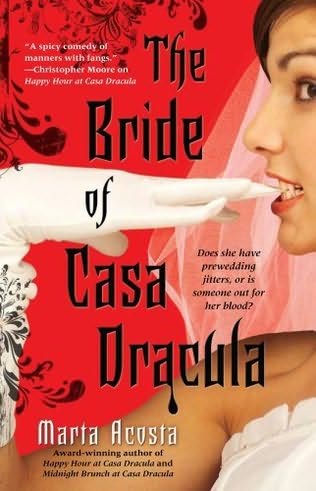
'The Bride of Casa Dracula' Casa Dracula #3 by Marta ACOSTA

From the BLURB:

Milagro De Los Santos is having serious problems planning her wedding to fabulous Oswald Grant, M.D. Her future in-laws loathe her, her dog just died, and Oswald's family has a genetic anomaly that makes them crave blood. Then her extravagant best friend hijacks the role of wedding coordinator, and the secretive Vampire Council assigns conniving Cornelia Ducharme to guide the couple through the ancient vampire marriage rituals.

To top it all off, Milagro's career is on the skids. She's reduced to ghost-writing the memoirs of a loony little man who claims to be a shapeshifter. And why does Cornelia's decadent, way too attractive brother, Ian, always show up whenever Milagro is away from Oswald? When a series of accidents interferes with wedding plans, Oswald worries that Milagro is cracking under the pressure. Is she just paranoid, or is a hidden enemy trying to make sure Milagro doesn't wed the undead?

Milagro De Los Santos is flying high. She is engaged to the love of her life, Oswald Grant. She has a ghost-writing project to keep her busy and a firm grasp on her red-coloured cravings.
Never mind that she and Oswald are fighting constantly, minus any make-up sex since the vampire council has banned copulation until the wedding. She is writing a memoir for Don Pedro, a self-proclaimed shapeshifter who also happens to be a complete nutbar. And Milagro’s blood cravings are only under control when she’s not around her ex-beau Ian Ducharme. . . the man who makes her blood fizz and her chichis ache.
But apart from that everything is fine. . .

The first two books in the series were all about our protagonist, Milagro De Los Santos, wanting to fit in. Milagro wanted to fit into her fiancées family and to be a part of the vampire society she had been infected into. But this third book is about what happens when the square peg has been rammed into the round hole. . .
“So you ate your pomegranate seed, but now you are not content to be queen of the underworld?” Ian asked.
Marta Acosta has some powerful writing juju going on in this third instalment of the ‘Casa Dracula’ series. Ms. Acosta draws on some fabulous references throughout ‘Bride’; rapid-fire allusions that swirl within the text and enrich the paranormal. Oswald and Milagro’s pre-marital struggles feel like a head-nod to Pygmalion, with Oswald as Henry Higgins trying to change his flower-girl into a lady she’s not. On a baser level it felt as though Milagro was a wolf trying to be tamed.

Milagro’s ex-lover and still-crush, Ian Ducharme, plays a vital role in this third book. . . even more so when his wacko sister, Cornelia Ducharme, comes to help plan Milagro and Oswald’s wedding. Ms. Acosta has said that she drew on Henry and Mary Crawford of Jane Austen’s ‘Mansfield Park’ for the characters of Ian and Cornelia. The Austen hat-tip is wonderful and befitting these twisted siblings, even more so when the Ducharme’s layers are peeled back. Cornelia Ducharme reminded me of Daisy Buchanan, and in fact the Grant mansion prompted me to think of Gatsby’s sprawling estate. . . even more so for the nostalgia Milagro feels for her first few months living with the Grant’s. I also couldn’t help but think that Milagro was Ian’s green light at the end of the dock.

The exploration of duality is explored when shapeshifters are introduced to the Casa Dracula universe. Then there’s the Greek mythology and the story of Persephone. Pomegranate seeds permeate the text – both literally and metaphorically. Milagro as Persephone caught between two worlds, always trying to live in both but belonging to neither. This theme is encapsulated in Milagro’s choice between two men – sweetheart Oswald and bad-boy Ian. And furthermore by Milagro's wish for all the normal things; love, family, white picket fence... while she's also desperate to fit into the hush-hush vampire society.

The duality conflict has been a staple of all the Casa Dracula books. The series is first and foremost a comedy-of-manners, and Ms. Acosta has always explored social niceties and hierarchies via Milagro’s Latina heritage. This has been one of my favourite aspects of the Casa Dracula series - that for all its paranormal tagging, the books have also been an exploration of modern bigotry. It’s not just vampires who are society outcasts. . .
Milagro has been referred to as a common Mexican girl; she has been relegated to the maid’s quarters and been the ‘odd one out’ in her group of blonde-haired blue-eyed university friends. Ms. Acosta has written some corker observations about Mexican Americans and their standing in society, like this comment made by Milagro’s friend, Nancy:
“Oh, darling, everyone’s using Spanglish. How else would you communicate with household staff?”
Acosta writes laugh-out-loud, so-wrong-it’s-right social observations that keep me thinking and chortling throughout the book.

One of my favourite things about this third book is the romance. Right from book one Milagro has been caught between two men – the safe and steady Oswald, and the dark and brooding Ian Ducharme. I have always been Team Ian, and my reasons felt justified by his appearance in this book;
I said. “I do hope we can continue to be friends.”
I didn’t expect him to burst into laughter, but he did, and I snapped. “What is so damn funny?”
When he finally stopped laughing, he looked more relaxed and said, “You and your attempts to be polite.”
“You think I’m incapable of fitting in with your swanky society pals?”
He stepped forward and took my hand. At his touch, a hot fizz went through my body. He looked into my eyes and asked softly, “Why are you so eager to be like everyone else when you’re Milagro De Los Santos?”
I don’t want to say how the book ends because it concerns Milagro’s final, romantic decision. I will say that the love triangle is solved, beautifully and messily. I cried. . . but I won’t say if it was tears of joy or frustration. But I will say it was an ending that left me panting for the fourth and final book ‘Haunted Honeymoon’.

5/5
| More