Search This Blog

Tuesday, December 21, 2021

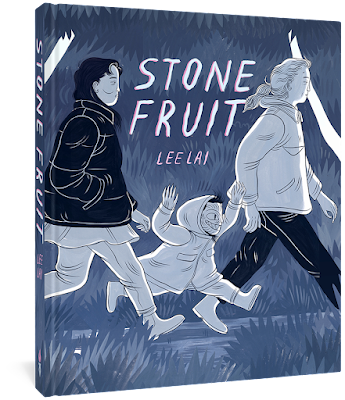
'Stone Fruit' by Lee Lai


From the BLURB:

An exhilarating and tender debut graphic novel that is an ode to the love and connection shared among three women and the child they all adore. 

Bron and Ray are a queer couple who enjoy their role as the fun weirdo aunties to Ray's niece, six-year-old Nessie. Their playdates are little oases of wildness, joy, and ease in all three of their lives, which ping-pong between familial tensions and deep-seated personal stumbling blocks. As their emotional intimacy erodes, Ray and Bron isolate from each other and attempt to repair their broken family ties — Ray with her overworked, resentful single-mother sister and Bron with her religious teenage sister who doesn't fully grasp the complexities of gender identity. Taking a leap of faith, each opens up and learns they have more in common with their siblings than they ever knew. 

At turns joyful and heartbreaking, Stone Fruit reveals through intimately naturalistic dialog and blue-hued watercolor how painful it can be to truly become vulnerable to your loved ones — and how fulfilling it is to be finally understood for who you are. Lee Lai is one of the most exciting new voices to break into the comics medium and she has created one of the truly sophisticated graphic novel debuts in recent memory.

‘Stone Fruit’ is a 2021 Fantagraphics graphic novel by Australia creator Lee Lai, who is based in Quebec. 

I think I’ve had a reading-hangover since finishing ‘Stone Fruit’ a few days ago. A novel of such singular brilliance and tender truth that managed to not overwhelm me as I crawl towards the end of 2021, but still pierced something in my conscience and clung so that I’ve been thinking about it ever since … 

The book is about Ray and Bron – a queer couple who a couple days a week mind Ray’s little niece, Nessie for her sister Amanda who is still juggling the messiness of life since her partner walked out on her and her daughter. Bron is struggling with their long-term mental health and the pressures of trying to exist in their own head while still trying to navigate life with Ray. When it all becomes too much, they move home to their conservative Christian parents and both Ray, Bron, Nessie and Amanda have to learn to cope in the aftermath of the complicated relationship fallout.  

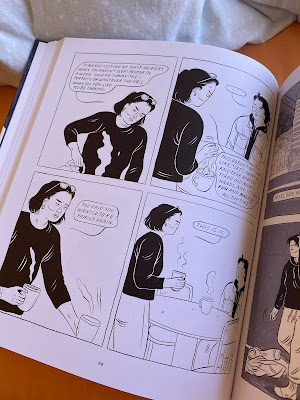
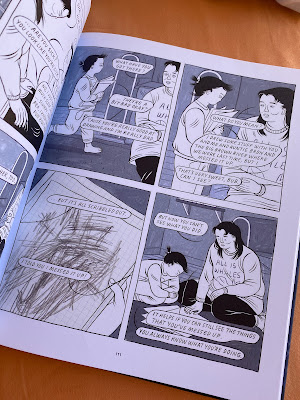
This book is stunning. On every level, it’s a knockout. Bron, Ray and Nessie when they hang out together – in treasured moments of elaborate imaginary play – Lai depicts them as serpentine, monster-esque creatures with a face full of fangs, large eyes and shifting skin and talons … the mask drops however, when Nessie’s mother and Ray’s sister Amanda enters the scene and they’re snapped back to reality and have to put their public personas back on. But these mythological-looking creatures that they are together feel like their true souls on the page, and the book is largely about them trying to get back to that state of play and openness that comes crashing down when Bron’s depressive state overwhelms their relationship with Ray and they return home for some time and space.

As both Bron and Ray navigate the slow breaking down of their relationship, they each find solace in extending olive-branches with their respective sisters – Bron’s whom they abandoned when they unceremoniously left home and cut ties with their family, and Ray’s Amanda who is still dealing with the aftermath of her partner abandoning her, and feelings of inadequacy as a mother to Nessie who witnessed Amanda’s own fragile mental state. 

Something I love in Lee Lai’s writing is the slow parcelling out of information … there’s no info-dumping here, and details of these character’s lives are revealed very naturally amongst characters, deep into the novel and when trust is starting to be established again, honest conversations had. Readers are never left in the dark, but rather we take on a child-like bystander quality similar to Nessie, where we can feel and sense that something is wrong or left unsaid – but it takes a while for these truths to come; but when they do, they’re all the more precious and important for being hard-won and entrusted to us. It’s a very beautiful and tender mode of storytelling here, still waters running deep … and when the current comes, it did take my breath away. Little revelations feel like tremors on the page for their build-up. 

I really loved this. I read a Publishers Weekly article where Lee Lai spoke about being a trans Asian-Australian cartoonist, and the Australian “creative comics scene is strong but the industry is still emerging,” and that’s very true. I loved the small hints of Australia in here (mentions of ‘Play School’ and Henny Penny) but I can see that something very special was able to be created via the wonderful Fantagraphics publisher, and I’m just so grateful for it.

‘Stone Fruit’ is undoubtedly in my Top 5 Favourite Reads of 2021. It’s one of those beautiful books that I didn’t realise I needed until I was deep into it, and then I was just so grateful for everyone who’d raved about it all year and paved the way for me to scoop it up. I will hold it very dear indeed. 

5/5 


Wednesday, November 3, 2021

'Lore Olympus: Volume One' by Rachel Smythe


From the BLURB:

Scandalous gossip, wild parties, and forbidden love - witness what the gods do after dark in this stylish and contemporary reimagining of one of mythology's best-known stories.

Persephone, young goddess of spring, is new to Olympus. Her mother, Demeter, has raised her in the mortal realm, but after Persephone promises to train as a sacred virgin, she's allowed to live in the fast-moving, glamorous world of the gods. 

When her roommate, Artemis, takes her to a party, her entire life changes: she ends up meeting Hades and feels an immediate spark with the charming yet misunderstood ruler of the Underworld. 

Now Persephone must navigate the confusing politics and relationships that rule Olympus, while also figuring out her own place - and her own power. 

***

‘Lore Olympus: Volume One’ collects episodes 1-25 of the #1 WEBTOON comic Lore Olympus, by Rachel Symthe.

So apparently Smythe started creating this web comic in 2018, and it is currently the most popular comic on Webtoon; as of January 2020 it had 299 million views. Confession though; I’d never heard of it. I just stumbled across the cover for Volume One on Goodreads and thought it sounded cool (I’m a sucker for Greek Mythology updates). 

If you’re unfamiliar with the Hades and Persephone myth, a really good refresher is provided by YouTuber Lindsay Ellis – it’s one of the first ‘Beauty & The Beast’-esque stories and depending on who is telling and when, it’s either romanticised or given the villain edit. In Smythe’s ‘Lore Olympus’ it’s most definitely on the romantic side, though that does not mean it’s all squeaky clean retellings here … in fact, at the very beginning of Volume One there’s a content-note trigger-warning for sexual coercion and manipulation (though probably not from who you think). 

Smythe’s Greek Mythology retelling has the feel and hedonism of a J. C. Leyendecker illustration, but with an almost ‘Fantasia’-like illustrative style … all solid hues, women with Betty Boop-curves and men sporting illustrated six-packs. It’s lush and also a little unformed … but that’s kind of true of the story too. It’s a ‘Gossip Girl’ meets ‘Suits’ and ‘American Psycho’ version of Olympus, the Greek Gods wearing nicely cut suits as they attend nymphe strip-clubs, Zeus and Hera conduct public spats and Goddesses walk around in tight mini-skirts and platform-heels with Ariana Grande high-ponytails. 

Is it revolutionary and cutting-edge with a new twist and spin on the ‘Hades and Persephone’? … I mean, no. Not really. It’s just very lush and a bit of a lightly hedonistic romp through the Greek Myths, nice enough but if I want to know more I think I’ll read the rest online. 

2.5/5


Wednesday, October 20, 2021

Interview with Kate Moore, author of 'The Radium Girls' and 'The Woman They Could Not Silence'


Hello Darling Readers, 

It is my distinct pleasure and honour to give you an Author Q&A (haven't done one of these in a while!) - for someone I most admire, and whose books I am absolutely *obsessed* with. 

The one. The only. Kate Moore - author of The Radium Girls and The Woman They Could Not Silence


** 


Q: You've written fifteen books across various genres, so you've clearly developed a very good instinct for story in this industry. But what was it about your award-winning international bestseller, The Radium Girls, that felt different when you thought of it? Could you tell even at the point of the first burst of idea; that it would be a special one, and go off on the rocket-ship trajectory it did? 

I genuinely didn’t anticipate the reaction that The Radium Girls has received. What was different about this story from my other books, however, was the passion with which I pursued the project and, ultimately, with which I wrote the book. At the time I stumbled on the radium girls’ story – which I did through directing a play about them – I’d been a freelance editor and writer for about six months. I was busy ghostwriting other people’s memoirs – usually, these were stories of courageously fighting for justice, which actually parallels my interpretation of the radium girls’ experiences perfectly – and working on very commercial projects, such as cat books and humour titles. I had never written a history book before. But I felt driven to tell the women’s story and I think that passion marked it out as different for me, even though I didn’t necessarily anticipate its subsequent success. 


Q: I love Radium Girls *so much* - I have the hardback, paperback, and Young Reader's edition and have re-read it three times in three years. I adore it! So I've got to know; are there plans for it to be adapted? It's begging to be a Chernobyl-esque HBO series, if you ask me! 

Oh my goodness, thank you so much for your love for the women and their story! I can say that there is interest from Hollywood and things seem to be going well, but if I’ve learned anything about dramatic adaptations of books over the past few years, it’s that it takes forever for anything concrete to happen. So, I’m keeping my fingers crossed – but not holding my breath! All I can say is watch this space.

***

Q: How did you come across the muse and historic-figure for your next investigations and new book, Elizabeth Packard? When did you first 'meet' her? 

Finding Elizabeth’s story was a topsy-turvy situation because I found the topic I wanted to write about before I found my story’s actual heroine. The genesis of The Woman They Could Not Silence occurred in the fall of 2017, amid in the fire of the #MeToo movement. What struck me about that empowering time was not that women were speaking out, but that – finally – we were being listened to and, crucially, believed. It got me thinking about how women have been silenced and discredited in the past – namely, through the claim we’re crazy. And that’s what I wanted to write about – the medicalisation of female behaviour, and the way perfectly sane women are dismissed as mad simply for standing up for themselves. 

Having decided on the topic, I went searching for a story – because I am at heart a storyteller, even though I write non-fiction. I hoped to find a woman from history whose real-life experiences could showcase these issues, which still resonate today. I fell down a rabbit warren of internet searches about women and madness, and on 15 January 2018, in a University of Wisconsin essay that I found online, in a single paragraph four pages in, I first read about Elizabeth Packard. That first clue was enough for me to dig deeper, and once I realized how special Elizabeth was – how resilient, how fearless, how inspirational – and how dramatic her story, I knew she was “The One”: the woman I would write about next. 


Q: I can see strong themes and connections between The Radium Girls and The Woman They Could Not Silence - but I'd love to know for you personally, what tethers all your work in this nonfiction space? How would you categorise those threads? And are you constantly looking for new events and figures to keep exploring in your work? 

I agree there are lots of parallels! For me, it’s actually several elements. The most obvious would be inspiring women fighting for justice, the indisputable drama of their stories, and the forgotten nature of their achievements, but I think there are also parallels in the shocking science history, in gothic horror, and in the way these historic events still resonate today. I think what tethers a lot of my work is the idea of helping people silenced through injustice to have a voice again. And I am always looking for new events and figures to keep exploring in my work – though it’s easier said than done to find the right topic, especially given the intimate narratives I aspire to write, which are packed full of first-person accounts, so you can hear from the people at the heart of these stories themselves.

***

Q: How do you go about just ... beginning? Once you've hit on a topic (person or historic event) - what's your first point of order in researching and just *starting*? First port of call? 

The very first port of call is the internet, which is probably not surprising in this day and age. In the very early stages of a project, you not only want to know the bones of the story (at least as people currently understand them to be – sometimes deeper research reveals inaccuracies!) but also whether people have written on the topic before (sometimes, that can be the nail in the coffin if a narrative non-fiction account already exists). The second stage for me is always research, research, and yet more research. That means visiting special collections, libraries and museums, conducting interviews with key figures and their families, travelling to key locations, and reading other books on related topics (including scouring their bibliographies for yet more research inspiration…). For me, it’s essential to conduct all my research for a book before I write a single word of the manuscript. 

Q: I'm so interested in narrative nonfiction, and the way the form has been elevated in recent years - I'm curious to know as author and researcher, what are the "rules" of nonfiction that you stick to, and what have you enjoyed playing around with in a more artistic sense? (I know some nonfiction authors are constantly tackling the 'what were they thinking' problem in non-fiction; inferring what these "characters" based on real-people would have felt in a moment, etc.) 

I always aim to stay tethered to the facts as my sources show them to be. In terms of the “what were they thinking?” problem, I’ve been blessed that with both my history books to date, I had a wealth of first-person material to draw on, so I knew exactly what my “characters” were thinking and feeling as they left a record behind. There are of course always holes in research and sources where you don’t know exactly what happened. My solution in these situations is usually to make it clear to the reader that there is a question, but to plant seeds of what might have been so the reader still sees that situation in their mind’s eye. For example, when Elizabeth Packard confronts Dr. McFarland at one stage, she’s uncharacteristically coy in her account of the meeting about what actually happened at the climax of their impassioned discussion. In the book, I therefore wrote about this moment as follows: 


She observed with some surprise, “his feelings burst their confinement.”

Did he slam the table? Stand up with force? Grab at her elbows to shake her roughly? We do not know; she did not say. It could have been a glare or a grasp or a guttural roar: all we know is that, with strong feeling, he finally reacted to her words.

In terms of what I enjoy playing around with artistically, my love is storytelling, so I love two things in particular – 1/ creating and setting scenes based on extensive research – describing the click of Elizabeth’s boots on the stone steps of the asylum, for example, and the way that intimidating building is lit by the glow of gas-lights as she approaches it in the dusky twilight – and 2/ trying to prompt an emotional response in the reader to the real events I’m describing. 


Q: I imagine in both your books, hefty as they are!, there's still a lot that gets chucked out in the edits. So what are two facts or quirky findings you had in both Radium and Could Not Silence that you regret had to be cut? 

Oh, *so* much goes in the edits! I’m terrible for overdelivering and having to cut back afterwards. Hmm, two facts or quirky findings that had to go… For The Radium Girls, a fact from early on in the book that I had to cut was that, at that time, 75% of teenage girls worked for wages and they made up the majority of women in the workplace (older women tended to be married with children, and they therefore stayed in the home). You might also be interested to know that the Parisian laboratory in which the Curies discovered radium was so ramshackle it was described as “a cross between a horse stable and a potato cellar.” In The Woman They Could Not Silence, I had to cut a paragraph about the history of hydrotherapy (water therapy) to treat mental illness. “Patients were…blasted with high-powered hoses, wrapped in wet sheets, and submerged for hours in tubs of cold water,” I wrote of this historic treatment. “It was not a new therapy: one eighteenth-century doctor developed a treatment—conceived to treat wives who would not sleep with their husbands—in which the women were stripped, blindfolded and tied to a chair, before being showered for up to 90 minutes with incredible quantities of water (in one case, 15 tonnes).”


Q: Any helpful 'how-to' books, podcasts, Ted Talks etc. that you encountered and helped you in your creative process?

I’d highly recommend The Exploress podcast (which is actually an Australian podcast!), which takes you on a fully immersive time-travelling journey through women’s history. I found several of her pieces super helpful and fascinating. Visit www.theexploresspodcast.com


Q: What are you reading and loving right now?

I just finished historical novelist Marie Benedict’s latest book, Her Hidden Genius, which is about the scientist Rosalind Franklin. It’s due out in January 2022 and I think readers are going to devour it. 


Q: What's next, and when can we expect to see it on bookshelves?!

I’m currently tackling the “what’s next?” question and as of yet haven’t settled on an answer! Whatever it ends up being, it will likely take me several years to research and write… so maybe set your calendar for 2025 (or thereabouts!).


'The Woman They Could Not Silence: Elizabeth Packard’s incredible fight for freedom, and the men who tried to make her disappear,’ by Kate Moore

Received from the Publisher 


From the BLURB: 

From the internationally bestselling author of The Radium Girls comes a dark but ultimately uplifting tale of a woman whose incredible journey still resonates today. 

Elizabeth Packard was an ordinary Victorian housewife and mother of six. That was, until the first Woman’s Rights Convention was held in 1848, inspiring Elizabeth and many other women to dream of greater freedoms. She began voicing her opinions on politics and religion — opinions that her husband did not share. Incensed and deeply threatened by her growing independence, he had her declared 'slightly insane' and committed to an asylum. 

Inside the Illinois State Hospital, Elizabeth found many other perfectly lucid women who, like her, had been betrayed by their husbands and incarcerated for daring to have a voice. But just because you are sane, doesn’t mean that you can escape a madhouse … 

Fighting the stigma of her gender and her supposed madness, Elizabeth embarked on a ceaseless quest for justice. It not only challenged the medical science of the day and saved untold others from suffering her fate, it ultimately led to a giant leap forward in human rights the world over.

*** 

'The Woman They Could Not Silence: Elizabeth Packard’s incredible fight for freedom, and the men who tried to make her disappear,’ is the latest book from London-based author Kate Moore, and her second non-fiction book after the bestselling and award-winning ‘The Radium Girls.’ 

Is it strange to read a book about 19th-century gender-based injustices and think of Britney Spears crossed with anti-lockdown rhetoric? Well. I can’t help it. From the author’s note the line is clear from the first; ‘This is not a book about mental health, but about how it can be used as a weapon.’ And indeed when the plight of Britney Spears’ has thrown a harsh light on the problem of conservatorships and sparked wider examination of them as a Disability Rights issue too. One of the most eloquently-put arguments against them that I read, came from the Ronan Farrow and Jia Tolentino New Yorker article; ‘“Our mistakes make us who we are, and teach us who we can be,” Martinis said. “Without bad choices, we can’t be wholly human. And with the best of intentions, we say to people with disabilities: we’ll keep you from ever making a mistake.”’

An overlapping venn-diagram has been the anti-lockdown rhetoric aimed at the most locked-down city in the world, mine – Melbourne. ‘Shadow Pandemic Vic’ put forth the ‘damaging to mental health and rise in suicide rates,’ argument for ending lockdowns sprinkled, with a “but what about the children?!” Helen Lovejoy proclamation. Never mind that many on the Internet were able to make very clear and compelling links between the ‘Shadow Pandemic’ “founders” the Liberal Party, suggesting political astro-turfing. While also showing that annual suicide data did not support the claims either. While many more pointed out that the risk of catching and spreading Covid-19 provided a much harder reality of hurt for young children especially; ‘Hidden Pandemic’: 1 Million Children Worldwide Lost A Parent To Covid, Study Finds.

It’s fascinating then, to come to Kate Moore’s latest book that begins in 1860 Illinois and find so many tendrils and talking-points to the here and now. But this initial comparison of weaponizing mental health, wasn’t the only one I made while reading … indeed; the book is an eerie shout into the post with echoes in the here and now, an important and spine-tingling book for the parallels that still exist. 

It’s the story of Elizabeth Packard, married to a preacher and content in a life and marriage that centred around home and church … until the woman's rights movement and crusade for the right to vote sweeps through America and takes hold of Elizabeth’s passions. Suddenly she and her husband Theophilius are having theological and philosophical arguments until eventually he decides to have his wife committed to an asylum, on grounds of insanity.  

What comes next is the harrowing detailing of her three-year incarceration, and a wider journey into the history of women being dismissed and abused on grounds of their own insanity. This is especially fascinating because I thought I knew so much of this via the story of pioneering journalist Nellie Bly, who checked herself into an asylum in 1887 and went on to detail the brutalising treatment and unethical practices that led to reforms of such institutions, via her journalism. But, as Moore explores, Elizabeth Packard upon release would go on to write her own books chronicling her experiences and beginning to shine a light on the practices and abuses that the likes of Bly would eventually turn their own investigations to.

This is by no means an easy book to read. But I enjoyed it so thoroughly, because I simply adore Kate Moore’s writing. I think it’s a known-fact at this point that ‘The Radium Girls’ remains one of my all-time favourite books and reading experiences I’ve ever had. I also now own it in paperback, hardback and young reader’s edition … and while ‘'The Woman They Could Not Silence’ doesn’t quite eclipse my adoration for ‘Radium Girls,’ it comes damn close in giving me a similar fire-in-my-belly reading experience and a real urge to get up on a pulpit and hand Kate Moore’s books out to all who’ll hear me preach her brilliance. 

5/5 


Sunday, September 26, 2021

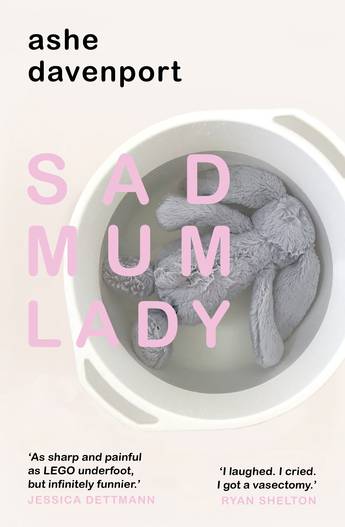
'Sad Mum Lady' by Ashe Davenport


From the BLURB: 

If David Sedaris and Sheila Heti had a baby… well, there'd be a lot to unpack there. But the ensuing stories would be brutal and hilarious and endlessly readable. And they'd look a bit like Sad Mum Lady. 

'If people knew how bad this was,' I said to a friend two weeks after the birth, nipples flashing red like emergency lights under my dressing-gown, 'they would be sterilised on their thirteenth birthdays.'

It sometimes feels like there's a rule for parents: if you're going to say anything mildly unhappy about parenting, you must also be at pains to stress that it is all worth it. What joy! What wonder! How lucky we are! 

But then there's the crying. And the body horror. The tearing and the leaking. And the crippling isolation. And the sleep deprivation. And somehow a dead rat in the cubbyhouse and the endless judgement of peers and neighbours and the internet. 

But fear not. Ashe Davenport is here. And she's not afraid to say it's fucked. 

Unapologetic and frank, Sad Mum Lady navigates the joys of motherhood in ways that will be familiar, hilarious and essential reading for parents and non-parents alike. Savage, true and deeply relatable - finally, a book that resists the sanitised, acceptable face of parenting. You might not feel better, but at least you'll feel less alone.

‘Sad Mum Lady’ was the humour non-fiction book from Ashe Davenport, released in 2020. 

Right. So. This book came out in June 2020 and it actually first pinged on my radar because of the most painfully ‘releasing a book in 2020’ way – the online book launch. Which I remember, loads of my friends on Instagram were talking about on the evening it happened. Lots of my mutuals and follows were saying something to the effect of; “OMG, if you’re not watching Ashe Davenport’s live book launch right now GET ON IT!” and lo – it appears that Davenport accidentally deleted the whole thing so I can’t direct you to watching the most hilarious and genius launch I’ve ever seen. I think … did it involve Ashe dressing up as a banana and letting her two kids climb all over and distract her at will? While she tried reading excerpts from the book? I am either remembering that accurately or the banana bit is just a lockdown fever-dream but either way – it was fantastic. 

And it was one of those 2020 moments where I said to myself; “I must remember to read that book.”

And then imagine that clapping monkey from ‘Rebel Without a Cause’ replacing my brain. 

Yeah. 

Fast-forward to 2021 and I have so many pregnant or just-gave-birth friends and being me, I want to gift them books. My go-to has been ‘The Motherhood’ edited by Jamila Rizvi because it’s fabulous, but I am not (nor do I ever want to be) a mother – but part of me wonders if I shouldn’t give my friends more varied and caustic, tender and honest portrayals of motherhood. Because everyone comes to motherhood differently. Aspirational or worriedly. I am not one, but even I know that.

Suddenly ‘Sad Mum Lady’ and the faded grey/baby-pink cover pops in my mind. Not the title or author, mind – just the cover and vague memories of a banana reading an excerpt in a livestream. Luckily I am someone with many bookselling friends so I did the DM rounds – providing my hazy recollections based on cover and online launch and OF COURSE, Em (@em_isreading) came through and I purchased the book from the stunning store she works at; Neighbourhood Books

But then I wondered if I shouldn’t read this book myself, before gifting it to some fragile pregnant and new mothers – a book called ‘Sad Mum Lady’ with a loving note saying, “thinking of you!” Don’t judge a book by its cover and maybe don’t gift it before reading it? 

And so I started … and then I couldn’t stop.

The important thing to know is; Ashe Davenport is the Melbourne-based author and family columnist for The Design Files (fab blog!). This book began as a personal blog called Sad Pregnant Lady, which would become ‘Sad Mum Lady.’ So it reads very much like a personal diary, a thought-stream and confessional, very much for fans of ABC show ‘The Letdown.’ 

But it’s interspersed with Ashe’s individual flare and experience (like her above-stairs neighbour whose ice habit and in-denial mother become a weird obsession in the uncomfortable final weeks of her pregnancy). 

Ashe writes with such stark honesty about the myths of motherhood – compared to the ‘earth mother’ Insta-filter holistic “sell” of it all. And she does examine her own childhood and young adulthood within this context too, particularly as she unravels her history of growing up with a surly single-mother, a more honest baby-boomer whose outlook on mothering and parenthood jars with Ashe’s attempts at a more progressive context – but is still beautiful, in its own way; 

She told me once that the role of a parent was ‘a short-term caretaker’ and I said it was the bleakest thing I’d ever heard. She said it wasn’t bleak at all, because it meant we were on separate pathways that intertwined, and we got to be in each other’s lives because we wanted to be. At last she felt the sun on her skin again, as the travelled along, parsley sprig in hand. 

There’s a lot in here that’s very personal – her personal relationships and the relationship with her own fraught mind and mental health. The relationship with her in-laws, and her partner Sam; 

We kissed and I remembered that I’d also made a central nervous system out of a drop of semen, and an entire human was about to burst through my body like a showgirl out of a cake. You’re welcome, I thought, brushing an eyelash from his cheek. And I forgive you. 

There’s some writing in here that is cosmically good and true. And sharp. My gosh is Ashe Davenport sharp; 

It was midnight, and Kristy suggested Sam take a nap on the hard square birthing mat in the corner. She offered no blanket or pillow, just the square, fit for a family dog. It wasn’t that he as being punished, because that would imply he had some kind of significance in her mind. It I was a passenger in the birth, Sam was a tin can by the side of the road we’d burned past several towns ago.

I’ve never been a mother, and I have no wish to. I can safely say reading Ashe Davenport’s ‘Sad Mum Lady’ left me neither regretting that decision, or embracing it overly – it just … is. And I so appreciated her frank, funny, and full spectrum of experience. It was a window for me – someone looking in – but I can also see this book being a doorway for so many, a secret passage where people get to admit the parts of being a parent that they don’t like, the disappointments and resentments they harbour, the joy and love of it too. All soaking in this big tub of life before getting mixed up in the tumble where it’ll all come out in the wash. Eventually. For better or worse, but mostly in the funny.

5/5   


Sunday, September 19, 2021

'The Heart Principle' The Kiss Quotient #3 by Helen Hoang


From the BLURB: 

A woman struggling with burnout learns to embrace the unexpected - and the man she enlists to help her - in this heartfelt new romance by the bestselling author of The Kiss Quotient, Helen Hoang. 

When violinist Anna Sun accidentally achieves career success with a viral YouTube video, she finds herself incapacitated and burned out from her attempts to replicate that moment. And when her long-time boyfriend announces that he wants an open relationship before making a final commitment, a hurt and angry Anna decides if he wants an open relationship, then she does, too. Translation: She's going to embark on a string of one-night stands. The more unacceptable the men, the better. 

That's where tattooed, motorcycle-riding Quan Diep comes in. Their first attempt at a one-night stand fails, as does their second and their third, because being with Quan is more than sex-he accepts Anna on an unconditional level that she herself has just begun to understand. 

However, when tragedy strikes Anna's family, she takes on a role that she is ill-suited for, until the burden of expectations threatens to destroy her. Anna and Quan have to fight for their chance at love, but to do that they also have to fight for themselves.


‘The Heart Principle’ is the third and final book in Helen Hoang’s loose contemporary romance trilogy, that started with ‘The Kiss Quotient’ and continued with ‘The Bride Test’. 

Hoang is also Actually Autistic, and each of her books features a neurodiverse hero (especially refreshing that in 2 of her books, it’s the female protagonists at various stages of their neurodiversity diagnosis that she explores). She also writes a full cast of API (Asian and Pacific Islander) characters, which sees these books having really full and rich focus on family and community that’s complimentary to the main romance plot. We see complicated daughter roles in ‘The Heart Principle’ in particular (and the most heartfelt author’s note from Hoang on this too, which had me in *tears*!), we’ve seen the immigrant experience explored, the working-woman narrative stress striving to “have it all,” and the pressure of body-image anxiety on men, as well as a character grappling with recovery after illness. 

For anyone who thinks romance as a genre doesn’t have these big, thoughtful discussions *anyway* - let Hoang be a gateway to your awakening because she does is extraordinarily well.

But you do stay for the romance - the heat and swoons, they’re all here. Tenfold. Hoang is one of the fastest rising stars in US-romance not just because she’s offered a breadth of experience and new viewpoints, but because she also writes exquisite build-up, focus on female pleasure and wonderfully frank discussions about sex and desire.

I do think 'The Kiss Quotient is still the stand-out greatest of the series, and 'Bride Test' is a slight dip in the middle - but 'Principle' brings it all back around and shows again why Hoang is one to watch in romance and will be an automatic-buy author for me, forevermore. 

She’s amazing. Read these books. Highly recommend.

4.5/5


Wednesday, August 25, 2021

'Uptown Girls' trilogy by by Joanna Shupe


Joanna Shupe’s ‘Uptown Girls’ is a historical romance (now concluded) series that began in 2019, and the third book was published last year in 2020. The books take place largely in 1891 New York City, and focuses on the three Greene sisters and uptown heiresses – three very different women whose bull-headed businessman of a father intends only the best for his daughters, but times they are a-changing and the girls are witnessing the suffrage and union movements unfold … and with these changes come their own ideas of how their lives should go, and it rarely correlates to what their parents want for them. 

First book ‘The Rogue of Fifth Avenue’ focuses on eldest sister Mamie, who is promised to be promised to the upper-crust son of her father’s oldest friend. But Mamie has been delaying signing the marriage papers, and instead she’s turned her mind and idealism to helping the city’s poor and working-class families – and the way she helps is by gambling with her sister in exclusive clubs (clubs that are also barred to them) and giving their winnings to the needy. But this Robin Hood behaviour has caught the attentions of her father’s busy-body lawyer, Frank Tripp – and he’s not impressed with Mamie’s wild and reckless after-hours behaviour, even if it makes her even more intriguing and tempting in his eyes. 

Second book ‘The Prince of Broadway’ is about second-sister Florence who has ambitions of opening her own (and exclusive) ladies’ gambling club – but to do that she needs a mentor in all things gaming; and that’s where the delectable and reclusive, elusive Clayton Madden comes into her schemes. He agrees to mentor her but the fire between them soon turns combustible.

Final book is ‘The Devil of Downtown’ about youngest sister Justine the “do-gooder” of downtown who has taken it upon herself to help track down wayward husbands walking out on their needy families, and making sure the City’s workers are not being exploited. It’s in her noble pursuits that Justine is forced to cross paths with notorious Bowery criminal King Pin, Jack Mulligan … and what follows is several deals with the devil that wind these two opposite souls closer and closer to one another, with delectable results. 

Right. So – can you tell that it’s Lockdown No. 6 in Victoria and I just need good, wholesome comfort-reads and that to me is historical-romance. The reliable, old faithful genre that without fail can lull me into compulsive reading habits and ensure I have something to look forward to when I dive into a series, or find a new author to explore their backlist. This week in lockdown that remedy for me has been Joanna Shupe; a his-rom author I’ve heard plenty about, but never read before but now I can’t seem to stop! 

Shupe is very much writing modern twists on historical-romances with wonderfully progressive heroes and heroines (where virginity is not a big deal, many female characters have already had previous sexual partners, crave their own careers and lives separate from the men they’re attracted to, and speak openly about welcoming the suffrage movements and the changes they herald! Not to mention a real upstairs/downstairs socio-economic outlook to the books, where the upper-class women don’t care for their status and gravitate towards working-class pursuits and men from all walks of life). If you like what Sarah MacLean is doing in the genre and similarly updating old tropes, then Joanna Shupe is the author for you!

I will say that in all of her books I found that she’d often go *one story-beat too many*. There’d often be one twist overboard, and an additional speedbump in the plot that the protagonists had to overcome that detracted from the rising tension of the climax and just meant that it dragged too long in the final act. That was a pretty common problem in all three books, but a relatively minor quibble. 

I’ll also say that I felt like the first book - ‘The Rogue of Fifth Avenue’ – was the most boring and disappointing, and didn’t seem to gel with the next two … Frank Tripp is more middle-class equivalent here (as a prominent attorney) and while there are secrets to his background, they’re not all that scandalous. Compared to the far better Books 2 and 3 featuring Madden and Mulligan as criminal underworld figures who capture the hearts of the Greene sisters – these books felt much more assured in their thematic purpose and promise, and were both the far more scintillating of the series. Even if the M/M of Madden and Mulligan and both men running gambling halls kinda confused me for a hot-minute in Book 2, it might have been nice to change up the underworld figures slightly – but I can’t deny I ended up loving both of them. So – yes – fair call, Book 1 is a bit of a snooze-fest but the next two are well worth the slog to get through. 

I also loved reading a historical romance set in New York City – something I don’t actually come across that often, but features prominently in Shupe’s backlist is the American industrial and just post-industrial era as settings, which I find really fascinating. It has this kind of ‘Gangs of New York’ feel to it, a lot of social mobility and recognisable places I so appreciated learning the history of. Really nice change from typical England/Scotland. 

All in all; loved these. I’m diving headfirst into Shupe’s whole list and loving it! 

4/5
| More