
tina werner
Congrats to Tina, and thanks to everyone who entered.
A very big thanks to Marta Acosta for doing the interview, providing the books and just being generally fabulous.


I recently read (devoured/inhaled) Marta Acosta's 'Casa Dracula' series and completely feel in lust with this author's unique brand of humour, à la Moliere's comedy-of-manners.
Luckily for me, Ms. Acosta doesn't mind having rabid fan-girls beg her for interviews...So, without further ado, I present to you the luminous laugh-out-loud brilliance of Marta Acosta!
 Q: Favourite book of all time?
 Q: Can I assume that you have a soft spot for my fair country, Australia? In ‘Midnight Brunch’ Milagro meets some boisterous Aussie blokes at a wine tasting. In ‘Bride of Casa Dracula’ the wacko Don Pedro (Mr. Nascimento) claims to have "taken a walkabout” in the Australian outback. Milagro likewise believes that “everyone loves a good platypus story.” Have you ever visited Australia, and if so what did you think of our sunburnt land? (and if not. . . can you please come and visit? Puh-lease?!?)
 Q: You released a book under the name Grace Coopersmith entitled ‘Nancy’s Theory of Style’. The book is a spin-off of sorts, about one of the character’s who appears in the Casa Dracula world. Why the pseudonym? And did writing under a different guise affect your ‘voice’?
  Q: Milagro carries a certain Llama (Llorona) story around “like a dead albatross”. Have you had any such seabird-addled stories in your career?
 Q: Were publishers wary of a book series with a Latina heroine?
  Q: Is ‘Haunted Honeymoon’ really the end of Milagro de Los Santos?
  Q: Word on the blogosphere is that you have a YA book coming out in 2012 called ‘The Shadow Girl of Birch Grove’. Can you tell us a little bit about this new project?
 Danielle, thanks so much for having me here at Alpha Reader. I was thrilled to discover your reviews of my books, especially since you really seemed to understand what I’m trying to do as a writer. It makes me feel quite appreciated…like receiving a check from my publisher!
 To enter:
 From the BLURB:
Ian stared at me with his languid, hooded eyes and said, “You’re very conflicted about who you are, what we are, as you’ve always been. But what is amusing in a girl becomes tiresome in a woman. Grow up.”‘Haunted Honeymoon’ is very much centred on Milagro – deconstructing her personality, her past and her predicaments. She is an infuriating character sometimes – both hyper-aware and utterly ignorant of herself. In other words, Milagro is just like everyone else in the world. But I loved that in ‘Haunted Honeymoon’ a lot of dirty laundry was aired, and characters spoke their minds and had their say – often voicing criticisms and witticisms that had been on the tips of their tongue for three books. The amnesia plot is essentially a stripping down of Milagro’s defences; a way for her to take a cold, hard look at her life decisions and gain perspective. It may be a cliché soap-opera storyline, but with Ms. Acosta’s writing juju the amnesia plot becomes a deeply profound and funny character exposè, more in keeping with an Oscar Wilde comedy-of-errors than the Goldie Hawn movie 'Overboard'.
“So says a man who spends every waking hour in pursuit of pleasure.”
“Remind me again, Milagro, what it is that you do to contribute to society, besides your decorative value, which is considerable.”
“I don’t believe in magic.”This is the grand finale for Milagro de Los Santos – and her send-off is absurdly wonderful and befitting the unique ‘Casa Dracula’ series. Milagro’s love life is sorted out, once and for all. She accepts hard truths and her own limitations, and the book finishes on a beautiful note of Scarlett-esque proportions; ‘tomorrow is another day’. I would be over-the-moon thrilled if Marta Acosta wrote more books in the ‘Casa Dracula’ series. But if ‘Haunted Honeymoon’ really is the last then it’s a beautiful send-off for one fabulous señorita.
“You are magic.” He put his fine-boned hand on my wrist. “You are Milagro de Los Santos, the Miracle of the Saints. You must trust in yourself, in the role that destiny has written for you. Even though others would put you in a cage, the one who watches you recognizes your true self and loves you still.”
I was surprised at the shiver that went through me. “I know you’re full of it, but damn if I don’t want to believe you.”
“Then do,” he said, and winked one of his big bug eyes.

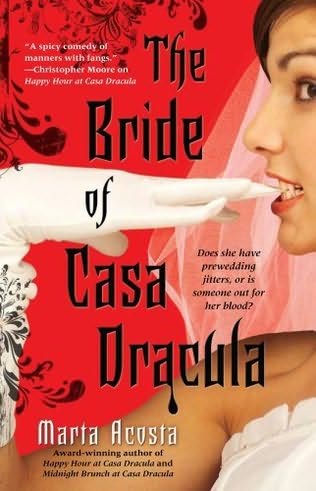 From the BLURB:
“So you ate your pomegranate seed, but now you are not content to be queen of the underworld?” Ian asked.Marta Acosta has some powerful writing juju going on in this third instalment of the ‘Casa Dracula’ series. Ms. Acosta draws on some fabulous references throughout ‘Bride’; rapid-fire allusions that swirl within the text and enrich the paranormal. Oswald and Milagro’s pre-marital struggles feel like a head-nod to Pygmalion, with Oswald as Henry Higgins trying to change his flower-girl into a lady she’s not. On a baser level it felt as though Milagro was a wolf trying to be tamed.
“Oh, darling, everyone’s using Spanglish. How else would you communicate with household staff?”Acosta writes laugh-out-loud, so-wrong-it’s-right social observations that keep me thinking and chortling throughout the book.
I said. “I do hope we can continue to be friends.”I don’t want to say how the book ends because it concerns Milagro’s final, romantic decision. I will say that the love triangle is solved, beautifully and messily. I cried. . . but I won’t say if it was tears of joy or frustration. But I will say it was an ending that left me panting for the fourth and final book ‘Haunted Honeymoon’.
I didn’t expect him to burst into laughter, but he did, and I snapped. “What is so damn funny?”
When he finally stopped laughing, he looked more relaxed and said, “You and your attempts to be polite.”
“You think I’m incapable of fitting in with your swanky society pals?”
He stepped forward and took my hand. At his touch, a hot fizz went through my body. He looked into my eyes and asked softly, “Why are you so eager to be like everyone else when you’re Milagro De Los Santos?”

 From the BLURB:
“I don’t know that I’m going back.”‘Midnight Brunch’ sees Milagro thrown into the deep-end and struggling with life after ‘happily ever after’. She’s dealing with Oswald’s jealousy, feeling like an outcast in the Grant family, hunger pains and job woes.
“Sure you’ll go back. I've seen sad endings and I've seen happy endings, and you’re a happy ending type.”
“You’re talking about movies, not real life.”
“Same difference,” he said.

 From the BLURB:
Instead I had my mother Regina, rats in the walls, and boyfriends who were like beach reads, momentary fun but nothing you’d ever bother to buy in hardcover. I worried that perhaps I, as a nonserious person, was only a beach read as well. I had just reread ‘Middlemarch’, and I had a deep and sincere desire to be a deep and sincere character.I was also really impressed by Acosta’s writing of Milagro’s vampiric transformation. For all of Acosta’s belly-aching laugh lines, she is capable of going very dark and gothic when the vampirism mythology calls for it. When Milagro becomes infected with Oswald’s blood, she undergoes a physical transformation. Her heightened senses and delirium have her hearing morse code from the rats scurrying in her walls. Acosta can be utterly creepy and respectful of the vampire lore – and I loved her ability to balance the serious horror with heightened humour.
His polite smile was even and his light brown hair was brushed in an unsuccessful attempt to subdue the natural waves. His eyes were brown, too. Slim and neatly groomed, he looked like a really sexy mathematician unaware that he was a prime number.As funny as Milagro is, Acosta has written her with real heart. A lot of Milagro’s observations are about being a brown girl in a predominately white (Swedish-looking) world. Milagro muses on being mistaken for wait staff at soirees and silently communicating via head-nod with fellow assimilated Latinas. Milagro’s observations on middle-class racism are never a main focus, but they are interesting side-observations made by Acosta that serve to make Milagro a fascinating woman.
