Search This Blog

Showing posts with label Graphic Novel. Show all posts

Sunday, April 9, 2023

'Anne Frank’s Diary: The Graphic Adaptation' by Anne Frank, adapted by Ari Folman, illustrated David Polonsky


From the BLURB:

The graphic adaptation of one of the world's most-loved books

'June, 1942: I hope I will be able to confide everything to you, as I have never been able to confide in anyone, and I hope you will be a great source of comfort and support.' 

In Amsterdam, in the summer of 1942, the Nazis forced teenager Anne Frank and her family into hiding. For over two years, they, another family and a German dentist lived in a 'secret annexe', fearing discovery. All that time, Anne kept a diary. The Diary of a Young Girl is an inspiring and tragic account of an ordinary life lived in extraordinary circumstances that has enthralled readers for generations. Anne Frank's Diary: The Graphic Novel is a stunning new adaptation of one of the greatest books of the last century.


‘Anne Frank’s Diary: The Graphic Adaptation’ by Anne Frank, adapted by Air Folman and illustrated by David Polonsky, came out with Penguin Random House in 2018. As of this month – the book is removed and banned from some Florida schools. Because a group of parents linked to the Republican Party, who complained over its ‘sexually explicit’ material, and a suggestion that it minimizes the events of the Holocaust. 

I’ve owned this edition for a long time, as someone who read Anne Frank’s diary when I was about the same age Anne was – 13 – when she started writing it. It’s one of those books that I think fundamentally changed me, and opened up the history of World War II in such a way as to hammer home the horrors of it, for regular people. I’ve seen most of the film and TV adaptations, and can vividly remember being shown the Elizabeth Taylor 1959 film in school. Anne Frank’s Diary, her story, remains one of those that remade me as a human-being, and set my moral compass from an early age. I have deep wells of joy, respect and grief for this book and its author, and I always will. 

I even visited the Anne Frank Museum in Amsterdam in 2008, a truly remarkable experience I’m privileged and grateful to have marked – because it had been something I’d longed to do since I was a young girl reading this other young girl’s thoughts, feelings, and memories for the first time. While there, I replaced my battered childhood copy with the 60th anniversary edition.  


When I heard that there was a graphic novel coming out, I thought it was a wonderful idea. A way to bring Anne Frank’s story to a new generation – and in vivid, visual colour. Yes, it would be interpreting Anne’s words with images she herself did not draw – but it would add new dimensions to her very personal diary, and make it accessible in an entirely new way and for even more readers; something I think Anne (a great lover of movies and magazines, who cut out images and posters and stuck them to her annexe wall) would have delighted in. 

And this graphic novel is – it must be said – stunning. I should really stop being surprised at how the graphic format elevates and opens up a text; the way it makes for a deeper, more critical intertextual reading because it’s asking you to marry text with images (something we all do on the daily) but the ways your brain has to fire up to connect what you’re reading and seeing, to sometimes realise that the images bely the text … that’s especially true here, and done masterfully. 

For one; David Polonsky is illustrating a great deal of rumour, imagination, and heady cocktails of fear informed by fantasy on behalf of Anne, both before she goes into hiding with her family and after. For instance; when her uncle arrives in Amsterdam from Hamburg, bringing word of how horrific life is for Jews in Germany now. Because this scene and its panels are Anne listening to her uncle recounting his first-person and firsthand experiences of the night of Kristallnacht, and the mass book-burnings; the drawings do reflect what we’ve seen in history books, and from photographs of the time. But very cleverly when the same uncle mentions rumours of a labor camp in Dachau (which he hasn’t seen, only heard about) and where people who are “not German enough,” are being sent - Anne says she can only imagine. And here Polonsky draws on and interprets that imagination – he uses Anne’s Jewish background to fill in the aspects of this horrific rumour that her mind can barely comprehend; and we see a call back to time before the Biblical story of Exodus, with modern-day Jews building a pyramid in the image of The Reichsadler ("Imperial Eagle") being overseen in their slavery by an SS guard. It’s a clever encapsulating of Anne’s currently childlike understanding of the bounds of human cruelty … looking at it with our modern knowledge though; of how truly barbaric Dachau was, part of a Nazi plan to solve ‘the Jewish question’ – this image is also working to signal that people in Amsterdam, upon the German invasion in 1940, really had no idea what was coming. 


This happens again, when one of the ‘annexe angels’ – Miep Gies – who helped the families in their hiding, recounts seeing one of her Jewish neighbours being taken away by soldiers. She also says that she met someone who’d managed to escape from a concentration camp – who tells her that the neighbour has probably been herded into one of the cattle trains to Westerbork … again; at this point, Anne and her family have no knowledge of what happens once these Jews go to the transit and concentration camps. She writes in her diary of them getting little food and water, of the poor lavatory conditions – alongside these musings, Polonsky has drawn an image of people snaking off one of these cattle trains, and lining up for food being served by white-hat chefs – this is as far as Anne’s knowledge and imagination can go, conceiving of terrible conditions. And to see this page is a gut-punch, because it’s so clearly the imagination of a girl who has no idea how bad things can get, will get. Polonsky has put a small dent in Anne’s too-innocent interpretation of what these “camps” can be – by placing gas tanks in the corner, with hoses running to the innocuous bunk houses. But it’s just off the page – in the corner – a creeping sense of dread and foreshadowing. 


Ari Folman and Polonsky has done a brilliant job of condensing Anne’s diary into the quicker pace necessary for a graphic novel – for instance, Anne’s many passages and pages feeling inadequate in comparison to her older, kinder, smarter, more beautiful (to her mind) sister Margot, are eloquently and silently rendered in a page of comedic comparisons between the two – the silence, the absence of text, here also works for the annexe setting, where Anne says they spend much of their day paranoid about not making a noise (and even her pen scratching in her diary sets the other residents on-edge, for fear that they’ll be found out because of it – and even worse, that the diary exists as tangible proof and account of their subterfuge, and that of their co-conspirators and saviours). 


Something else that Folman and Polonsky do exceedingly well here is mapping Anne’s evolution of girlhood and womanhood. Yes, they’ve edited the original diary text and they haven’t included *everything* (because to do so would equate from a text-only of 400 or so pages, to roughly double that becoming 800 pages if they had to diligently interpret all of that and transpose text plus images …)  but they’ve kept in what is most crucial. And Anne’s maturing and explorations of her body, her feelings, and her mind are incredibly intrinsic to the spirit of the Diary, and Anne herself. So they have kept in the passages of her recounting asking her friend Jacque if they could show each other their breasts, and her desire to kiss her – of her saying that she finds statues of female nudes, throw her into ecstasy … they also include her developing a close friendship and romance with fellow annexe-dweller, Peter – while also pining for the boys she used to flirt and go with before the war. 


Why? Why is Anne’s budding sexuality and this sense of self so important to the story? 


the same text, from the 60th Anniversary edition of the Diary


I’d argue because it makes her human. Not some out-of-reach martyr but a regular girl with perfectly normal and relatable thoughts and feelings – who desired to spend a year in London and Paris one day, more than she yearned to settle down and get married … but who died in February or March of 1945 at the Bergen-Belsen concentration camp, at the age of 15.

And this is the true beauty and tragedy of Anne Frank’s Diary. What I first discovered it as a teenage girl, roughly the same age Anne was when she wrote it – the knowledge that a girl who sounded like me; who had the same thoughts, fears, frustrations, curiosities, worries, and desires as me, despite us living decades apart – that that same girl could be vilified and died, all because of her faith … it hits so much harder. She was one person amongst the six million European Jews, and at least five million prisoners of war, Romany, Jehovah’s Witnesses, homosexuals, and other victims of the Holocaust – and to get to know her via the diary, was to lose her. To feel the loss of someone so vibrant and funny, bratty and capricious, talented and brave. It’s almost too much to think of what – and who – was lost in the Holocaust, who was brutally taken and what the world would look like today if this travesty had been avoided. We compartmentalise, to a degree, and think of Anne Frank – one among millions – taken too soon, and what a loss to humanity that is. ‘Anne’s diary ends here,’ are among some of the most tragic words in modern literature. 

Otto and Anne Frank knew the power of her own words too. He knew that his daughter’s diary was one way to put a human face on the tragedy of the Holocaust – because that became Anne’s intention too. In my 60th anniversary edition, the foreword mentions that one night in the annexe and using their secret radio – the families heard Gerrit Bolkestein (a member of the Dutch government-in-exile, broadcasting from London) spoke about wanting to gather eyewitness accounts of the suffering of the Dutch people under German occupation. All eyes turned to Anne (and she recounts this in her diary) – to which she starts going back and adding in passages to what she’s already written, tidying up certain sections, and crossing-out more mundane entries. This creates a second diary, effectively, so we have Diary A and Diary B. 


When Otto Frank returns to Amsterdam – the sole survivor of the annexe – he discovers that Miep Gies has saved Anne’s diaries, never having read them. Otto decides to honour Anne’s wishes, and edits the diaries with the intention of sending them to a Dutch publisher – he particularly edits out real names of people who don’t wish to be included, he doesn’t transpose certain pages about Anne’s mother (whom she had a fraught relationship with) and the more vicious takes she had on the likes of Mrs Van Daan and Albert Dussel (a combination of Anne’s signature quick-wit and quicker temper, made more volatile by living in close-quarters). And because this was a conservative time still, Otto edits out the more sexually-charged passages – since it’s really not the fashion to mention sex at all (don’t be shocked by this – there’s literally a British obscenity trial held in 1960, over the publication of ‘Lady Chatterley's Lover’ by D. H. Lawrence). The version that Otto collates becomes ‘version C’ of the diary. 

The Dutch version is published in 1947, but it’s not translated into English until 1952 (if you want some idea of what a slow-sensation it was, it definitely had a slow-burn, word-of-mouth and rose in popularity). But it absolutely made an impact once it was translated more widely – again in my 60th anniversary edition, a quote from Martin Gilbert (one of the world's pre-eminent historians of the Holocaust); ‘Her story came to symbolize not only the travails of the Holocaust, but the struggle of the human spirit in adversity … Bergen-Belsen was liberated by British troops in April 1945. One of them wrote to me recently: “I was too late to save Anne Frank.” That shows the impact that her story has made, and will continue to make.’ 

And make no mistake; there was power in releasing the Diary, not least because antisemitism and post-war propaganda abounded, and this somewhat combatted it. As much antisemitism as existed in the years leading up to, and during World War II, it didn’t just evaporate with VE Day. And post-war lies started as soon as Germany fell; the idea that regular Germans didn’t know what was happening to Jews and other minorities and intellectuals targeted by the Nazis? A post-war lie. Heck, even upon publication, rumours began that Anne Frank’s diary was a hoax; to the point that when he died in 1980, Otto Frank willed his daughter’s manuscripts – the diaries – to the Netherlands Institute for War Documentation, who ordered a thorough investigation into their authenticity … and found them to be the real deal. And in fact from the versions a, b and c a new edition – ‘The Critical Edition’ was released, which also contains biographies of the annexe families and the Frank’s in particular. And it has become a legacy of both the Anne Frank Foundation, and Anne Frank Museum to spread the word of Anne Frank’s life and Diary, to ensure the text is as widely accessible as possible, for all time. 

So imagine my horror when I hear that Jennifer Pippin, the chair of the Indian River chapter of "Moms for Liberty," opposed the graphic novel in Florida school libraries for ‘sexually explicit,’ material and – my blood boiling at this point – an accusation that it “minimizes” the Holocaust. 

Such accusations are baseless and cowardice. It suggests a lack of literacy and common-sense that could only be course-corrected by listening more, and speaking less. But to be clear; Moms for Liberty is a conservative nonprofit that portrays itself as a grassroots parent organisation, but in reality has numerous ties to the Republican Party – and ulterior motives galore. 

This banning and the accusations heaped on the text are not about preserving young, innocent minds or ensuring a robust education about the horrors of the Holocaust. You know how I know it’s not about that? Because after ‘Adolf Hitler,’ Anne Frank’s name is probably the most-associated with the true horrors of WWII and the human travesty and shame of the Holocaust. Anne Frank and her diary have done more to spread awareness about antisemitism (that still rages to this day) and put a human face to the unfathomable grief and horror of that war, than anyone else in human history … It’s not about this graphic novel. There is nothing shameful or sinister in Ari Folman and David Polonsky’s version. 

Moms for Liberty – when that word means; ‘the state of being free within society from oppressive restrictions imposed by authority on one's way of life, behaviour, or political views.’ What a noxious and pathetic lot they are. The only shame here exists for Jennifer Pippin and “Moms for Liberty,” who have more in common with Anne Frank’s captors and tormentors, than with Anne herself. 

The graphic novel is a glorious read that delights in showing the funny, robust, capricious and captivating life of Anne Frank during the darkest of times in human history – bringing her to life for a whole new generation, and in a newly accessible, visual format. ‘Anne’s diary ends here,’ but the lessons of it continue and will reach far and wide – if we fight for it. 

5/5 


Sunday, March 26, 2023

'Gender Queer: A Memoir' Deluxe Edition by Maia Kobabe


From the BLURB: 

In 2014, Maia Kobabe, who uses e/em/eir pronouns, thought that a comic of reading statistics would be the last autobiographical comic e would ever write. At the time, it was the only thing e felt comfortable with strangers knowing about em. Then e created Gender Queer. Maia’s intensely cathartic autobiography charts eir journey of self-identity, which includes the mortification and confusion of adolescent crushes, grappling with how to come out to family and society, bonding with friends over erotic gay fan fiction, and facing the trauma and fundamental violation of pap smears. Started as a way to explain to eir family what it means to be nonbinary and asexual, Gender Queer is more than a personal story: It is a useful and touching guide on gender identity—what it means and how to think about it—for advocates, friends, and humans everywhere.

'Gender Queer: A Memoir' by American graphic novelist Maia Kobabe came out in 2019, and has been on my radar since then, but I just never got around to getting my hands on it ... until an incident happened at a Queensland (Australian) public library that put the book back in my periphery in a big way; Gender identity memoir removed from Queensland library shelf, referred to classification board

The book is (as of March 26, 2023) still with the Australian Classifications Board (ACB) as far as I know and has been reported by the media here; Clock ticking on 'Gender Queer' censorship decision. And now having read the beautiful deluxe hardcover edition, for the first time ... I can only hope with my whole heart that common-sense and common-good prevails; and some of that bending towards justice happens, because this book is glorious and to deny the opportunity of young readers in particular to find the generosity of Kobabe sharing their story within its pages, would be an absolute travesty. 

Maia Kobabe uses e/em/eir pronouns – also referred to as Spivak pronouns - they are nonbinary, and queer and 'Gender Queer' is the memoir of how they fit the pieces of themselves together like a puzzle over the course of their child and young adulthood. 

What is particularly wonderful and connecting in the story, and makes the possible censorship ban in Queensland (and elsewhere, since the novel has been challenged in many schools across the US too) that much more saddening, is the fact that Kobabe really acknowledges the roles that pop-culture and fandom played in them figuring out who they are. 

I mean; 'Gender Queer' is a veritable *feast* of geekery - I myself was delighted to see references made to 'Strangers in Paradise' by Terry Moore, Archive of Our Own FanFiction writing, Neil Gaiman and Terry Pratchett, NaNoWriMo (National Novel Writing Mont), 'Supernatural,' Tamora Pierce, 'Lord of the Rings,' One Direction, and David Bowie plus many, many more ... and perhaps - ironically, painfully - is the inclusion of how much the 'Harry Potter' fandom meant to Kobabe. It was a desire to finish those novels faster than their mother was reading one-chapter-a-night that pushed them to become a truly independent reader. But a figuring out of themselves via the media they consume plays such a big part in the story. 


Of Bowie's music for instance, Kobabe write; Bowie's music was the first that felt like mine, within a joyous illustration of their teenage-self vibing to the music in the middle of outer-space with the sun blazing as hot as their new passion, a rocket-ship zooming by and planet Earth waiting to welcome them back down with this fundamental new understanding of themselves, that Bowie has just gifted them ... YES! That's exactly what art can do.


Art changes people, and people change the world and I genuinely believe - I know! - that so many kids, parents, guardians, teachers, anyone! would be touched by this novel and have their understanding of gender and the binary lovingly, powerfully expanded through this tender tale. It's Kobabe rifling through their old diaries, fandoms, obsessions, crushes, and painful moments of body-awareness and self-discovery ... so generously gifted to the reader, and I myself was very thankful for the ways that they found to articulate and illustrate the complicated thoughts and feelings they were experiencing. I may not have had them myself, but I feel like I understand them because Kobabe writes with such patience and fortitude, I feel like my sympathy has grown. 

To deny the opportunities this book could bring would be the far greater injustice. It is perfectly aimed at older-teens in the young adult space, and to suggest it is inappropriate would be far more harmful. To all the young people who will see themselves within the pages, and no doubt feel the same sense of galaxy-bursting relief and happiness that Kobabe did upon hearing David Bowie for the first time.

C'mon, ACB - Let the children lose it, Let the children use it, Let all the children boogie ...

5/5

Tuesday, December 21, 2021

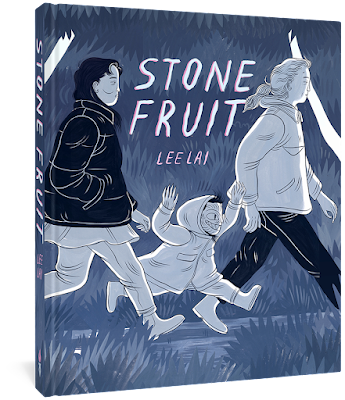
'Stone Fruit' by Lee Lai


From the BLURB:

An exhilarating and tender debut graphic novel that is an ode to the love and connection shared among three women and the child they all adore. 

Bron and Ray are a queer couple who enjoy their role as the fun weirdo aunties to Ray's niece, six-year-old Nessie. Their playdates are little oases of wildness, joy, and ease in all three of their lives, which ping-pong between familial tensions and deep-seated personal stumbling blocks. As their emotional intimacy erodes, Ray and Bron isolate from each other and attempt to repair their broken family ties — Ray with her overworked, resentful single-mother sister and Bron with her religious teenage sister who doesn't fully grasp the complexities of gender identity. Taking a leap of faith, each opens up and learns they have more in common with their siblings than they ever knew. 

At turns joyful and heartbreaking, Stone Fruit reveals through intimately naturalistic dialog and blue-hued watercolor how painful it can be to truly become vulnerable to your loved ones — and how fulfilling it is to be finally understood for who you are. Lee Lai is one of the most exciting new voices to break into the comics medium and she has created one of the truly sophisticated graphic novel debuts in recent memory.

‘Stone Fruit’ is a 2021 Fantagraphics graphic novel by Australia creator Lee Lai, who is based in Quebec. 

I think I’ve had a reading-hangover since finishing ‘Stone Fruit’ a few days ago. A novel of such singular brilliance and tender truth that managed to not overwhelm me as I crawl towards the end of 2021, but still pierced something in my conscience and clung so that I’ve been thinking about it ever since … 

The book is about Ray and Bron – a queer couple who a couple days a week mind Ray’s little niece, Nessie for her sister Amanda who is still juggling the messiness of life since her partner walked out on her and her daughter. Bron is struggling with their long-term mental health and the pressures of trying to exist in their own head while still trying to navigate life with Ray. When it all becomes too much, they move home to their conservative Christian parents and both Ray, Bron, Nessie and Amanda have to learn to cope in the aftermath of the complicated relationship fallout.  

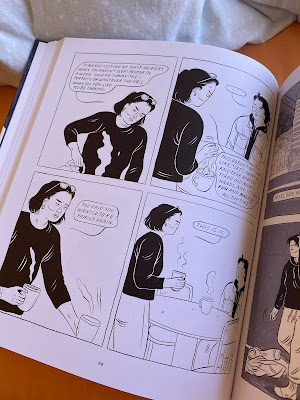
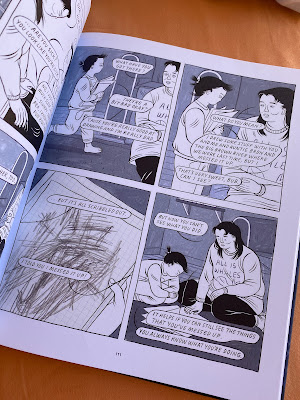
This book is stunning. On every level, it’s a knockout. Bron, Ray and Nessie when they hang out together – in treasured moments of elaborate imaginary play – Lai depicts them as serpentine, monster-esque creatures with a face full of fangs, large eyes and shifting skin and talons … the mask drops however, when Nessie’s mother and Ray’s sister Amanda enters the scene and they’re snapped back to reality and have to put their public personas back on. But these mythological-looking creatures that they are together feel like their true souls on the page, and the book is largely about them trying to get back to that state of play and openness that comes crashing down when Bron’s depressive state overwhelms their relationship with Ray and they return home for some time and space.

As both Bron and Ray navigate the slow breaking down of their relationship, they each find solace in extending olive-branches with their respective sisters – Bron’s whom they abandoned when they unceremoniously left home and cut ties with their family, and Ray’s Amanda who is still dealing with the aftermath of her partner abandoning her, and feelings of inadequacy as a mother to Nessie who witnessed Amanda’s own fragile mental state. 

Something I love in Lee Lai’s writing is the slow parcelling out of information … there’s no info-dumping here, and details of these character’s lives are revealed very naturally amongst characters, deep into the novel and when trust is starting to be established again, honest conversations had. Readers are never left in the dark, but rather we take on a child-like bystander quality similar to Nessie, where we can feel and sense that something is wrong or left unsaid – but it takes a while for these truths to come; but when they do, they’re all the more precious and important for being hard-won and entrusted to us. It’s a very beautiful and tender mode of storytelling here, still waters running deep … and when the current comes, it did take my breath away. Little revelations feel like tremors on the page for their build-up. 

I really loved this. I read a Publishers Weekly article where Lee Lai spoke about being a trans Asian-Australian cartoonist, and the Australian “creative comics scene is strong but the industry is still emerging,” and that’s very true. I loved the small hints of Australia in here (mentions of ‘Play School’ and Henny Penny) but I can see that something very special was able to be created via the wonderful Fantagraphics publisher, and I’m just so grateful for it.

‘Stone Fruit’ is undoubtedly in my Top 5 Favourite Reads of 2021. It’s one of those beautiful books that I didn’t realise I needed until I was deep into it, and then I was just so grateful for everyone who’d raved about it all year and paved the way for me to scoop it up. I will hold it very dear indeed. 

5/5 


Wednesday, November 3, 2021

'Lore Olympus: Volume One' by Rachel Smythe


From the BLURB:

Scandalous gossip, wild parties, and forbidden love - witness what the gods do after dark in this stylish and contemporary reimagining of one of mythology's best-known stories.

Persephone, young goddess of spring, is new to Olympus. Her mother, Demeter, has raised her in the mortal realm, but after Persephone promises to train as a sacred virgin, she's allowed to live in the fast-moving, glamorous world of the gods. 

When her roommate, Artemis, takes her to a party, her entire life changes: she ends up meeting Hades and feels an immediate spark with the charming yet misunderstood ruler of the Underworld. 

Now Persephone must navigate the confusing politics and relationships that rule Olympus, while also figuring out her own place - and her own power. 

***

‘Lore Olympus: Volume One’ collects episodes 1-25 of the #1 WEBTOON comic Lore Olympus, by Rachel Symthe.

So apparently Smythe started creating this web comic in 2018, and it is currently the most popular comic on Webtoon; as of January 2020 it had 299 million views. Confession though; I’d never heard of it. I just stumbled across the cover for Volume One on Goodreads and thought it sounded cool (I’m a sucker for Greek Mythology updates). 

If you’re unfamiliar with the Hades and Persephone myth, a really good refresher is provided by YouTuber Lindsay Ellis – it’s one of the first ‘Beauty & The Beast’-esque stories and depending on who is telling and when, it’s either romanticised or given the villain edit. In Smythe’s ‘Lore Olympus’ it’s most definitely on the romantic side, though that does not mean it’s all squeaky clean retellings here … in fact, at the very beginning of Volume One there’s a content-note trigger-warning for sexual coercion and manipulation (though probably not from who you think). 

Smythe’s Greek Mythology retelling has the feel and hedonism of a J. C. Leyendecker illustration, but with an almost ‘Fantasia’-like illustrative style … all solid hues, women with Betty Boop-curves and men sporting illustrated six-packs. It’s lush and also a little unformed … but that’s kind of true of the story too. It’s a ‘Gossip Girl’ meets ‘Suits’ and ‘American Psycho’ version of Olympus, the Greek Gods wearing nicely cut suits as they attend nymphe strip-clubs, Zeus and Hera conduct public spats and Goddesses walk around in tight mini-skirts and platform-heels with Ariana Grande high-ponytails. 

Is it revolutionary and cutting-edge with a new twist and spin on the ‘Hades and Persephone’? … I mean, no. Not really. It’s just very lush and a bit of a lightly hedonistic romp through the Greek Myths, nice enough but if I want to know more I think I’ll read the rest online. 

2.5/5


Wednesday, June 30, 2021

'In: The Graphic Novel' by Will McPhail


From the BLURB:

Nick, a young illustrator, can't connect with people. Whether it's the barista down the street, his own family or Wren, an oncologist whose life becomes painfully tangled with his, Nick can't shake the feeling that there is some hidden realm of human interaction beyond his reach. He staggers through meaningless conversations and haunts lookalike, vacuous coffee shops in the hope that he will find it there. But it isn't until Nick learns to stop performing and speak about the things that really matter that the complex and colourful worlds of the people he meets are finally revealed to him. 

Illustrated in both colour and black-and-white in McPhail's instantly recognisable style, In is poignant, fresh and hilarious. McPhail transforms the graphic novel with a heart-wrenching compassion uncannily appropriate for our isolated times.

‘In.’ is the debut graphic novel by award-winning ‘New Yorker’ cartoonist Will McPhail.

I have loved Will McPhail for the longest time, and have been following him on Instagram for years. He’s one of the smartest cartoonists around, who can flip you on a dime – from painfully accurate social commentary, to thoughtful introspection on humanity. One of my all-time favourite pieces of his is ‘Lady No-Kids’ which I yearn to own as a print, and hopefully will one day if/when he restocks! His ‘Bedtime’ cartoon is another fave; but just generally I’m always eyeing his online store and hope to own a print one day! 

I was thrilled when I heard that he had a debut graphic novel coming – even more that it would be an original work, not a collection of his cartoons. So excited was I, that I didn’t even wait for the August ANZ-release, but nabbed myself a UK copy from Foyle’s because it’s also signed with one of his signature drawings! I die! 

‘In.’ is somehow exactly what I expected from McPhail, and at the same time so reverently surprising and arresting. It tells the story of Nick Moss, an artist much like Nick himself – he’s playing at being a sad man in a sad bar, where he meets young woman Wren who catches him entirely off-guard. What follows is Nick going about his life – helping his Mum fix a fixer-upper apartment, avoiding his neighbour whose sex-life he knows far too much about, juggling seeing his nephew and having deep-and-meaningful’s with his sister, spontaneous sexual encounters with Wren … until one day when he stops pretending and avoiding and just – confronts. He tells a little truth to the plumber who comes to fix his toilet, and gets a little truth right back. He’s honest with his young nephew, and is gifted openness in return. And with each exchange comes a surrealist exploration of a foreign land – intercut with the black-and-white line-drawings of Nick’s real life, are these full water-colour depictions of familiar-but-not, grand landscapes and dreamscapes. 

At the heart of this story – more than just a magical realist New Yorker cartoon come to life – is a very human story of connection, and time running out. A call to throw off the social mores and just … be.

This story was … phenomenal! I cannot believe how much I laughed, and then at the end how much I cried and was so deeply moved – not least because the story took an acutely personal turn for me, and it just hit beautifully hard. 

McPhail excels at highlighting the atrocious awkwardness of life – it’s in the wide-eyed, slack-jawed horrified facial expressions of his characters. The ‘Bob’s Burgers’-esque storefront vignettes told entirely in signage. Awkward naked bodies, arms flung high in a bad dance move, and self-conscious inner-monologues alongside snappy speech-bubbles. It’s all here in ‘In.’ – magnified and personified by Nick and this snapshot of his life when he feels like he’s circling something bigger than himself … like his memories of being “a slippery little penny of a boy,” at a childhood waterpark, with a slide like a coin vortex funnel. 

This novel was wonderful and painful. I laughed so much, and it got such tears from me too. It is one of the best reading experiences I’ve ever had, and as well as reminding me just how brilliant Will McPhail is (truly; even his ‘unboxing’ video was comedic gold) it showed me what graphic novels can be, and do. This is working on so many levels of sophistication and with such a feathery light touch, it will absolutely get under the skin and imprint on you. 

5/5


Thursday, June 24, 2021

'Two-Week Wait: an IVF story' by Luke Jackson, Kelly Jackson (illus. Mara Wild)


From the BLURB:

An original graphic novel based on the IVF stories of its husband-and-wife authors and the 1-in-50 couples around the world like them. 

Conrad and Joanne met in their final year of university and have been virtually inseparable since then. For a while, it felt like they had all the time in the world. Yet now, when they are finally ready to have kids, they find that getting pregnant isn’t always so easy. 

Ahead of them lies a difficult, expensive, and emotional journey into the world of assisted fertility, where each ‘successful’ implantation is followed by a two-week wait to see if the pregnancy takes. Join Joanne and Conrad, their friends, their family, their coworkers, and a stream of expert medical practitioners as they experience the highs and the lows, the tears and the laughter in this sensitive but unflinching portrayal of the hope and heartbreak offered to so many by modern medicine.

‘Two-Week Wait: an IVF story’ by Luke and Kelly Jackson, illustrated by Mara Wild is a graphic novel from Scribe.

So, this is a graphic novel in a genre that’s loosely termed “graphic medicine” about illness, chronic pain, medical study and the healthcare system generally – all in the graphic novel format. It follows the likes of ‘Kid Gloves’ by Lucy Knisley, ‘The Facts of Life’ by Paula Knight, ‘Can't We Talk about Something More Pleasant?’ by Roz Chast and ‘Marbles: Mania, Depression, Michelangelo, and Me’ by Ellen Forney. 

In ‘Two-Week Wait’ we get the story of Conrad and Joanne, loosely based on the real-life experience of authors Luke and Kelly Jackson. Conrad and Joanne at 34 decide they’re ready and prepared to become parents … but then 35 is creeping up and they’re still not pregnant. Thus begins their journey into infertility; chronicling their medical diagnoses and then the various specialty doctor’s plans to use in vitro fertilization (IVF) to combat Joanne’s previously undiagnosed endometriosis, and Conrad’s slightly-low sperm-count. 

This is an intimate quasi-memoir that tracks the emotional and medical journey through IVF, with illustrations by the Hamburg-based artist, Mara Wild. And I really did enjoy this, even as I was one-removed from the story; as a young woman who has always known she doesn’t want children, I do have friends who’ve struggled with infertility and gone through the IVF process and I suspect having that connection and grounding to the very real emotional arc will hit differently, depending on the experiences you bring to the reading.


That being said; I did read this and think it was fairly … prosaic? Maybe it’s that the Australian publishing landscape has been so painstakingly slow in taking up the graphic novel format for all readerships, but especially adult graphic novels. So it’s not surprising that something like ‘Two Week Wait’ is what gets up with one of our most prestigious small publishers – a fairly unassuming tale with broad general appeal to wary adult audiences unsure of the format, but responsive to the story generally. 

But for me I did find it a little one-note? Even as I thought it was very emotional, and beautifully told via Mara Wild’s cool-toned tenderness with pops or warmth, like the light of hope getting in. 


I couldn’t help but crave a story that goes deeper and more layered. I found myself latching and wondering more about the passing stories and experiences of Joanne and Conrad, and wanting a fuller investigation there. Like Joanne’s previously undiagnosed endometriosis, and maybe a tale about that medical journey – possibly with an ending that accepts infertility and childlessness, or adoption? And maybe the breakdown of, or overcoming in a relationship that comes with these new realities? Conrad begins getting weighed down by the medical costs of IVF, and a big part of me wondered what the journey is for those couples who simply can’t afford $10K per-round of IVF? What are the socio-economic barriers to fertility and family? 

All in all; I think this is probably a great graphic novel to introduce novice adult readers of the format to, and especially if the journey of infertility will be a personal and impactive tale for them. It delightfully reminded me of the British sitcom ‘Trying’, and I am always going to be glad to see more Australian graphic novels, especially for adult readers. But I also found it a little lean and ploddingly typical. 

3.5/5


Wednesday, August 5, 2020

'Stepping Stones' by Lucy Knisley


'Stepping Stones' is graphic novelist Lucy Knisley's first middle-grade fiction book.

Knisley is best-known for her adult memoirs ('Relish', 'Kid Gloves', 'Displacement' and more) but recently she has illustrated picture-books like 'You Are New' and 'Go To Sleep: (I Miss You)'

'Stepping Stones' is her first venture into middle-grade realms however, and even though it's biographical (emphasised by the author's note at the back) the protagonist here is called 'Jen' and names have been changed throughout.

'Stepping Stones' tells the story of Jen who has moved to the country with her Mum and her Mum's new boyfriend, Walter following her parent's divorce. Every weekend, Walt's kids - young girls Andy and Reese - come along to Peapod Farm and what begins as a tense relationship on multiple fronts eases into a sweet acceptance of changed circumstance and family-unit.

Knisley's MG offering is very much in the vein of Raina Telgemeier's books - which are also largely biographical recounting aspects of Raina's life growing up in San Francisco (books like 'Smile', 'Sisters', 'Guts' etc.). Raina is really the queen of this niche in tween graphic-novels for a largely female readership; in fact her most recent book 'Guts' with Scholastic got a 1-million copy print-run because her past successes proved she could reach that sales-figure (and did!). It makes sense that a publisher would tap Knisley to produce in this space too; given that she's had huge success in an adult-biographical graphic realm (her last book 'Kid Gloves' was nominated for a Harvey Award, in the Eisners) and in her adult books she's doing similar work to Raina; mining past traumas and complications in her life, to break open various spaces and conversations for her audience (Knisley has written about everything from; miscarriages, to birth complications, break-ups, loss of grandparents, bisexuality, etc.)

But there's something missing in translation as Knisley switches from an adult to middle-grade audience in 'Stepping Stones'. I think what I absolutely love in her adult works is the way she goes off on context-tangents (in 'Kid Gloves' she included pages explaining a history of misogynistic and racist medical practices that see black women dying from labor-complications due to a mismanaged and white patriarchal healthcare structure in America). In her adult works she also seamlessly flashes forward and backward to moments in her life as recounting them brings a fuller understanding of past incidences and future upheavals. That's all missing from 'Stepping Stones' ... we occasionally see Jen (who is also a budding comics artist) drawing out past memories of her parent's fraught marriage and breakdown, but they're stick-figures and light on introspection.

Maybe most frustrating is the character of Walter - her Mum's boyfriend - who really is a bully, and whose own children touch on past incidences between their father and mother, how his aggressive emotional behaviour likely led to divorce. Everything to do with Walt is really left open-ended and not confronted, and it robs the reader of a feeling of conclusion, in a way?

HOWEVER - I did wonder if 'Stepping Stones' was intended as the first in a series based at Peapod Farm, or following the post-divorce adventures of Jen and her family? There are little hints that maybe 'Stepping Stones' is setting up more exploration in this world, and it did strike me that this could be a similar series to Rita Williams-Garcia's 'Gaither Sisters' in switching locations each book, depending on which parent or family-member the girls are with (certainly I could see a Book #2 following Jen home to the city and staying with her Dad?)

As it is; something of 'Stepping Stones' feels a little ... flat? Too short, not quite rich enough with intertextual play like I've come to expect from Knisley and not enough depth to the situations and characters being set-up. I'll hold out hope it's simply a matter of more coming soon!

3/5

Thursday, May 7, 2020

'Something New' and 'Kid Gloves' by Lucy Knisley


SOMETHING NEW blurb:

Lucy was another single girl in New York City, traversing the dating world and her own heartbreak, when her ex-boyrfriend John swings into town for a visit, with a special box hidden in his toiletry kit. This is a story about suddenly finding yourself completely ecstatic while also being completely at sea. Traversing the foreign world of wedding planning, Lucy and John will face family drama, gender stereotypes, and giant fluffy dresses on the way down the aisle. (First Second Books, 2016)


KID GLOVES blurb:

If you work hard enough, if you want it enough, if you’re smart and talented and “good enough,” you can do anything.

Except get pregnant.

Her whole life, Lucy Knisley wanted to be a mother. But when it was finally the perfect time, conceiving turned out to be harder than anything she’d ever attempted. Fertility problems were followed by miscarriages, and her eventual successful pregnancy plagued by health issues, up to a dramatic, near-death experience during labor and delivery.

This moving, hilarious, and surprisingly informative memoir not only follows Lucy’s personal transition into motherhood but also illustrates the history and science of reproductive health from all angles, including curious facts and inspiring (and notorious) figures in medicine and midwifery. Whether you’ve got kids, want them, or want nothing to do with them, there’s something in this graphic memoir to open your mind and heart.

‘Something New’ is the 2016 graphic novel memoir by Lucy Knisley, and ‘Kid Gloves’ is her 2019 one.

I’ve loved Lucy Knisley’s graphic-novels and social-media ever since she came out to Melbourne for our Writer’s Festival in 2013, and I purchased a copy of ‘Relish’. After that, I followed Lucy across all channels and heartily enjoyed the glimpses into her growing life that she afforded fans and followers.

‘Something New’ is the story of how Knisley and her husband John, got married – but like all of her autobiographical work, it delves deeper than just the surface-level recounting of events and milestones. Knisley really mines her emotional and personal journey, and in ‘Something New’ she starts like a new friend would, by filling readers in on all the background stuff they should know before launching into the through-line – like the fact that she and John were broken up kind of unofficially, when he proposed.


The graphic-novel maps her and John’s up and down relationship, and the point at which they decided to tie the knot. From there the focus is on how they went about managing their ‘wedding fever’ and planning what can be one of the biggest expenses in young people’s lives … but Knisley being an artist and a proudly bisexual woman, also delves into her discomfort with many of the heteronormative (or outright bonkers) traditions of wedding and marriage, the uncomfortable franchise of nuptials; so the book becomes a longer-view of how she and John go about building a future life together through the microcosm of this one event and how they make it more personal and significant *to them*.


‘Kid Gloves’ is the book I was really looking forward to, if only because in 2016 on her social-media channels (and since then) Knisley has spoken candidly of how close she came to dying while giving birth to her and John’s first child, Pal (not his real name, but a nickname for ‘Palindrome’ for his unique birth date). Knisley suffered preeclampsia and lost a lot of blood, they put her in an induced coma and while Pal was perfectly healthy, the birth left Knisley with a few ongoing health-problems. So I always knew ‘Kid Gloves’ would be a tough but vital read within the ‘series’ of Knisely’s memoir graphics. And it is, whoo boy.


I cried a lot reading ‘Kid Gloves’ – for both Knisley’s personal story, but also for how she links her journey of motherhood (through two miscarriages, depression, and then a near-death birthing experience) to wider societal and medical realities for women. She delves into the fact that women’s bodies and childbirth in particular were for so long misunderstood, shamed, and abused by the health profession, and largely because it was entirely made up of men and with religious bents. And it’s not much better in America now – without universal healthcare, and a system that largely undermines and lets black women die at a much higher rate and for entirely preventable reasons (as a snapshot; ‘The U.S. maternal mortality rate has more than doubled from 10.3 per 100,000 live births in 1991 to 23.8 in 2014.’ Compared to; ‘The maternal mortality rate in Australia in 2017 was 6 deaths per 100,000 women giving birth.’ That’s *insane* that that’s the American maternal mortality rate, and it’s climbing every year.)


Knisley manages to link a lot of past and current medical failures when it comes to women’s bodies, to a much deeper denial of women’s experiences and proper education of their bodies starting from a young age. It’s really profound, and very moving.

And then of course it was Knisley’s personal journey; her openness about her miscarriages and the depression they threw her into, the battle she was undergoing with her body – both in wanting to get pregnant, when she did finally and was violently ill, and then the ultimate betrayal of it nearly killing her (and within all that; the guilty, self-hate and trauma that’s increased by societal guilt and pressure … oh, the way she interweaves all of this is catharsis on so many levels.)


I am not married, nor do I have kids. I, in fact, have always known that I never want to be married and never want to have kids – Knisley acknowledges and cheers this choice amongst women too, there’s absolutely no shame. But I still loved and connected to these books, as I do all of Knisley’s stories. Yeah, it’s that I just like *her* and think she’s ace, but it’s more than that – she’s a gifted storyteller, somebody who can weave the personal amongst the political and societal and that’s very hard to do in such a warm and compelling way. But Lucy Knisley does it, every damn time.

5/5


Tuesday, October 8, 2019

'Pumpkinheads' by Rainbow Rowell


From the BLURB: 

A smart and swoony Rainbow Rowell romance in full colour graphic novel form. 

Deja and Josiah are seasonal best friends. 

Every autumn, all through high school, they’ve worked together at the best pumpkin patch in the whole wide world (not many people know that the best pumpkin patch in the whole wide world is in Omaha, Nebraska, but it definitely is). They say goodbye every Halloween, and they’re reunited every September 1. 

But this Halloween is different - Josiah and Deja are finally seniors, and this is their last season at the pumpkin patch. Their last shift together. Their last goodbye. 

Josiah’s ready to spend the whole night feeling melancholy about it. Deja isn’t ready to let him. She’s got a plan: What if instead of moping they went out with a bang? They could see all the sights! Taste all the snacks! And Josiah could finally talk to that cute girl he’s been mooning over for three years . . . 

What if their last shift was an adventure? 

Beloved writer Rainbow Rowell and Eisner Award–winning artist Faith Erin Hicks have teamed up to create Pumpkinheads, a tender and hilarious story about two irresistible teens discovering what it means to leave behind a place - and a person - with no regrets.

‘Pumpkin Heads’ Graphic Novel by Rainbow Rowell, illustrated by Faith Erin Hicks 

I absolutely tore through this last night and thoroughly delighted in it. Basically the same premise as Rowell’s short-story ‘Midnights’ (from the Stephanie Perkins Anthology ‘My True Love Gave To Me’ and later included in a cute little novella) about the once-a-year meeting of two people who get along fabulously.

This time it’s the fall seasonal workers Deja and Josiah who’ve been working the Succotash Hut together at their local Pumpkin Patch for four years. They’re seasonal friends who don’t meet up outside of Halloween busy work, but when they are together in October it’s clearly a laugh-riot. But this is their final season together, with school ending and both of them moving on from the Patch - so Deja decides she’ll need to help shy Josiah *finally* talk to Fudge Shoppe girl who he’s been crushing on these many years.

Their final working night together becomes an adventure through the Pumpkin Patch and it’s completely hilarious and adorable; Rowell’s sweet Young Adult tale perfectly matched to Hicks’ bold graphic style, with plenty of delightful details throughout. I’ll admit - being Aussie - the enormity of the Pumpkin Patch lifestyle was a *little* lost on me ... but it’s charming more than confusing.

I think the true success of this graphic novel is that it's a contained timeline - spanning the dying hours of Dega and Josiah's last shift at the Patch - it's a completely self-contained story. Rowell's brilliant writing gets across what Deja and Josiah mean to one another, as they reminisce about their time at the Patch and have such an easy camaraderie and repartee, readers really feel the intimacy of their friendship and shared-history, and can also wallow in the feeling of something so special coming to an end ... it's a tricky balance that Rowell absolutely perfects; she does nostalgia very well, and has such an astute understanding of the connections young people forge and the power of place in their lives. 

Faith Erin Hicks was also the perfect illustrator for this long-awaited project. I'm familiar with her work because I loved 'Friends with Boys' and 'Pumpkinheads' reminded me to check out more of her work. Rowell brilliantly uses Deja and Josiah's dialogue to communicate nostalgia and connection; Faith Erin Hick's bold illustrations have so many tiny and delightful details throughout; it gives another layer of thoughtfulness and specialness to the Pumpkin Patch setting especially, that makes it feel so much more real and unique to characters and readers alike. 

And I’m just hoping Deja and Josiah end up getting more seasonal work together - maybe at a Santa’s Grotto? This was *gorgeous* and I highly recommend. 

5/5


| More