Search This Blog

Showing posts with label Suzanne Collins. Show all posts

Sunday, March 23, 2025

'Sunrise on the Reaping' (The Hunger Games, #0.5) by Suzanne Collins


This book is like a Rorschach test for fans ...


— Either Suzanne Collins wrote a second prequel book in 'The Hunger Games' universe as an easy franchise cash-grab (and yes, a movie adaptation of 'Sunrise on the Reaping' is in the works) OR, Suzanne Collins has been paying attention ever since Donald Trump lost the 2020 election and chucked a January 6 insurrectionist hissy-fit, and has been mapping the writing-on-the-wall as America teeters towards fascism, with another prescient instalment of her YA Dystopian series that was originally inspired by the invasion of Iraq and America's insatiable love for reality television.

— Either books are inherently political and 'The Hunger Games' is a really clever argument in support of "just war" theory (an ethical framework to determine when it is permissible to go to war) and one of the most political-est books young people can read, OR books are pure entertainment and 'The Hunger Games' is just good schlocky fun, and anyway it's a rip-off of the 2000 Japanese movie 'Battle Royale' based on the 1999 novel of the same name by Koushun Takami that pipped 'The Hunger Games' (2008 publication) by 9-years.

— Either this prequel is illustrating a fine point that revolutions are not born, they're made. Or to quote the musical Hamilton; “Legacy. What is a legacy? It's planting seeds in a garden you never get to see," and though we saw the spark of the mockingjay by following Katniss' story and being given passing understanding of District 13 and how many people were involved in the rebellion and how long they'd been scheming ... 'Sunrise on the Reaping' is really delving into showing readers just how the foundations were laid, how rebels are pushed and moulded by violence. OR this was all just nostalgia-bait and fan-service, a literary 'Weekend at Bernie's' making ghoulish marionettes out of dearly beloved and deceased secondary characters from the series.

— Either Suzanne Collins repeatedly shows her hand and political views and it's not by coincidence how foresighted this book feels, or the entire series for that matter ... case-in-point; this book coming out as Israel has again resumed killing Palestinians in collective-punishment and to enact their larger ethnic-cleansing project (FYI: Israel’s war on Gaza is deliberately targeting children – new UN report ... oh, and total coinky-dink; Netanyahu’s testimony in corruption trial postponed due to Gaza war) OR ... no, that's not the case? Israel is not The Capitol. Netanyahu is no autocrat like Snow (Netanyahu is waging war on Gaza and on us – his ‘enemies within’. It’s the path to autocracy), "if we burn, you burn with us" can in no way be applied to politics of the Middle East and American geopolitics ... just, no?

Well, look, books are political - they have been since Gutenberg invented the printing press in 1440 and made knowledge dissemination, y'know, a thing ... the fact that I'm a woman who was taught to read is in and of itself - a miracle of the modern-age, and if books weren't political then the Church would have kept them hoarded (and by golly they tried!) and for monks-eyes-only. This book is political, but to what extent is up to the individual.

I, personally, can't shake the fact that Suzanne Collins' near-mythological genesis story of this tale ties into American and allied aggression in Iraq, and the "just war" theory echoes everywhere in this day and age ... does Yemen have a right to defend itself? Do Palestinians? "We seek nothing but the elementary right implanted in every man: the right if you are attacked, to defend yourself," written on a mural in East Belfast, harkens back to The Troubles and now. And in Australia the Irish hip hop trio from West Belfast, Kneecap, just toured and teamed up with Indigenous artist Aretha Brown to "Defy the Occupation."

I also can't help but note the gift of silence that Suzanne Collins gives readers (then, and now) with each release. She doesn't do events, not even for releases - and not even for this one. She's no J.K. Rowling clawing for relevancy and trashing her reputation with fascistic and bigoted public rhetoric. There's no awkward Kafkaesque discovery of her religious underpinnings to the tale à la Stephenie Meyer's mormonism in 'Twilight'. The most Collins has said of a political nature is a repeat of her famous "flipping between the channels of war and reality-TV," and a fairly deep-dive interview with her long-time editor David Levithan in that 2018 New York Times article. We don't know if she's anti-Zionist or not. We don't know if she voted for Trump, or Harris - or at all. She let's the work speak for itself, knowing full well it is the aforementioned Rorschach test for readers. And I think that's challenging, and a little bit wonderful in this day and age.

For me, I loved this book. I think Collins threaded a very fine needle, keeping Haymitch Abernathy's end in sight as she wrote his genesis and that of the rebellion. I gasped, I bawled my eyes out, I got suckered into liking characters I knew were doomed to death ... I felt losses I'd already experienced, anew. This is a master-storyteller, not necessarily through astonishingly clever and good writing but pretty darn good pacing, plotting and characterisation. Yes; some of that plot became a little mechanically mediocre and convenient towards the end (last 50 or so pages, went a little wonky - understandable as she approaches an inevitability all readers were braced for) ...

I do think that if anything the truth of this book’s genesis maybe lies in a little of both worlds of commercialisation and politics. I see a lot of ‘Star Wars: Rogue One’ to this story, the 2016 blockbuster prequel to the original ‘Star Wars’ universe that explains how the rebels got their hands on the plans of the Death Star in order to target its in-built vulnerabilities.
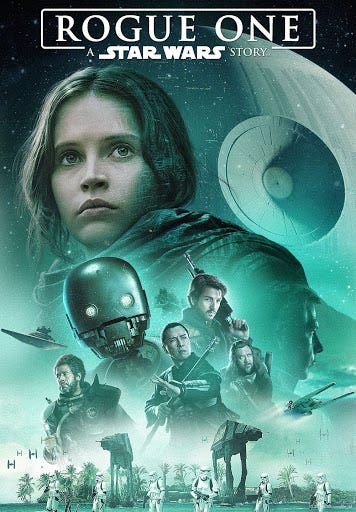
Rogue One: A Star Wars Story | List of Deaths Wiki | Fandom

Interestingly a big focus in that story, is on a young woman who is a reluctant fence-sitter at first but eventually comes around to the idea of rebellion. In fact, one of the most famous lines from the film is; "Rebellions are built on hope." 

Interestingly and just as with ‘Sunrise on the Reaping’, ‘Rogue One’ isn’t a kittens-and-rainbows happy-ending. It can’t be, because of what we know about what is to come in this universe and the story we’ve already been told. Schrödinger's cat is dead, so to speak, and we know that.

Much like Collins, it’s also a film that plays and pays fan-service, delightedly so.

It’s not surprising that ‘Rogue One’ is my favourite of the new Star Wars stories, and that I loved ‘Sunrise on the Reaping.’ Maybe for the same reasons, I loved them both; when you’re writing stories supporting just war theory and how messy revolutions can be, it’s not a bad thing to put a little sting in the tail and make them hurt, a little.

But I loved this. It resonated and moved me, and that's the Rorschach test that matters.

4/5

Wednesday, May 25, 2011

Waiting on Wednesday: 'The Hunger Games' movie


"Waiting on Wednesday" is a weekly event, hosted by Jill @Breaking the Spine, that spotlights upcoming release that we're eagerly anticipating.


So this is not a traditional waiting on Wednesday – because I'm not waiting (salivating, chomping at the bit, gagging, begging. . .) for a book. It’s actually a movie that’s based on a book. . . same, same – but different!

Suzanne Collin’s ‘The Hunger Games’ movie adaptation to be released in 2012.

I have to admit, I was one of those nay-sayers who balked at the idea of Jennifer Lawrence in the role of Katniss Everdeen. Trust me; I am happy to repent in the wake of press photos. . . Jennifer Lawrence looks like she’s totally going to kick Capitol ass!


I am sorry that I originally wanted Kaya Scodelario in the role (though I do still think she would have made an incredible ‘girl on fire’!). But I have since watched ‘Winter’s Bone’ and been figuratively ‘shut up’ by Lawrence’s bow and arrow + hair-dye.

Though, in my defense, when Jennifer Lawrence was announced as Katniss Everdeen the only reference I had for her was looking like a Baywatch-wannabe at the Oscars:


I'm still a little iffy on Woody Harrelson as Haymitch Abernathy (yes, I was rooting for Robert Downey Jnr, just like everybody else!). And I'm not getting the same lusty heart-palpitations for Josh Hutcherson (Peeta) as I do for Liam Hemsworth (Gale) – but my initial doubts about Jennifer Lawrence have taught me not to count my eggs before they hatch, and not to judge a cast before you see their promo shots. Lesson learned!

And may the odds be ever in your favor!


P.S. – is it 2012 yet? Because I'm also hanging out for the ‘Arrested Development’ movie. Seriously, I'm so excited I could weep!

Thursday, November 25, 2010

'Mockingjay' Hunger Games #3 by Suzanne COLLINS

From the BLURB:

Young Katniss Everdeen has survived the dreaded Hunger Games not once, but twice, but even now she can find no relief. In fact, the dangers seem to be escalating: President Snow has declared an all-out war on Kattnis, her family, her friends, and all the oppressed people of District 12. The thrill-packed final installment of Suzanne Collins' Hunger Games trilogy will keep young hearts pounding.

** SPOILERS if you haven't read book #1 and #2 **

The Districts are rebelling. Thanks to Katniss Everdeen and a handful of berries, she has become a symbol of revolution – the mockingjay. Together with exiles from District 13 and the uprising residents of the other Districts, Katniss and the rebels are going to take down the Capitol. No more ‘peacekeepers’. No more deprivation and starvation. No more child sacrifices. No more ‘Hunger Games’.

Game over.

I went into the third and final book in ‘The Hunger Games’ trilogy knowing it would be a tear-jerker. Suzanne Collins’ series is an awful glimpse into a distorted and dystopian world ruled by an entertainment-hungry dictatorship and fuelled by fear. There was no fathomable way that Ms Collins could write an all-round ‘happy ending’ for Katniss and crew. Still, even preparing myself for what I knew would be a hard-to-swallow final book, I was alarmed by the despair in ‘Mockingjay’. I cried constantly throughout the last 100 pages. . . but I still, surprisingly, loved the send-off.

Suzanne Collins has written a very complicated final instalment. She is very cleverly giving her younger readers a history lesson with ‘Mockingjay’ by focussing so much of the book on the Hunger Games and Capitol politics. Katniss Everdeen becomes the symbol for the rebellion – her ‘mockingjay’ character is the personification of fight and freedom for the districts. Collins has written Katniss and her created mockingjay persona as a sort of Che Guevara or Rosa Parks – and Collins’s history lesson is in showing her young audience just how orchestrated and make-believe a revolution can be. Uprisings don’t happen overnight – they need people and symbols to stir the embers of discontent.
I turn my gaze skyward and watch the flight of a hawk across the sky. “President Snow once admitted to me that the Capitol was fragile. At the time, I didn’t know what he meant. It was hard to see clearly because I was so afraid. Now I’m not. The Capitol’s fragile because it depends on the districts for everything. Food, energy, even the Peacekeepers that police us. If we declare our freedom, the Capitol collapses. President Snow, thanks to you, I’m officially declaring mine today.”
A lot of ‘Mockingjay’ is cleverly devoted to politicking and the behind-the-scenes of a revolution. And it makes for fascinating reading. Throughout the book I kept hearing that ‘V for Vendetta’ quote: “A building is a symbol, as is the act of destroying it. Symbols are given power by people. A symbol, in and of itself is powerless, but with enough people behind it, blowing up a building can change the world.” Collins beautifully articulates the strength behind symbolism and the mobility of revolution and Katniss Everdeen is a wonderful conduit for such explorations;
“President Snow says he’s sending us a message? Well, I have one for him. You can torture us and bomb us and burn our districts to the ground, but do you see that?” One of the cameras follows as I point to the planes burning on the roof of the warehouse across from us. The Capitol seal on a wing glows clearly through the flames. “Fire is catching!” I am shouting now, determined that he will not miss a word. “And if we burn, you burn with us!”
Obviously the take-down of the Capitol is at the crux of ‘Mockingjay’ (and the entire ‘Hunger Games’ series). But an equally large portion of the book is devoted to Katniss’s impossible love triangle and the choice she must make between long-time friend Gale, and her arena partner, Peeta. I don’t want to give anything away. . . but a lot of my crying throughout the book had to do with Peeta and Katniss. Just. . . wow. They were heart-wrenching. Utterly and completely heart-wrenching.

Like I said, I went into ‘Mockingjay’ knowing that the trilogy couldn’t, faithfully, finish on a happy ending. There was just no way because a happy ending is not conducive to a dystopian trilogy, unfortunately. Still, I was shocked (and surprisingly impressed) by how cut-throat Suzanne Collins was in this book. She unabashedly puts Katniss through the physical, emotional and mental wringer. Collins is blood-thirsty, killing off beloved characters and giving them gruesome send-offs reminiscent of the arena in book #1.

All of the deaths left me an emotional, vicarious wreck. At the time of reading I was almost angry with Ms Collins for writing such despair and it got to the point where I was hoping and praying for just one good thing to come out of ‘Mockingjay’. But upon reflection, I can appreciate and accept that all that death and gloom was necessary. You have to go there to come back, so to speak. And really, if Ms Collins had written anything softer she would have been selling-out and kowtowing to fans. Instead she remained true to the heart of her series – it started out bloody and ended bloody. Well, bloody brilliant, in my opinion.

Yes, ‘Mockingjay’ is sad, and violent and in no way a clean, conventional ‘happy ending’. But it’s all relative. . . because although ‘The Hunger Games’ is a dystopian look at killing sport, it’s equally true that at its heart the series is about fighting back. It’s about choosing to die on your feet rather than live on your knees. Yes, it’s violent and dystopian - but it’s ultimately about hope. Collins distils her series’ overarching themes in this final instalment, sending Katniss and crew out with an explosive ‘BANG’, which is equal parts sad and brilliant.

5/5


My ‘Hunger Games’ obsession knows no bounds. Now that I've tackled the books, I look forward to the film adaptations. For what it’s worth, I’m backing Kaya Scodelario for Katniss (because Skins is amazing and I could believer her ass-kicking!). Hurry up 2013!

Consequently I have now watched the film adaptation of a Japanese novel by Kōshun Takami. If you read the 1-star Amazon reviews of 'The Hunger Games', you'll notice that a majority of them accuse Ms Collins of ripping-off the plot of 'Battle Royale' (in which a Japanese school class are left deserted on an island and ordered to kill each other in 3 days as cameras tape the whole thing). I have now seen the movie (which is gory and brilliant!) and intend to read the book. Are there similarities to 'Hunger Games'? Yes. But then again, 'Hunger Games' has similarities to 'Lord of the Flies' too. Collins's book tears away from 'Battle Royale' when Katniss exits the arena and starts a revolution. Still, it's worthwhile seeing. And it looks as though a Westernized adaptation is on the way for 2011 (to beat the 2013 'Hunger Games' movie perhaps?)

Wednesday, November 24, 2010

'Catching Fire' Hunger Games #2 by Suzanne COLLINS

From the BLURB:

Katniss Everdeen and Peeta Mellark won the annual competition described in Hunger Games, but the aftermath leaves these victors with no sense of triumph. Instead, they have become the poster boys for a rebellion that they never planned to lead. That new, unwanted status puts them in the bull's-eye for merciless revenge by The Capitol. Catching Fire maintains the adrenaline rush of Suzanne Collins's series launch.

** SPOILERS for ‘The Hunger Games’ **

Katniss Everdeen and Peeta Mellark won the Hunger Games. . . at the expense of the Capitol. Katniss made the grave error of making the Gamemakers and the Capitol look bad – with a handful of berries she effectively ignited a district-uprising. And now the Capitol wants revenge.

Outright killing Katniss could potentially add fuel to the rebellion’s flames. So the Capitol go one step better. . . under the banner of the Hunger Games ‘Quarter Quell’ they announce that the 75th Hunger Games will include only previous reaping winners. That means Katniss and Peeta are back in the arena. . . and this time, they won’t win.

A good portion of ‘Catching Fire’ is devoted to creating big overarching bad guys for the whole series. In ‘The Hunger Games’ Katniss’s focus was on the immediate threat of her fellow tributes, as opposed to the larger threat of the Capitol. In that first book the real bad guys weren’t really seen, only heard. Because Katniss was in the reaping arena, the most interaction she and Peeta had with the Capitol villains was via the booming voice of Claudius Templesmith or Caesar Flickerman, the games interviewer.

In ‘Catching Fire’ Collins gives face and substance to the true villains of ‘Hunger Games’ – and the head-honcho baddie is President Snow, who ultimately orchestrates the reaping and ensures that the district never forget the meaning behind the massacres. President Snow is a wonderfully sinister bad-guy. His physical description is spot-on perfection – everything from the smell of roses and blood to his cosmetically-enhanced, puffy lips. He’s a bad-guy for the books, and utterly despicable.

I went into ‘Catching Fire’ unsure of what to expect. Collins left ‘The Hunger Games’ off on such an emotional cliff-hanger between Katniss and Peeta and their orchestrated, honest romance. . . but as for the plot substance of ‘Catching Fire’, I really didn’t know where Collins would go next. Well, my jaw well and truly dropped in this second book. From the ‘Quarter Quell’ to President Snow’s threats – I spent a good portion of ‘Catching Fire’ simply muttering “omigod, omigod, omigod, omigod!”

I loved reading about the fallout from Katniss and Peeta’s win – the small hints of their survivors-guilt and fractured lives in the aftermath of the reaping. I also loved reading about Katniss’s renewed vigour – like a phoenix rising from the flames (for a second time);
Life in District 12 isn’t really so different from life in the arena. At some point, you have to stop running and turn around and face whoever wants you dead. The hard thing is finding the courage to do it.
I also loved the romantic focus in ‘Catching Fire’. Katniss is caught between Peeta (the boy with the bread) and her best friend, Gale. Katniss and Gale have been hunting partners for years – and that’s all Katniss thought they were. But her pretend relationship with Peeta in the arena had Katniss questioning her feelings for both boys. . . and upon returning home, Katniss discovers that Gale was deeply wounded having to watch her and Peeta’s ‘romance’ play out on the small screen.

I love how deliciously complicated Collins’s romance is. It’s as edge-of-your-seat as what happens in the Games arena – and like the nuts-and-bolts plot I never knew what to expect with the love triangle. I don’t even know who I’m hoping Katniss ends up with. . . Gale or Peeta. Baker or Hunter? I just don’t know! But for what it’s worth, I loved how much more complicated Katniss and Peeta’s relationship got when they went into the arena for a second time;
“Peeta, how come I never know when you’re having a nightmare?” I say.
“I don’t know. I don’t think I cry out or thrash around or anything. I just come to, paralysed with terror,” he says.
“You should wake me,” I say, thinking about how I can interrupt his sleep two or three times on a bad night. About how long it can take to calm me down.
“It’s not necessary. My nightmares are usually about losing you,” he says. “I’m OK once I realize you’re here.”
‘The Hunger Games’ is an epic young adult trilogy. It’s such an amalgamation of brilliance – at once a complicated exploration of modern media, darn good thrill-ride complete with an intense love triangle. I am well and truly addicted.

I have to admit, any regret I was feeling over not starting this series back in 2008 was quickly quenched when I read the final page of ‘Catching Fire’. . . even knowing that ‘Mockingjay’ was waiting for me on my bookshelf, I could not crack that final book open quick enough to quell the suspense that Collins leaves us with at the end of ‘Catching Fire’.

5/5

Monday, November 22, 2010

'The Hunger Games' Hunger Games #1 by Suzanne COLLINS

From the BLURB:

Could you survive on your own, in the wild, with every one out to make sure you don't live to see the morning?

In the ruins of a place once known as North America lies the nation of Panem, a shining Capitol surrounded by twelve outlying districts. The Capitol is harsh and cruel and keeps the districts in line by forcing them all to send one boy and one girl between the ages of twelve and eighteen to participate in the annual Hunger Games, a fight to the death on live TV.

Sixteen-year-old Katniss Everdeen, who lives alone with her mother and younger sister, regards it as a death sentence when she steps forward to take her sister's place in the Games. But Katniss has been close to dead before—and survival, for her, is second nature. Without really meaning to, she becomes a contender. But if she is to win, she will have to start making choices that will weigh survival against humanity and life against love.

‘The Hunger Games’ is the first book in Suzanne Collins ridiculously popular (and heartbreakingly wonderful) ‘Hunger Games’ trilogy.

The first book came out in October 2008 and generated a *lot* of buzz. It helped that Stephenie Meyer and Stephen King provided puffs for the book’s cover, and generally ensured that two very different but far-reaching audiences would give the book a go. . . but more than that, film buzz started up pretty much from the get-go. I was aware of the hype, but I also knew that ‘The Hunger Games’ was the first book in a trilogy. . . so I decided to bide my time and wait for all the books to come out and read them back-to-back. The third and final book, ‘Mockingjay’ was released in August of this year. . . but I still waited three months before I started reading.

. . . And now I regret not starting this trilogy sooner (it’s ‘Downside’ all over again!)

There is a New World Order where the Capitol rules, absolutely. In a bid to quench uprisings and rebellion, the Capitol have made sport out of sacrifice. . . every year they hold The Hunger Games. Twenty-four people from each District (starting at age 12) are randomly selected to enter into a fight to the death – for the amusement and entertainment of Capitol residents. The Games are viewed around the world, cameras lapping up the blood and gore and audiences rooting and sponsoring their favourite sacrifices.

Two children from each district, one boy and one girl, enter into the ever-changing arena landscape to battle against one another and come out the sole, victorious, survivor. The reaping provides dual purpose – entertainment value and to remind the District’s that the Capitol can offer their children up to slaughter without batting an eyelid.

This year Katniss Everdeen is one of the Game’s offerings. Along with Peeta Mellark, these two represent District 12 – Panem’s lowliest, poorest district famous only for coal mining. Katniss enters into the game with the dwindling hope that she will survive and return home to her mother and little sister, Prim. But a risky strategy by Peeta might just turn the game around for them. . . if they spin a tale of being star-crossed lovers, thrown into the Hunger Games only to kill one another, can they win the heart of the crowd and accomplish the impossible? Can they actually win?

‘The Hunger Games’ is summer-blockbuster reading. It’s a cross between George Orwell’s 1984, Gladiator, Mad Max and John Marsden’s ‘Tomorrow’ series. . . in a word: ‘phenomenal’. I hate to use clichés, but ‘The Hunger Games’ is literally ‘unputdownable’. It’s the sort of book that you hole yourself up with in your room, and when someone comes in to tell you that dinner is ready or it’s time for you to go to work, you snarl and snap at them and tell them to get the hell out because you just got to a really good part and they’re killing your reading-mojo. . . it’s that kind of book!

There are so many layers to ‘The Hunger Games’. On the surface it’s a damn good yarn – full of tension, action, unrequited love and moral conundrums. . . but if you dig deeper you start to really appreciate how complex Suzanne Collins’s universe is.

The book acts as a sort of mirror to society. In a time when reality TV rules the box, Collins writes a distorted, dystopian imagining of reality TV in the future – where blood-sport is the new norm. The same way that George Orwell predicted a watchful Big Brother society, Collins forecasts a disturbing new trend in reality television. And a lot of the book’s focus (even indirectly) is on the audience who lap up the bloodied television show.

I loved reading about the Capitol and its residents. It is with characters like Effie Trinket (one of District 12’s ‘mentors’) that Collins takes current notions of ‘celebrity’ to exaggerated and disturbing lengths. I loved reading about the look and dress of Capitol residents – from the stylist who dyed her skin a pea-green shade to the gold eye-tattoos and rampant plastic surgery. There’s no doubt that Collin’s fictional future dystopia is our current society in a fun-house mirror – embellished and ruined.

‘The Hunger Games’ is a twisted, romantic fare. Peeta and Katniss’s ‘romance’ is wonderful and wonderfully complicated. The book is told from Katniss’s perspective, so when Peeta starts flirting she (and readers) are never entirely sure if it’s a strategy or genuine love. Add into the mix the fact that Peeta and Katniss are going into the Hunger Games arena knowing only one of them can survive. . . and this isn’t your typical romance. I've never read such high romantic stakes in a Young Adult book and I loved the fact that the ‘love story’ is just as edge-of-your-seat as the action of fighting to the death. Brilliant!

Perhaps my favourite aspect of ‘The Hunger Games’ was the characters and Suzanne Collin’s making heroes out of her young protagonists. I love reading YA books where the author doesn’t ‘talk down’ to her characters, and therefore audience. Collins has really made a hero of Katniss – she has written her as a tough-as-nails, ass-kicking young woman. And I especially loved that all of the young characters in this book don’t rely on adults to ‘save’ them – they have to save themselves because, in fact, the adults are the bad guys. The adults are the Gamemakers and Capitol politicians who insist on throwing these games every year and making a killing example out of these poor kids.
As my last act of defiance, I will stare her down as long as I can see, which will probably not be an extended period of time, but I will stare her down, I will not cry, I will die, in my own small way, undefeated.
“Yes, I don’t think you’ll have much use for your lips any more. Want to blow Lover Boy one last kiss?” she asks. I work up a mouthful of blood and saliva and spit it in her face. She flushes with rage. “All right, then. Let’s get started.”
Like John Marsden, Suzanne Collins throws her young characters into impossibly awful situations, letting them save themselves and test their own mettle. Brilliant. These are characters that young readers can admire and learn from.

I absolutely, unabashedly and whole-heartedly loved the first book in the Hunger Games trilogy. On the one hand I kind of wish I had jumped on the Suzanne Collins band-wagon sooner. . . but at the same time I was totally relieved reading the last page of ‘The Hunger Games’ and knowing that ‘Catching Fire’ and ‘Mockingjay’ were waiting for me on my shelf. I don’t know how I could have stood the suspense otherwise.

A movie is in the works, slated (very tentatively) for a 2013 release. Normally I’m apprehensive about a beloved book getting the screen-treatment. . . but Suzanne Collins’s writing is destined for big-screen magnificence. She’s done all the work for the scriptwriters - now if a cast is assembled who can reflect the inherent brilliance of Collin’s characters, this could be a new movie franchise to fill the Harry Potter and Twilight void.

5/5

P.S. – I've got to give a big THANK YOU to the many reviewers who kept pimping these books and reminding me to read them. People like Larissa... I really should just adopt the mantra “do everything Larissa says!” because she hasn’t led me astray yet :)

| More