Search This Blog

Showing posts with label Liane Moriarty. Show all posts

Wednesday, October 10, 2018

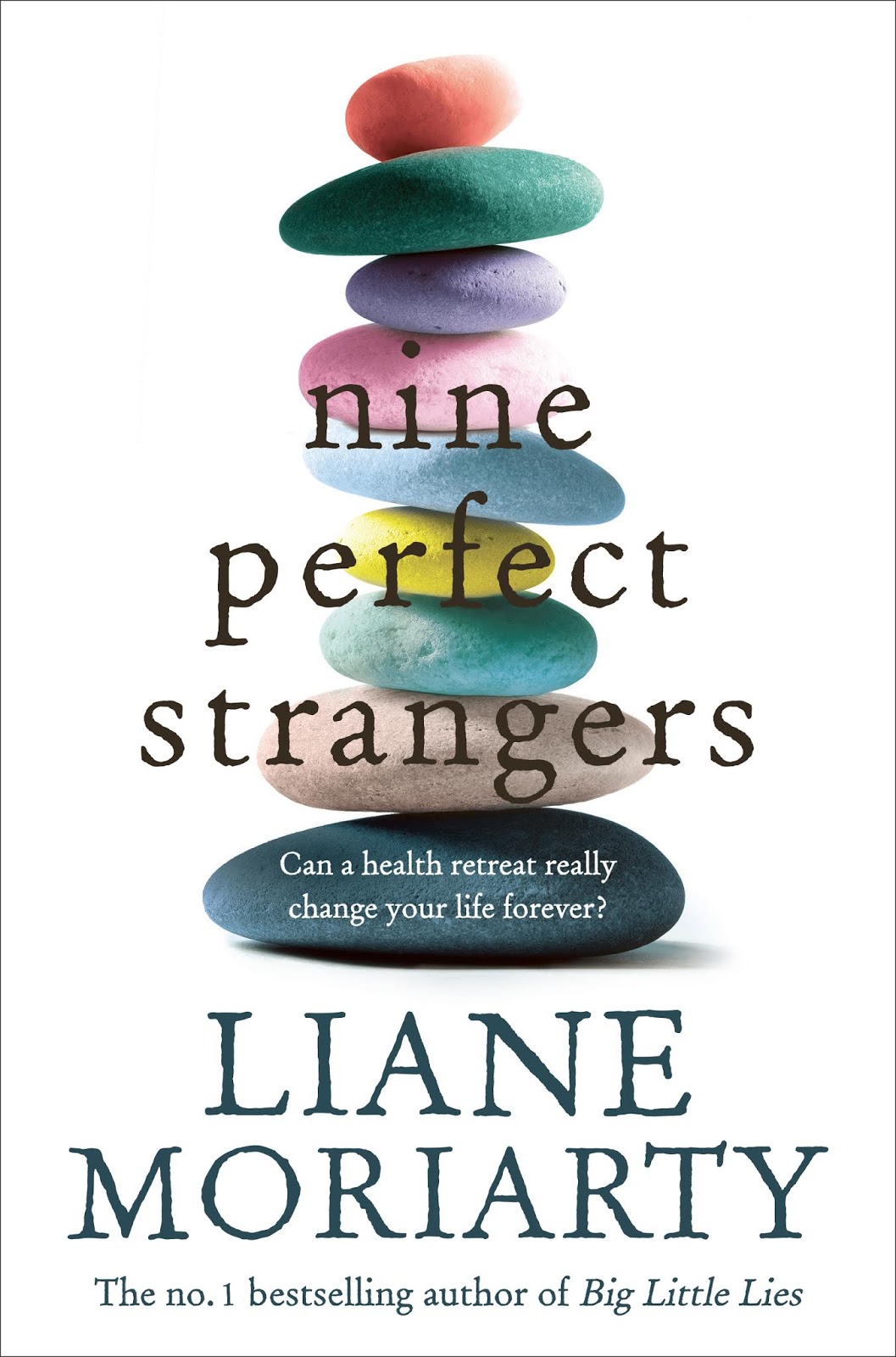
'Nine Perfect Strangers' by Liane Moriarty


From the BLURB: 

The retreat at health and wellness resort Tranquillum House promises total transformation. Nine stressed city dwellers are keen to drop their literal and mental baggage, and absorb the meditative ambience while enjoying their hot stone massages. 

Watching over them is the resort's director, a woman on a mission to reinvigorate their tired minds and bodies. These nine perfect strangers have no idea what is about to hit them. 

With her wit, compassion and uncanny understanding of human behaviour, Liane Moriarty explores the depth of connection that can be formed when people are thrown together in... unconventional circumstances. 

Okay - I went into this Liane Moriarty a *little* bit dubious, but I came out converted and all the better for having read it. 

Any hesitations I had were around the nine perspectives (there's actually more, but it works well) and because the whole 'wellness retreat' thriller-esque storyline had burnt me once with 'Fearless' by Fiona Higgins (which was *truly* awful, but thankfully 'Nine Perfect Strangers' is nothing like it). This latest from Liane Moriarty was another true joy and gem of a read; it's layered and complex, while also reading like a gossipy unravelling of human psyche and intimate relationships. I particularly loved the underpinnings of needing to choose your own happy-ending, and especially how that was characterised in the (sort of?) main protagonist of Frances, an older woman and once semi-famous romance author who has just been duped by an internet love scam. 

Frances is a bit of a conduit, I think, for Liane's experiences on the author circuit prior to becoming a NYT-bestselling author. So she has some delicious asides about gropey older male authors at writers festivals, bad reviews that claim her romance is anti-feminist for concluding with a happy ending, and the way she can't stand reading "literary" crime-thrillers without quotation marks and in which beautiful women either die or fawn over the grizzled older male detective. 

Ohhhhhhh, Liane - this is pure gold. And I think she has more than earned the right to have an author character get astutely persnickety about these things (also, can the sentence "unassuming mum from the suburbs" in relation to Liane just die already?) 

I also continue to adore how much Liane embraces Australian sensibilities. I've not ever read a US-version of her books, but I hope perfect observations like these remain; 

He loved the sound of the whipbird: that long, musical crack of the whip that was so much a part of the Australian landscape you had to leave the country to realise how much you missed it, how it settled your soul. 

Liane Moriarty continues to write at the top of her game, as a justifiable juggernaut of the publishing realm. That she's a genuinely lovely person, whip-smart author and keen observer of human interaction just makes her success that much sweeter ...

5/5

Monday, February 1, 2016

'Three Wishes' by Liane Moriarty


From the BLURB:

Three sisters, one birthday, one little problem ...

It happens sometimes that you accidentally star in a little public performance, your very own comedy, tragedy or melodrama.

The three Kettle sisters have been accidentally starring in public performances all their lives, affecting their audiences in more ways than they'll ever know. This time, however, they give a particularly spectacular show when a raucous, champagne-soaked birthday dinner ends in a violent argument and an emergency dash to the hospital.

So who started it this time? Was it Cat: full of angry, hurt passion dating back to the 'Night of the Spaghetti'? Was it Lynn: serenely successful, at least on the outside? Or was it Gemma: quirky, dreamy and unable to keep a secret, except for the most important one of all?

Whoever the culprit, their lives will have all changed dramatically before the next inevitable clash of shared genes and shared childhoods.

‘Three Wishes’ was bestselling Australian author Liane Moriarty’s very first novel, published in 2004.

So, I just learned the other day that the title of Moriarty’s new book (coming July 2016) is ‘Truly Madly Guilty’ and I am just ridiculously excited for it. I am a very big fan of Liane Moriarty’s books, which I first started reading in 2011 – I’d read four of her six published books, keeping two of her backlist in my ‘rationing reading’ pile. But upon learning the news of her forthcoming seventh book, I found myself craving her words so pulled out one of those books I was rationing.

‘Three Wishes’ was Moriarty’s first ever published book, but it absolutely stands against all her others, including her most recent New York Times-Bestselling titles. Moriarty definitely sticks to themes that clearly fascinate her – revolving around families and secrets – what’s sort of amazing though, is that in each book I read she finds new cracks and crannies, and wonderful ways to break these themes wide open.

‘Three Wishes’ is about triplets Lyn, Cat and Gemma – and a year in their lives when each one goes off the rails in big and little ways. Cat’s learning that her happy marriage to the perfect guy is anything but, Lyn’s need to be a Highly Effective Person is making her panic, and a previous relationship has made Gemma scared to put down roots and commit to a life-plan. Readers are introduced to the three sisters on the night everything implodes – at their birthday celebration at a restaurant, which leads to a very public meltdown – then backtracks to the beginning of the year when everything first started fraying.

So – fair warning – I have cried while reading every Liane Moriarty book, but I cried the most while reading ‘Three Wishes’. Just something about this one really got to me – particularly the character of Cat, who is just put through the wringer again and again and again in this one, and reading her many, many lows left me feeling like a giant, exposed bruise – tender to the touch. I’ve never actually wished for a sequel for any of Moriarty’s books before, but I find myself wishing for a wee sequel (or even guest-appearance in another book?!) of Cat – just to make sure she’s okay, to check in and see how she’s going.

Cat didn’t need to see her mother’s face to know the lemony expression of distaste that would be pulling at her mouth as she said the word “counselling.” Counselling was something other people did.
Cat took the cushion off her face and sat up. “People get pregnant from having sex, Mum. Not from a perfect marriage. You ought to know that.”

That being said, I also loved this book because – as with the other earlier books of Moriarty’s I’ve read – I could read the kernels of an idea in ‘Three Wishes’ that was later expanded in ‘Big Little Lies’. Gemma’s story is really only half-told in this book, partly because she’s kept this a secret from her family for so many years – but I could see Gemma’s story, in many ways, picked up and carried through to completion in ‘Big Little Lies’ which was quite cathartic for such a harrowing aspect.

I especially loved ‘Three Wishes’ because it is about sisters – and the really interesting role we each play in our families, where we tend to stick to our personality traits that were assigned to us as children. The good child, the problem child, the goofy child. Moriarty has also explored this in ‘What Alice Forgot’, exploring the fractured relationship of sisters Alice and Elisabeth – and Moriarty being one of five sisters, it’s no wonder she explores such family dynamics with nuance and cutting accuracy, and I simply adore her take on these familial lines. I also loved that ‘Three Wishes’ explores women’s infertility and craving for baby, something else the book has in common with ‘What Alice Forgot’ – it’s just a very modern problem that is fascinating to read how it causes such hairline fractures in various relationships.

I simply adored ‘Three Wishes’. When I said I was reading this one, a few people told me it’s their personal Liane Moriarty favourite and the one they go back to re-read the most. I’m not so sure my heart could handle revisiting this book (at least for a while), mostly for Cat’s collapsing year that just resonated and stung me the most. But I can see why it’s ranked so high on people’s lists, and as is always the case after reading a Moriarty book, I feel a little wrung out and invigorated now that it’s all over.

5/5 

Sunday, February 1, 2015

'What Alice Forgot' by Liane Moriarty


From the BLURB:

When Alice Love surfaces from a strange dream to find she's been injured in a gym, her first concern is for her unborn baby. She's desperate to see her husband, Nick, who she knows will be worried about her.

But Alice isn't pregnant. And Nick isn't exactly rushing to her bedside. She is a mother of three going through a bitter divorce.

Alice has lost ten years of her life - and she wants them back.

‘What Alice Forgot’ was the 2009 novel from Australian author Liane Moriarty.

The first Liane Moriarty book I read was 'The Hypnotist's Love Story' in 2011, which I absolutely adored. I had always meant to go and read her backlist after that, but then in 2013 'The Husband's Secret' was released and quickly after that 'BigLittle Lies' cemented Moriarty’s newfound place on the NYT-bestseller list and heralded her as a fantastic new Aussie author export. At some point I decided to save up her three older books – ‘Three Wishes,’ ‘The Last Anniversary,’ and ‘What Alice Forgot,’ – a sort of book-rationing, if you will. But now that I’ve finally got round to Alice, I don’t know how I’ll stop myself from gorging on the other two.

‘What Alice Forgot’ reminds me a little of a favourite (short-lived) TV show from 2007 called ‘Samantha Who?’ which starred Christina Applegate as an amnesia-sufferer who wakes from a coma with no memories of her life, but a sudden realisation that she’s not a very nice person and hated by mostly everyone who knows her …  each episode saw Sam gaining back one of her memories, only to realise they further highlight what a bad person she was and reconciling to be a better person post-memory loss.

When Alice Love is knocked out during gym class she wakes up in 2008 – but the last memory she has is of being pregnant in 1998. She wakes to discover that her first pregnancy has turned into three children, the husband she adores is currently in the process of divorcing her and she’s drifted so far away from her younger sister that they may as well be living in different countries.

‘What Alice Forgot’ reads like a bit of a puzzle, as Alice (and readers) have to piece together her last ten years – almost like a ‘whodunit’ … why are she and husband Nick separating, who are her three children, how is her mother salsa-dancing, why does her sister look so defeated, what’s the mystery surrounding her dead best friend Gina and how exactly has Alice become such an “involved” individual over the course of ten years;

He smiled uncertainly. ‘The class mums arrange social events for all the other mothers, and communicate with the teachers, organise the reading roster and, ah, that sort of …’ 
Oh Lord. It sounded horrendous. She’d become one of those civic, involved type of people. She was probably really proud and smug; she’d always known she had a tendency towards smugness. She could just imagine herself, swanning about in her beautiful clothes.

Alice has three children under the age of ten, and her 2008-self is indeed heavily involved in school politics. It’s in this storyline that I could read the first kernels of ‘Big Little Lies’ coming out – her 2014 novel about the events surrounding the death of a parent at a primary school trivia night. Moriarty delves, ever so slightly, into the playground politics that affect parents more than children these days – the gossip and grapevine, the appearance of happy-families when secrets and scandals are lurking inside every lunchbox. It’s skimmed in this book, but I really loved thinking about how Moriarty took this beginning of an idea and developed it more fully (and sinisterly) in ‘BigLittle Lies.’

Running alongside Alice’s third-person story are the first-person therapeutic journal entries of her younger sister, Elisabeth who is slowly getting to the core of a recent meltdown. Elisabeth and her husband Ben have been trying for a baby for seven years – through miscarriages and IVF treatments, Elisabeth has become bitter and depressed and when her sister loses the last ten years of her life, it forced Elisabeth to examine how her own ten years have changed her into someone she doesn’t like very much. I loved Elisabeth’s story – it was heartbreaking and so brutally honest as she pours her heart out about being infertile and feeling like a failure as a woman. I actually would have loved more of Elisabeth’s story – it almost doesn’t make sense running alongside Alice’s, but the two do converge eventually (as all Moriarty’s storylines seem to do) but regardless, I would have loved to spend more time with Elisabeth.

Occasionally we also get blog-entries from Elisabeth and Alice’s grandmother Frannie – these are funny asides that don’t take up a lot of page-time (thankfully) but I did end up barely skim-reading towards the end.

The ending also felt a little bit rushed to me – I would have liked to spend a little more time with Alice and Elisabeth especially (at least ten more chapters, actually). I think it would have been interesting to dissect the aftermath as much as anything else.

I understand that ‘What Alice Forgot’ is in the movie-works (as is ‘The Husband’s Secret’, while ‘Big Little Lies’ has been optioned for a “limited series” penned by David E. Kelley and starring Nicole Kidman & Reese Witherspoon!!). Honestly, much as I love those other two Moriarty books, I think I’m going to look forward to the ‘What Alice Forgot’ adaptation most of all. It raises really interesting questions about family and fragility, motherhood and feminine ideals – the amnesia storyline sounds a little ham-fisted melodramatic, but with Moriarty’s formidable pen she really does turn it into an interesting examination of modern-day life and family.

4.5/5

Saturday, August 2, 2014

'Big Little Lies' by Liane Moriarty


From the BLURB:

'I guess it started with the mothers.'
'It was all just a terrible misunderstanding.'
'I'll tell you exactly why it happened.'

Pirriwee Public's annual school Trivia Night has ended in a shocking riot. A parent is dead. Was it murder, a tragic accident... or something else entirely?

Big Little Lies is a funny, heartbreaking, challenging story of ex-husbands and second wives, new friendships, old betrayals and and schoolyard politics. No. 1 New York Times bestselling author turns her unique gaze on the dangerous little lies we tell ourselves every day and what really goes on behind closed suburban doors.

'Let me be clear. This is not a circus. This is a murder investigation.'

The Pirriwee Peninsular is a fictional slice of Sydney-sider heaven. A laid-back beach community with a mix of well-to-do’s and blue collar families, all of whom congregate at the only Primary School, Pirriwee Public.

This school year has already kicked off with a bang, when the new crop of little darlings were embroiled in a bullying scandal on orientation day – that’s right, one little girl was sporting bruises and finger-pointed a classmate (a little boy, whose mother was also new to the area and so young she was mistaken for a nanny!).

But this little incident would prove only the tip of the iceberg for the new school year – especially when you consider the bullying that went on amongst the parents in retaliation to allegations thrown against their own children.

Is it any wonder the Trivia Night ended in the murder of a parent?

Backtrack six months to where it all began, and follow three mothers who would prove too close for comfort to the ongoing investigation.

Madeline is as glittery as she is fiery, never happier than when she’s wearing righteous indignation – and lately she’s had cause to wear it often. Not only is she at the beginning of the terrible teenage years with her 14-year-old daughter, Abigail, but Abigail’s father (who walked out of their marriage and left Madeline the single-mother to their baby) is living on the Peninsular too – having moved there with his new wife, and their toddler daughter who will be attending Pirriwee Public with Madeline’s own daughter from her second marriage. There really should be a law against ex-husband’s and their new (replacement) families sharing school zones.

Celeste is one-half of dazzling couple with her jet-setting husband, Perry. They live in a sprawling house, have the best of everything and Perry makes up for his long absences with beautiful bits of jewellery for his stunning wife. They have twin boys who are starting at Pirriwee Public this year and Perry’s Facebook account can attest to their perfectly happy family … except it’s all a lie.

Jane is twenty-five and single-mother to beautiful little boy, Ziggy. Painfully thin and self-conscious, she up and moved to Pirriwee on impulse and because she thought Ziggy would quite like the beach. Her family have been concerned about her ever since she confessed to being pregnant from a one-night-stand she has no wish to go into more detail about … save to say, Ziggy won’t be meeting his biological father anytime soon, not so long as Jane has something to say about it.

These three women form a united front when, on the Pirriwee Public orientation day, one of their children is singled out as a bully – and then subjected to ongoing and unsubstantiated bullying by Pirriwee Public parents who want them expelled from the school.

It’s going to be a hell of a year.

‘Big Little Lies’ is the new fiction book from Australian author Liane Moriarty.

The Moriarty name has long been associated with literary excellence and bookish-obsession for many Australian readers. Jaclyn Moriarty is the extremely popular young adult author of ‘Ashbury/Brookfield’ fame, and recently Nicola Moriarty has rounded out the triumvirate literary powerhouse. But lately the rest of the world has started sitting up and paying some serious attention to Liane Moriarty, the sister who since 2003 had been quietly releasing wonderful adult fiction titles (and the occasional children’s book) … until last year when her novel ‘The Husband’s Secret’ made it to #1 on the New York Times Bestseller list and catapulted this Australian women’s fiction author into a new stratosphere of international literary fame.

The praise was deserved, as ‘The Husband’s Secret’ (a favourite book of 2013 for me) was a tight, psychological suburban-gothic thriller that was as much an examination of marriage as it was of guilty-conscience. And now Liane Moriarty has come out with ‘Big Little Lies’ – which has already received a Kirkus starred review and seems destined (and deserving) of another trip to the top of the NYT Bestseller list for Moriarty … with this book she turns her eye to women’s secrets, family microcosms and the funny little world of child rearing in an era of mummy-bloggers and bullying as the hottest of hot-button topics.

Let me just say – this is one of my favourite books of 2014. Hands down.

I don’t have children, but I come from a family of teachers (many of whom teach Primary school) and I absolutely delighted in this book for the way it so seamlessly (and frighteningly) matched up with the anecdotes my family bring home from their jobs. The helicopter parents, and precocious little darlings and the “everyone get’s a trophy!” ethos of modern-day parenting/schooling – it was vicariously delicious, and I envision many readers squirming for how Moriarty portrays these caricatures of modern-day family with pin-prick accuracy. And, believe me, Liane Moriarty gets some descriptions so perfectly, so acerbically, right:

‘So are these women nice?’ asked Celeste. ‘Or should we steer clear?’ 
‘Well, they mean well,’ said Madeline. ‘They mean very, very well. They’re like, hmmm, what are they like? They’re like Mum Prefects. They feel very strongly about their roles as school mums. It’s like their religion. They’re fundamentalist mothers.’
 
It’s the sort of book you read and, with descriptions like that, you’ll instantly have a private light-bulb moment and chuckle because it’s just like someone you know (and when that happens, please, recommend the book to them).

The story begins on the fateful trivia night, when someone dies – and then backtracks to six months before and the bullying incident that sparked a parental warfare in the playground of Pirriwee Public. Each chapter from then on offers a glimpse into the present-day investigation going on into the murder, with hilarious excerpts from the detective interviewing the parents (who also offer the odd tid-bit of gossip and personal opinions on all players involved).

Gabrielle: I was new to the school. I didn’t know a soul. ‘Oh, we’re such a caring school,’ the principal told me. Blah, blah, blah. Let me tell you, the first thing I thought when I walked into that playground on that kindergarten orientation day was cliquey. Cliquey, cliquey, cliquey. I’m not surprised someone ended up dead. Oh, all right. I guess that’s overstating it. I was a little surprised.

The book follows three mothers – Jane, Celeste and Madeline – each with their own problems and secrets, and maps their friendship and how they three came to be on one side of the parental warfare.

I ‘discovered’ Liane Moriarty in 2011 with ‘The Hypnotist'sLove Story’, which I loved. I’ve since gone back and read Moriarty’s backlist … but I’ve got to say, I think ‘The Hypnotist's Love Story’ marked a turning point for her that reaches a brilliant crescendo with ‘Big Little Lies’. Her earlier books were a lot funnier, and much more typical ‘women’s fiction’ (sigh, do I dare use the word ‘beach reads’?). They’re good, don’t get me wrong, but I think Moriarty started exploring much darker stories and sharper edges with ‘The Hypnotist's Love Story’ which then led to the very gothic ‘The Husband’sSecret’ and now ‘Big Little Lies’ feels like the best of both worlds – this book is funny, particularly for Moriarty’s social commentary around family, female obligation and school. But this book is also very dark – I always read feminist undertones in Moriarty’s work, and in ‘Big Little Lies’ especially she touches on domestic abuse, single-mother stigma, the conflict of “working women can’t have it all”, female beauty and sexuality, pornography and a slew of other topics … coupled with the over-arching murder storyline, this is a brilliantly placed book for being so dark and so funny and so darkly funny.

Jane looked up and her heart sank.
It shouldn’t matter. She knew it shouldn’t matter. But the fact was that some people were so unacceptably, hurtfully beautiful, it made you feel ashamed. Your inferiority was right there on display for the world to see. This was what a woman was meant to look like. Exactly this. She was right, and Jane was wrong.

This was such an enjoyable read. One moment I’d be cackling manically and then when I finished reading a chapter I’d think on the events for hours afterwards, for all the controversies Moriarty had raised. I loved this book, it really does cement Liane Moriarty as someone who is very deserving of her new literary fame (though I say that reservedly, she’s always been beloved in Australia – it’s mostly America who is suddenly taking notice of her).

I’m calling ‘Big Little Lies’ as my favouritest-favourite book of 2014 thus far. A big call, but it’s a bloody great book.

5/5


US and UK covers 


Monday, June 17, 2013

'The Husband's Secret' by Liane Moriarty

Received from the Publisher

From the BLURB:

Cecilia Fitzpatrick, devoted mother, successful Tupperware business owner and efficient P&C President, has found a letter from her husband.

"For my wife, Cecilia Fitzpatrick
To be opened only in the event of my death"

But Cecilia's husband isn't dead, he's on a business trip. And when she questions him about it on the phone, Cecilia senses something she hasn't experienced before. John-Paul is lying.

What happens next changes Cecilia's formerly blissful suburban existence forever, and the consequences will be life-changing for the most unexpected people.

Lianne Moriarty’s new novel begins with a bit of Greek Mythology, and the story of poor Pandora who’s been given a bad rap and turned into a sorry metaphor over time, especially considering “nobody said a word about not opening it!”

It’s an apt metaphor, indeed. The unsuspecting and fair Pandora who didn’t know what she was getting herself into when she innocently opened a jar and unleashed horrors onto the world. Cut to modern-day Sydney and Cecilia Fitzpatrick is wrestling with her conscience about opening a letter her husband never thought she’d find, to be opened only in the event of his death (which is a problem, since he’s still very much alive and healthy). Cecilia is an upstanding citizen and beyond-reproach mum at St. Angela’s primary school, where her three daughters are currently attending. Cecilia is a good Catholic, a superb Tupperware saleswoman and loving wife to equally upstanding John-Paul. But this letter is nagging at her – especially when John-Paul is thrown into a fit over it, and her daughters start sharing their own concerns about dad’s behaviour. . . 

In Melbourne, Tess O’Leary has just had a veritable Pandora’s Box blown up in her face, when her husband Will and beloved cousin (more like sister), Felicity, announce their pious love and declare that they’d very much like to start a relationship . . . Tess is shaken to her core, and fuelled with hate. Herself a socially awkward by-product of divorce, and with her young son Liam to consider, she decides to leave her husband and cousin to their debauchery in the hopes they come to their senses – she and Liam leave for Sydney, to stay with her ailing mother and escape the heartache. But while trying to escape the deluge, Tess runs into an old flame and PE teacher at St. Angela’s where she’s just enrolled Liam. Connor Whitby was a blip on Tess’s romantic past, but seeing him again (and aged into a right spunk!) pulls a passion out of Tess that surprises her as much as Will and Felicity’s betrayal.

And then there’s Rachel Crowley, who is hoping to pry open an ages-old Pandora secret. Rachel works administration at St. Angela’s; she is a besotted grandmother to Jacob and widowed wife who is terrified when her son, Rob, and his wife announce they’ll be packing their bags and living in New York for two years. Rachel is also the mother of Janie Crowley – the girl who was famously murdered in 1984, strangled to death and her body left in the local park with rosary beads the only clue to her murder. To this day, the police have no real suspects – though Rachel personally believes Connor Whitby to have ‘lies in his eyes’, as the last person to have seen her daughter alive . . . 

While there are certainly plenty of Pandora-esque tragedies and catastrophies flying around this book, Moriarty plays out a few more metaphors than just the Greek. There’s a biblical ‘eye for an eye’ element running throughout, as these three women test their convictions and heartaches, measure their anger against forgiveness and seek very different retributions against the backdrop of St. Angela’s primary school. Then there’s also the history of the Berlin Wall running concurrently – as Cecilia’s daughter is obsessed with history and has turned her mind to the Cold War, escape artists and the momentous historical collapse of the wall. The Berlin Wall being a metaphor for sealing in and keeping out . . . but also, perhaps, the inevitability of collapse – that secrets very rarely remain kept forever, and walls once put up are bound to come crashing down.

I adored this book. I previously read and loved Moriarty’s 'The Hypnotist's Love Story' and vowed to read whatever she came up with next – though I have no idea why I waited so long (a full month!) to read ‘The Husband’s Secret’. This book hooked me in the first chapter, and by the fourth I was inwardly snarling at anything that kept my away from reading more, more, more (very annoying while reading on the train and making my destination – I did consider just doing a continuous loop until I got to the end of the book). 

There’s a big ‘what if?’, ‘Sliding Doors’ element to this book. Rachel blames herself for running seven minutes late on Janie’s last day – seven minutes that might have meant she’d been waiting for her mum instead of walking home through the park. Tess starts thinking what could have been when she runs into Connor Whitby after so many years, and so much recent heartbreak. And Cecilia blames the Berlin Wall (and foraging in the attic for a souvenir piece) for her uncovering her husband’s letter, and eventually his secret. . . Moriarty weaves this in beautifully to the book, and very occasionally an omniscient narrator reveals what was lost and gained from the small variants of life.

I suppose ‘The Husband’s Secret’ could be said to be all about wives and mothers, as the three main characters very much are. But Moriarty also examines her protagonists as women, which I found really interesting. It was little things – Janie Crowley vulnerable as she walked through the park, Tess driving late one night and noticing a man walking home (musing that a woman would never think to do that). It was Cecilia raising her daughters;

Cecilia noticed that beautiful women held themselves differently; they swayed like palm trees in the breeze of all that attention Cecilia wanted her daughters to run and stride and stomp. She didn’t want Polly to bloody sway. 

And while this is a novel about marriages, Moriarty swerves away from the usual line of ‘nobody really knows what goes on in a marriage apart from the people involved’. . . instead, she explores the possibility that even then, those involved in the marriage don’t know themselves at all;

‘There wasn’t anything really wrong with our marriage, was there?’ she said. ‘We didn’t fight. We were in the middle of watching season five of Dexter! How could you break up with me when we were in the middle of season five?’

I would say this is also a book about anger and morals and how those two are sometimes intertwined, but more often at loggerheads. And Moriarty captured anger so well that I could taste the metallic indignation, like blood, on the tip of my tongue in some paragraphs;

Cecilia thought she’d experienced anger before, plenty of times, but now she knew that she’d had no idea how real anger felt. The white-hot burning purity of it. It was a frantic, crazy, wonderful feeling. She felt like she could fly. She could fly across the room, like a demon, and claw bloody scratch marks down John-Paul’s face.

This is a superb novel that, upon finishing, I instantly wanted to pass on to someone else to read so I could talk about it with them. I think these characters are going to stay with me for a good long while, and I don’t think I’ll ever really be settled or comfortable with the decisions they made throughout this book (I’ll always think “what if?”). I’ll never again make the mistake of waiting one whole month to read a Liane Moriarty novel. 

5/5

Wednesday, October 19, 2011

'The Hypnotist's Love Story' by Liane Moriarty

Received from the Publisher

From the BLURB:


Ellen O'Farrell is an expert when it comes to human frailties. She's a hypnotherapist who helps her clients deal with everything from addictions to life-long phobias. So when she falls in love with a man who is being stalked by his ex-girlfriend she's more intrigued than frightened. What makes a supposedly smart, professional woman behave this way? She'd love to meet her!

What she doesn't know is that she already has. Saskia has been masquerading as a client, and their lives are set to collide in ways Ellen could never have predicted.

This wonderfully perceptive new novel from Liane Moriarty is about the lines we'll cross for love. It's about the murky areas between right and wrong, and the complexities of modern relationships.

As Ellen is about to discover, we're all a little crazy – even her.

Ellen might just be on the cusp of something. After three failed long-term relationships (one of which hurt, quite a lot) and trawling through Internet dating sites, Ellen might just have found something worthwhile. Patrick. A surveyor; man of maps. Widowed, with an eight-year-old boy called Jack. He might be ‘the one’ (not that Ellen necessarily believes in ‘the one’, thanks to a feminist single mother, but it would still be nice…)

But on their fourth date Patrick announces that he has something to tell Ellen, something quite important. Oh, no. He’s going to say he still isn’t over his dead wife – can never love again. Or he’s baffled by her hypnotherapy practice and doesn’t see himself with someone hippy-dippy like her. Or he doesn’t ‘do’ monogamy. The wheels start turning. Her heart and hopes start packing up, and she’s already mentally preparing herself to get over him. But Patrick’s confession is both a relief, and creepily curious. He has a stalker. Her name is Saskia. They dated for three years, and she has been stalking him for three years. Ellen is okay with this; she can handle a non-violent stalking ex-girlfriend. To be honest, she’s even a bit titillated by the news.

Saskia can’t believe it when Patrick seems smitten with ‘The Hypnotist’. Ellen. She probably eats legumes by the barrel-full and dances under the full moon. Honestly. Patrick doesn’t seem to understand that she and him are still connected – even if he ended things three years ago. Doesn’t he understand that she was Jack’s mother – she helped raise him and toilet-train him and teach him to say ‘please’. Patrick can’t just erase her from his life. So she’ll try and become apart of their new life – his and Ellen’s. If she can’t say her peace and let him know how much she hurts, then Saskia will be content to be on the sidelines, a third appendage to this budding romance.

‘The Hypnotist’s Love Story’ is the new stand-alone novel from Aussie author, Liane Moriarty.

I loved this book! I went into the novel with an open mind, thoroughly intrigued by the title and hypnotism focal point. I had a friend who was cured of nail biting via hypnotherapy, and when I worked in retail I had a regular customer who was a hypnotherapist (I admit, I was a little disappointed that he never wore capes and top-hats, just regular business-casual clothes). I loved the book, but not for the reasons I thought I would …

First of all, I have to say that the hypnotism isn’t really the crux of the story. It’s a convenient (and peculiar) plot trigger, and a thinly-veiled metaphor for relationships in general. Still, I did really enjoy reading about Ellen’s sessions and the finer details of hypnotherapy. It was fascinating to read the delicacies of wording, rhythm, and recollection. But I was also quite relieved that Moriarty (and Ellen) were aware of the stigmas attached to hypnotherapy as a quack profession. Ellen reveals that past boyfriends have treated her occupation with patronizing contempt, which is nothing compared to what her GP mother thinks of her practice. Plus, Moriarty has fun with the hypnotism schtick, and I found myself cackling at a few of Ellen’s insights into her profession of the mind;

‘I’m wondering if you can visualize a wall. And I’m sorry to tell you that it’s painted apricot. But the good news is you’re repainting it an exquisite blue. Your paintbrush is moving up and down in rhythmic strokes. Up … and … down. Up … and … down.’
Too complicated? Ellen had found she needed to be careful with her metaphors. Men often got too literal. A man might say afterwards, ‘You should have had me paint an undercoat first.’ Women tended to go off on tangents. One of her earliest clients had said that she loved to sunbake, so Ellen did what she thought was a pretty safe induction about lying on a tropical beach. Afterwards, the client admitted that she’d spent the whole time trying to choose which swimsuit to visualise herself wearing.


Regardless of the novel’s title, ‘The Hypnotist’s Love Story’ is not really about hypnotism. It’s more about what hypnosis represents – it’s about relaxing your mind to delve into the subconscious, to induce yourself into remembering (sometimes reliving) moments of your life (or past life) in order to view them with new perspective. And that is the crux of ‘The Hypnotist’s Love Story’.

All of the characters are living in their delusions, unable to break away from how they see the past, and the present. Saskia is the worst of all – a woman who doesn’t like being called a ‘stalker’, but admits (in her first person-narration) that she and Patrick didn’t have a clean-cut end to their relationship, instead it was left to infection and fester … and now she’s stuck in her role as ‘the crazy lady’. As readers we are initially thrown by Saskia, the clearly deluded female stalker. Stalkers are usually men, they’re normally ex-lovers or ex-husbands who are brutal and frightening and don’t know when to stop. Very rarely are stalkers women – unless, of course, we’re talking females who stalk their celebrity crushes in the glitzy land of Hollywood;

‘Where’s the woman’s self-respect?’ snapped Julia. ‘Just move on, for God’s sake. She’s making us all look bad.’ There was a real edge to her voice, as if she was personally offended.
‘You mean she’s making women look bad?’ said Ellen. ‘It’s normally men who do the stalking. It’s good. She’s showing women can stalk just as effectively as men.’


But as the story unravels, and more perspectives are put into the pot, Moriarty does a most curious and wonderful thing – she lets us walk a mile in the stalker’s shoes, and even (for me at least) take her side. We learn of Patrick’s rather harsh treatment of Saskia when their three-year relationship ended. We discover that it wasn’t so much losing Patrick that stung worst of all, but losing Jack – the boy she had helped to raise. But Moriarty delves further still … into Patrick’s badly handled grief over his wife’s passing. The bad timings that wreck relationships worse than infidelity. And the pure pain of ‘just letting go’.

And of course there is Ellen – herself the product of a badly timed coupling that saw her raised by a cutting feminist single mother and two beloved godmothers. Ellen, who is experiencing similar difficulties with Patrick that Saskia must have – particularly where his ex-wife is concerned, Colleen, who sits upon a pedestal in his mind.

Ellen and Saskia do cross paths – unknowingly and cunningly – but it’s when they don’t share scenes that they connect the most. They think about each other, obsess even. Saskia wonders what Ellen has that she didn’t, and she envies her new family with Patrick and Jack. Ellen, meanwhile, is fixated on this woman from Patrick’s past – this woman who is clearly hurt and must have once meant something to him. Ellen even forms an odd little unknowing bond with Saskia, as she commiserates over the ‘wonderful’ and dead Colleen, a woman who must have also stuck in Saskia’s craw for her still importance in Patrick’s love life.

It’s also interesting to read the duality and juxtaposition of Saskia’s envious musings about Ellen, versus Ellen’s less-than-perfect reality with Patrick. Saskia seems to remember her time with Patrick and Jack as being perfect – meanwhile as their relationship develops and grows, Ellen can attest to the less than wonderful aspects of coming into an already-established family.

I loved Liane Moriarty’s ‘The Hypnotist’s Love Story’. It’s a book that looks quite cutesy and deceptively quirky on the surface – pretty front cover, interesting hypnosis topic. But there’s a lot going on below the surface. Moriarty is exploring the complexities and fall-outs of unconventional modern relationships, she is investigating matters of the heart and how we all live a little in our fantasies. ‘The Hypnotist’s Love Story’ does have romance, but more than anything it’s observing the delusions of love, the cling-with-white-knuckles insanity of falling for someone who doesn’t fall back. It’s a beautifully complex novel, coloured in grey and utterly compelling.

5/5
| More