Search This Blog

Showing posts with label short stories. Show all posts

Tuesday, November 15, 2022

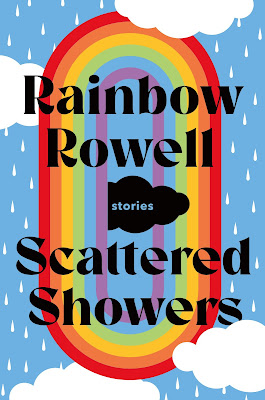
'Scattered Showers' by Rainbow Rowell


'Scattered Showers' is an Anthology collection of nine Rainbow Rowell short-stories, five of which are brand-new created for this collection.

Many have appeared elsewhere; like the first story 'Midnights' from the 2014 Stephanie Perkins edited YA anthology collection 'My True Love Gave to Me: Twelve Holiday Stories', which is about two friends who we first meet at a 2014 New Years Eve party and then follow through many NYE parties right through to their first year home after college.

'Midnights' also appeared in a hardcover gift 'Almost Midnight: Two Festive Short Stories' alongside the second story in the new 'Scattered Showers' collection, 'Kindred Spirits' - which is about unacquainted teenagers in 2015 waiting in line across 4 days, for the new Star Wars movie 'The Force Awakens.'

These two stories really set the pace of the whole collection, and Rainbow Rowell's biggest theme throughout all her works which is; duos. Sets. Two people, soulmates or mates for right now ... truly her biggest thread through all Rowell stories from 'Simon Snow' to the 'Pumpkinheads' graphic novel is the dyadic - a focus on two people. For this reason I really wish they'd called this collection 'Double Rainbow,' but I understand a quite literal Rainbow/Rainbow may have been confusing over-kill.

We have the new short-story 'Winter Songs for Summer' - about a girl getting over a break-up, and her downstairs college neighbour who helps her grief maturate with mix-tapes.

'The Snow Ball' is another newbie, a very Taylor Swift-feeling short about a guy friend getting ready to attend a school dance with a girl who is not his best female friend, and the ways they talk circles around one another to figure out how they both feel about that.

'If the Fates Allow' is a 'Fangirl' prequel which did release as an Amazon Original Story in 2021, and features the character of Reagan home for the first times during Covid and having back-porch chats with her neighbour during uncertain times.

'The Prince and the Troll' is another original and the weirdest one in this collection, to me - it's a fantastical allegorical (I want to say climate-fiction?) short story that felt a little like it wants to be 2017 film 'The Shape of Water' but mostly reads like a commercial for Starbucks?

'Mixed Messages' made it up to me though, as it's a short-story featuring the characters from Rowell's debut (and my fave!) novel, the 2011 'Attachments'! It's a real-time glimpse into where these characters ended up, and I delighted in it! I also think it's a great prompt for anyone that isn't aware of Rowell's debut novel, to go back and discover it!

'Snow for Christmas' is a 'Simon Snow' short story, which I did not read because I haven't yet been able to get into that series. I'm sorry! I will, eventually - one day!

And finally, another fave for me was 'In Waiting' ... which is a delightfully trippy and heartfelt meta short-story which felt very much like the 2006 Will Ferrell movie, 'Stranger than Fiction.' It's about quite literally a new character called James, who has been dropped into the between-place where (presumably) Rainbow Rowell's ideas hang out, her not-quite-yet fully-formed and outlined characters hang in limbo until she knows what to do with them ...

He got excited when he realized they were both from Nebraska.
"That's nothing," she said. "We're all from Nebraska. It's like how Stephen King's characters are all from Maine."


... and the longest-serving character in this stable is Anna, who has grown up in this place and who Rowell seemingly can't let go of, but won't slot her into a novel yet either (God Forbid she be used in a short-story though.) This one was a little 'The Good Place' too and I absolutely loved it.

Overall I think Rowell's short-story talent is on display here; certainly the stories that she maybe had more time to develop (like those previously published) are the strongest, while her forays into genre-fiction and metaphor fell flat for me, except in the Rainbow Rowell metaverse of character limbo 'In Waiting.'

I do love that all of these short stories collected in one beautiful, hardcover place (with illustrations by Jim Tierney) - and how they solidified for me, Rowell's ongoing obsession with duality and soul-mates, two peas in a pod and the dyad of it all.

I'm glad I own this, because I am a fan ('Attachments' remains my fave, followed closely by 'Pumpkinheads' graphic novel, and 'Fangirl' - but the 'Midnights' short-story is also up there) and I do think I'll keep coming back to this collection and these little tasters of growing up, coming-of-age, friction and fragility, connection and love ... one example of this is a line in 'Midnights,' when a group of friends have re-gathered at their annual NYE basement party the first year they've (mostly) all returned home from first-year at college;

"Is it weird being in Omaha?" Simini asked her. "Now that everybody's left?"
"It's like walking through the mall after it closes," Mags said. "I miss you guys so much."

4/5

Thursday, August 15, 2019

'A Constant Hum' by Alice Bishop


From the BLURB:

It’ll all be okay, my mother said, and I remember the way her familiar face scrunched, afterwards – reflected back at me, in the fogged bathroom mirror, when she thought I couldn’t see. 

Before the fire – before the front of flames roars over the hills—the ridge is thick with gums. After the fire, all the birds have gone. There is only ash and melted metal, the blackened husks of cars. And the lost people: on the TV news in borrowed clothes, in temporary accommodation on the outskirts of the city, or remembered in small offerings outside the town hall. 

A Constant Hum grapples with the aftermath of bushfire with an eye for the telling detail. Some of these stories cut to the bone; others are empathetic tales of survival, even hope. All are gripping and stunningly written, heralding the arrival of a vital new voice in Australian fiction.

Well, that was a feast made from grief and completely, hauntingly, divine. ‘A Constant Hum’ by Alice Bishop is a Short Story Collection based on the aftermath of the 2009 Black Saturday bushfires. 

It features a variation of viewpoints and Short Story forms - everything from minisagas to microfiction, and microstory (of only a few words) interspersed with flash fiction and longer form short stories too. 

Horses
There were still reports, years later, of the horses that night: their coats matted and sweet from sweat in smoke-blurred headlights.  

The pace of them - longer and short form one after the other - makes it read like the waves and stages of grief. And sometimes we get the barest hint of an aspect of the tragedy, like it’s all we can handle of the whole. One line a character utters in a story hints at these fleeting moments: ‘It’s okay, Haze, sometimes things just disappear.’ 

It’s stunning, and unsurprising that Bishop herself grew up in Christmas Hills - one town devastated by the fires. This collection feels both assured and vulnerable, a hard and hurting reading but necessary and so very, very fulfilling. I loved it.

It’s also worth reading her acknowledgments at the back - and the very end, where Bishop lists all the places where many of the stories were previously published or recognised: journals and magazines, websites, and short story prizes ... it highlights how long Bishop has been writing and finessing this collection, and it’s proof-positive that building a writing resume (particularly of your short-story work) is well worth doing. It takes time, but the best things often do.


5/5

Monday, September 5, 2016

'The Love of a Bad Man' by Laura Elizabeth Woollett

Received from the Publisher 

From the BLURB:

A schoolgirl catches the eye of the future leader of Nazi Germany. An aspiring playwright writes to a convicted serial killer, seeking inspiration. A pair of childhood sweethearts reunite to commit rape and murder. A devoted Mormon wife follows her husband into the wilderness after he declares himself a prophet.

The twelve stories in The Love of a Bad Man imagine the lives of real women, all of whom were the lovers, wives, or mistresses of various ‘bad’ men in history. Beautifully observed, fascinating, and at times horrifying, the stories interrogate power, the nature of obsession, and the lengths some women will go to for the men they love.

‘The Love of a Bad Man’ is a short story collection by young Australian author, Laura Elizabeth Woollett.

I have been dying to read this book, ever since I met Laura Elizabeth Woollett at the launch of ‘Betanarratives’, where we both had short stories in the ‘Body Language’ edition. Laura gave me a very brief run-down of her short story collection that was coming out with Scribe, describing it very succinctly as; "lovers, wives, or mistresses of various 'bad' men in history,” and I was so on-board. I’d been keeping my eyes and ears peeled ever since, and now that I’ve read the collection I’m not the least bit surprised that this tantalising theme completely holds-up under the weight of Woollett’s considerable talent.

There are twelve stories in all, focused on real women throughout history, but telling their fictionalised stories. Some of these women I was already familiar with (Hitler’s mistress Eva Braun, Blanche the sister-in-law to Bonnie and Clyde and Charles Manson’s California girls) but others were a welcome revelation and unusual little history lesson. The likes of Martha Beck (one half of "The Lonely Hearts Killers") and 13-year-old Caril Ann for her fateful relationship with a murderous greaser were all new to me. Even the stories of women I was familiar with had secret compartments to be unlocked in the telling, no matter that their lives have been reimagined by Laura. There were still sprinklings of truth; like discovering that Hitler probably had a sexual relationship with his niece, Geli Raubal, before she killed herself and he found young Eva Braun for example. I guarantee that these stories will set you off on a most macabre Internet search to satisfy the curiosity they invoke (there is also a very handy appendix that I cut away to after finishing individual stories, to stop me from putting the book down and interrupting my read with a Google search!).

I actually want to talk about ‘Suicide Squad’ in relation to ‘The Love of a Bad Man’ – which, I know, is totally out of left-field … but is it?

When I finished reading Woollett’s work, I went that weekend and saw ‘Suicide Squad’ in cinemas. There’s been a lot of talk around the movie’s particular disservice to fan-favourite character Harley Quinn, namely in making an even bigger mess of her already problematic and abusive relationship with The Joker. Read about that bizarre coupledom that goes to hell in a hand-basket in the movie here, here, here and here if you are so inclined. But I basically agree with everyone (even actress Margot Robbie) in just not getting that relationship, especially not the way it’s been portrayed in ‘Suicide Squad’ … But I actually want to talk about how Woollett’s entire collection can be seen through the pop-culture prism of Harley Quinn (who is a feminist icon for some fans, which I also don’t really get?)

Woollett is exploring various women who, – much like Harley Quinn – are seeking and accepting the love of bad men. The difference is that Woollett works damn hard to get to the ‘root of the root and the bud of the bud’ of this thing called love, and what she brings up are startling realisations. Sometimes uncomfortable, sometimes understandable but all of them are unique in trying to understand how these women tick. And she is very much interested in the women over the men in this collection. In most of the stories, the men are as unknowable to the reader as they are to their loves and lovers – which is often much appreciated (I don’t particularly want to work hard at understanding Hitler’s thinking, quite frankly). Woollett is embodying and writing to the flip of that ‘Behind every great man there's a great woman’ shtick, and instead saying that cliché works for bad men and women too.

‘You should go home while you can, baby,’ he tells me at a camp outside Waco. ‘I’ll put you on a bus right now. You’ll be back with your folks by nightfall.’  
I think of my poor old pa, deaf in one ear, and the little Okie church where he preaches to other farmers. But there’s no leaving Buck, no matter how much he tries to baby me, no matter how much bickering, dirt, and tears. This is the life we’ve been given, and if anything makes us better than animals, it’s each other. 
—‘Blanche’

The history-buff in me loved how Woollett also picks apart threads of time to provide context for these women and their crimes. It's another testament to how finely researched these women were, that Woollett really does look for their tender truths amongst the rubble of history;

According to my sister Ilse, there’s a Jew in Vienna who spends all his time listening to bored women talking. They lie down on a couch with their backs to him, plucking at their blouse buttons and going on about all sorts of things: their dreams, their memories, their childhoods.  
‘Why?’ I ask Ilse. 

‘For enlightenment,’ she says. ‘Of course, you wouldn’t know anything about that.’
—‘Eva’

… But if I’m being really honest, I just loved this collection for the gore-factor too. I think this is pretty close to a historical horror short story collection, and there’s something deliciously gothic and gory/gorgeous in picking at these wounds and wickedness;

On the night of Charlie’s frying, I watch the clock. I watch the minutes click by as they strap his arms to the chair and fix the metal bowl over his head. I look out at the darkened prison yard, my forehead cold against the window grating. The minute hand ticks one after midnight. I close my eyes and smell the smoke of him on the night air.
—‘Martha’

I adored this collection! ‘The Love of a Bad Man’ is definitely a favourite book of 2016 for me, and I’m keen to read whatever else Laura Elizabeth Woollett’s writes next.

5/5

Monday, April 11, 2016

'Where the Shoreline Used to be' Stories from Australia and Beyond, Edited by Pam McIntyre and Susan La Marca


From the BLURB:

A rich and unique collection of short fiction, poetry, illustration and song lyrics from Australia and beyond.

An encounter with a strange boy on a beach, a dog in space, a world of butterflies, a talking whale, two girls who take on the world, and a thousand silver ghosts . . . Like the pull of the tide, these stories and poems will draw you in and encourage you to explore.

Funny, dramatic and poignant by turns, and featuring both established writers and exciting new talent, Where the Shoreline Used to Be is a stunning collection that will challenge and excite your imagination.

Including: Shaun Tan • Scot Gardner • Arwa Abousamra • Trudy White • Kate Miller-Heidke • Keir Nuttall • Felicity Castagna • Amie Kaufman • Alice Pung • Gayle Kennedy • Davina Bell • Meg Caddy • Courtney Barnett • Barry Jonsberg • Meg McKinlay • Kyle Hughes-Odgers • Shivaun Plozza • Ali Cobby Eckermann • Margo Lanagan • Wil Wagner • Lizzie Wagner • Tony Birch • Leanne Hall • PM Freestone • Andrea Hirata

‘Where the Shoreline Used to be’ is a collection of short stories from Australia and beyond, edited by Pam McIntyre and Susan La Marca, who also edited the 2012 short story collection, ‘Things A Map Won't Show You’.

I loved McIntyre and La Marca’s first short story collection, and was so happy to see them come out with a second book that’s perfectly oriented for the schools market. There are long and short-short stories, poems and artwork within – all of which will stir the imaginings of young readers, and hopefully encourage them to dabble themselves in this wonderful medium.

As with ‘Map’, ‘Shoreline’ is pretty free-form thematically – these authors, poets and illustrators are allowed to run rampant with that beautiful title, though a sense of time more than place feels to have the slight upper hand.

Margo Lanagan’s ‘The Queen’s Notice’ is visceral and feral-delightful, reading like something of a ‘Romulus and Remus’ foundation myth;

It was true, he did smell, strongly and cleanly of deep earth and queen-favour. His mind was beginning to fill with other things, as a quick-tunnel trickles full of loose earth, but he still had the queen’s scene in all his skin-folds, creeping in his mouth-hairs, raw and clear, warm and sweet.
—Margo Lanagan, The Queen’s Notice
 
Amie Kaufman’s autobiographical ‘I Swear This Part is True’, cuts to the very heart of storytelling in the first place, when it comes to our own histories;

We are our own myth makers, every one of us. This is why, when it comes to our stories, the manner of the telling matters very much. Tell it right, and you can shape and create a small part of yourself.
—Amie Kaufman, I Swear This Part is True

Arwa Abousamra’s very personal ‘Muslim Footprint’ navigates her arrival in Australia at the age of nine. She came from Saudia Arabia where she was born but that wouldn’t recognise her citizenship – and then she goes through her years of schooling when she was both made to feel like an outsider, and proud of her heritage.

The whole book is full of delicious morsels – there’s not one story in there that I didn’t love. But to pick out a very few more …

Kate Miller-Heidke’s 2009 song ‘Caught in the Crowd’ has the lyrics reproduced, and as a poem it blends in beautifully with time setting – of those moments in school when you’re more than a little ashamed of the way you behaved. Those who’ve fallen in love with Shivaun Plozza’s debut novel ‘Frankie’, will revel in her short story here called ‘The Point’ – about the sheer awkwardness of being in close proximity to other people’s families while being an interloper on vacation with them. The opening line – ‘the caravan stinks of tinned pineapple,’ – was so evocative, I could feel the humidity from the page. One of my favourite Australian artists – Kyle Hughes-Odgers – illustrates a short story by Meg McKinlay (‘How To Make A Bird’).


Pam McIntyre and Susan La Marca have turned their keen editorial eyes to delivering another fantastic collection of Australian short stories that are perfect for school study, and pure enjoyment too.

5/5  

Thursday, August 14, 2014

'Through the Woods' stories by Emily Carroll


From the BLURB:

A fantastically dark and timeless graphic debut, for fans of Grimm Tales, The Melancholy Death of Oyster Boy and the works of Neil Gaiman

'It came from the woods. Most strange things do.'

Five mysterious, spine-tingling stories follow journeys into (and out of?) the eerie abyss.

These chilling tales spring from the macabre imagination of acclaimed and award-winning comic creator Emily Carroll.

Come take a walk in the woods and see what awaits you there...

Emily Carroll is a storyteller, in the most primordial sense of the word. All of her illustrated gothic/horror stories feel like a conjuring of campfire tales told with a dash of folklore, urban legend and heady doses of fright. What makes this a particular accomplishment is that many people (like me) would have first discovered Carroll via her webcomics, scrolling through the panels of her stories, which are made no less terrifying for their original screen medium.

But now, for the first time, Carroll has gathered those webcomics in a book – ‘Through the Woods’ is her debut graphic novel collection of old and new stories.


I’ve been a fan of Emily Carroll’s webcomics since first stumbling across her website many years ago. I remember finding and falling in love with her work, even before I really got into the comic scene with the likes of ‘Saga’ and ‘Ms Marvel’. I don’t think I even really understood that Carroll was a comic artist back then – when I thought comics were all Batman, Superman and not much in-between. I think I just thought of her as a writer-illustrator who scared the beegeesus out of me with the story ‘His Face All Red’ (which is still my favourite).

There are five stories in this collection, plus an introduction and conclusion.

‘Our Neighbour’s House’ tells the tale of three sisters left to fend for themselves when their father does not return from his hunt, and what happens when a man in a wide-brimmed hat starts visiting them in the dead of night. 

‘A Lady’s Hands are Cold’ has a ‘Bluebeard’ feel, when a young woman goes hunting through her new husband’s house for the source of a mysterious song.

‘His Face All Red’ is my personal favourite, from Carroll’s original webcomics series. It tells the tale of a man who has it on good authority that the person claiming to be his brother is an impersonator.

‘My Friend Janna’ is about two friends who get into the medium business; contacting spirits of people’s deceased loved ones.

‘The Nesting Place’ introduces us to Bell, who is staying with her brother and his strange fiancée while she’s on school break … but discovers something terrifying in the woods near the house.


Carroll is a great gothic storyteller, but more than that she’s a wonderful short-story writer. She knows how to pack a lot into just a few sentences, and has mastered the art of building to a climax – really hitting home with great one-liners in particular. All of her stories feel like they fit on either the folktale or urban legend spectrum – either seeming like something harking back to medieval times (like ‘A Lady’s Hands are Cold’ reminding of the French folktale ‘Bluebeard’) or they feel urban legend in that “a friend, of a friend of mine” sense (like ‘The Nesting Place’).

The other thing I love about Carroll is that her illustrations often look like old-school children’s book illustrations, and that seems to make them feel all the more sinister. Some of them have quite a Miroslav Sasek or J.P. Miller look – but often the bright colours and round-faced characters are at odds with the creepy text. 


Not surprisingly, Carroll has cited children’s books as a big inspiration for her – from Charles Keeping to Andrew Lang (“Essentially any book that gave me nightmares when I was a kid is a driving force behind what I make now.”)

Carroll has been published in anthologies and her webcomics have made her quite famous (in fact, Carroll is illustrating the graphic novel adaptation of Laurie Halse Anderson’s ‘Speak’, due out in 2016) but ‘Through the Woods’ is her graphic novel debut … but it definitely won’t be her last.

5/5


Tuesday, June 11, 2013

Secret Night by Danielle M. Binks


Your mother kept the night a secret from you for six years.

This slips out while you and your husband are undressing, sniggering together about tonight’s dinner at Ben and Theresa’s, and how ridiculous it is that they’ve decided not to teach their son to say please and thank you because they want him to be ‘spontaneously genuine’ in his interactions with others. 

Jed was saying how he didn’t think Ben was so airy-fairy, but he can just picture Theresa reading advice in a stupid New Age parenting manual and deciding it was genius.

So you said how sometimes perfectly sane people do silly things where their kids are concerned, like your mother keeping the night a secret from you for six years.

‘Come again?’ he asks, his shirt half-way unbuttoned.

You thought he hadn’t heard, but when you turn around to place your watch on the nightstand, you see he’s looking at you with doubtful eyes and a mouth that’s verging on a smirk.

 ‘My mother, she didn’t tell me that there was a night-time until I was six-years-old.’

Jed slowly pulls his shirt off and goes to hang it in the closet, and you notice how his belly has started blooming above his belted trousers, like the cap of a mushroom with his skinny legs the stalk.

He comes back to bed just as you’re settling in with Patricia Cornwell, and you can feel his eyes on you and a blush creeping up your neck, but you determinedly find your spot and stare at the words on the page.

‘Are you going to tell me?’ he finally asks.

‘Tell you what?’ you say, turning a page in the book.

‘Why Eleanor would do something like that?’ he replies, and after a beat adds, ‘and how she managed to pull it off for six years?’

A blush creeps a hot trail past your jaw to your cheeks, and you fleetingly think that you haven’t blushed this way in front of Jed since before you were pregnant.

‘I don’t know, she just never told me that there was a night-time and a day-time.’ 

You turn another page.

‘But, how?’ he asks, ‘why?’

Puffing out an angry breath you cut a violent dog-ear into the page and turn to look at him, resting on his side with one eyebrow quirked atop his wrinkled forehead.

‘I don’t know, she just never taught me that there was a day and a night or about stars and the moon and when it was bedtime she always shut the curtains in the house so I couldn’t see outside and she never said “good night” she’d always just say “sleep tight”,’ you huff again, ‘So I guess I always just thought that it was daylight, all the time.’

He doesn’t say anything for a moment and you end up just staring at each other for minutes, just listening to each other breathe, until you have to cut the silence; ‘okay? Can we drop this now? I’m sorry I even bought it up.’

‘Well, we would have never done anything like that if we’d had kids,’ he says, ‘and we’d have taught them their P’s and Q’s too,’ and then he’s flopping onto his back, leaving you to stare at him in the buttery glow of the Tiffany lamp.

 You must make a sound, because his head turns and then his hand is reaching to squeeze yours and he says something like; ‘Sorry, I didn’t mean . . . ’ 

‘No, no, no,’ you say, swiping at your eyes and rolling to your back but keeping your hand tethered to Jed’s. ‘It was crazy, and I don’t know why she did it in the first place and I never thought to ask her. I don’t even know why I've never told you, or anyone, it’s just a bizarre little piece of my childhood history. . . ’ and then you let out a breathy laugh that fishtails at the end, with a little hitch in your throat.

‘When I was little, mum made me cover my eyes whenever we drove past a McDonalds,’ Jed suddenly breaks the silence and you give a wobbly little smile as he continues, ‘fat lot of good trying to hide the place did,’ patting his paunch belly. 

Another moment passes with his hand pulsing yours, and then he’s sitting up again, crossing his legs, Indian-style. He runs his hands down your calves, but his brow is still wrinkled.

‘What?’ you ask, giving his pyjama-clad knee a tap with your foot.

‘How did she tell you?’

‘About night?’

He nods, keeps his hands running up and down your calves, ignoring the slight rise of growing hair. ‘You must have been scared when you first saw the dark.’

‘I always knew about the dark,’ you say quickly, ‘I knew that the lights went on and off in the house and I slept in a dark room, I knew about the lights going out I just didn’t know. . . ’ now that you’re saying it out loud, you hear how odd it is, how different your mother made you because of this one component of your childhood. 

Jed rubs your leg a little firmer, bringing your attention back; ‘Were you scared when she told you?’ 
And you think back to a day that was actually a night, years and years and years ago; when your mother woke you by tracing the arch of your eyebrow with the pad of her finger.

‘No,’ you say, ‘not at all.’ 

You stare up at the ceiling, ignoring the persistent crack that’s coming through the plaster; you admire the glow of the lamp on the dark walls and imagine your bedroom like a lighthouse on this darkened street.

‘She woke me up by whispering into my ear; “I have something to show you,” and her breath tickled, and I remember knowing it was a surprise. . . ’ you look up to see Jed staring at you, so intently, and you smile at him, ‘I suppose it was a surprise.

‘It was summertime, because I remember I was only wearing knickers and a singlet, and mum made me put on my slippers and she was wearing one of dad’s old t-shirts that she could never throw away, and it went down past her knees. 

‘And she took my hand and led me through the house, where all the curtains were shut, and she took me to the back door and told me to push it open. And I did, and I remember thinking there was another house attached to ours, hitched to it like a caravan,’ you turn and Jed is smiling with you, ‘because I couldn’t think why it was dark in our backyard, except that there was another house with all the lights switched off too.
‘Then she sat down on the little stoop, and pulled me between her legs and she told me to look up, and I did, and there were all these tiny holes in the roof where light was getting in. But then she explained to me, she said “stars” and I remember not knowing what she was talking about, but that word was the prettiest one I'd ever heard, and it was even nicer coming from my mum, saying it in a whisper into my neck. Stars, I thought, and then mum pulled me into her chest. . .’

You stop now. Because that first night becomes blurred, it ends with your mum’s breath on your neck, her arms holding you and the night sky before you for the very first time.

‘Why do you think she did it?’ Jed asks.

You give your head a little shake, and Jed uncrosses his legs and takes his place beside you, his side pressed against yours, and when he starts talking you feel the vibrations of his voice shaking your bones.

‘How amazing would it have been if she’d been able to keep the secret for longer? Imagine turning eighteen and your mum telling you she has a surprise. And at eighteen, when you think you’ve got everything figured out and you’re ready to bat any curveball – imagine in that moment your mum takes your hand and shows you night,’ he turns a little, and then his soft rumble is in your ear, ‘imagine thinking that you have everything all figured out, and then your mum shows you that you’ve still got so much to learn, that the world as you know it can still surprise you, because you’ve been living in daylight without ever knowing what was on the other side.’ 

You turn to your husband, his eyes shining and crinkled at the corners, his mouth beautiful and pink and as kissable as the first night you saw him.

‘Thank you for telling me,’ he says.


•


© Danielle M. Binks 2013

This story was Highly Commended in the 2013 Bayside Writing Competition 

Friday, December 14, 2012

'Things a Map Won't Show You: Stories from Australia and Beyond' Edited by Pam McIntyre and Susan La Marca


From the BLURB:

An unforgettable collection of short fiction, poetry and comic art from Australia and beyond . . . 

A boy who tries to fly, a cricket game in a refugee centre, a government guide to kissing, the perils of hunting goannas, an arranged marriage, an awkward blind date, a girl who stands on her head, an imprisoned king and a cursed Maori stone . . . 

Sometimes funny, sometimes dramatic, always compelling, this collection featuring both established writers and emerging talent will broaden your horizons and excite your imagination.


Including: James Roy • Tanveer Ahmed • Michael Pryor • Ursula Dubosarsky • Sonya Hartnett • Doug MacLeod • Oliver Phommavanh • Brenton McKenna • Tara June Winch • Sudha Murty • Oodgeroo • Paul Jennings

‘Things A Map Won’t Show You’ is a collection of short stories from Australia and beyond. Edited by Pam McIntyre and Susan La Marca, the collection features new and established writers who were given “free range to choose genre, location or form”, in writing for Year 7-8 readers.

I love, love, loved this book! Pam McIntyre and Susan La Marca have done a phenomenal job of gathering diverse voices across a range of genres and all appealing to young adult readers. Here is a collection that revels in the short story, and will entice young readers to love them too. I really can’t fault this collection, and I’d actually quite like to occupy a rooftop one sunny Sunday and shout my praise from said rooftop.

First off, the look of this book is absolutely stunning. The artwork within is just lovely, and that visual aspect carried over to three short stories. Brenton McKenna’s ‘The Art of Hunting’ is an exhilarating graphic short story.


In ‘Starks’s Statues’, Tohby Riddle offers remnants of an 1860s photo journal which makes for a fascinatingly quirky short.


Chris Wheat’s ‘A Guide to Better Kissing for Australian Teens’ is ingeniously set out like a Government pamphlet.


I also loved the diversity of this collection. Obed Raggett is one of the Aboriginal writers to contribute. His biography explains that he tells stories “he learnt as a boy from his mother; others he heard around the camp fireplace” and in ‘The Two Little Round Stones’ he’s retelling one such story, which is as haunting as it is beautiful.

And I appreciated that verse stories are also included, and one of my absolute favourites was from the reflective ‘Poetry’ by Horiguchi Daigaku


Poetry 
I want to seek my poetry in pain and hardship. 
I want to write a poem irrevocable once written. 

A house without beams or pillars  
But that stays firmly upright,  

Each line supporting the other, each word 
Echoing through its neighbour. 

I want a poem that never comes to an end at its end. 
I want to find my poetry in pain and hardship.  

—Horiguchi Daigaku

So, what brings all these short stories together? There’s a definite love of the land expressed in just about all of the stories. And what I found really beautiful in some, was a child-like wonder – whether it be of the home we've always known, or a new discovery of our surroundings. Like in James Roy’s second-person narrative, ‘Out of the Yellow’, in which you and your family are driving eight hours to get your first glimpse of the ocean. 

You walk right down to the damp sand, your feet sinking into it. So this is it. This is where Australia ends and the rest of the world begins. This is what the black wiggly line means – this very spot is somewhere on it. One more step and you’re off the edge of the map, out of the yellow and into the pale blue.Another wave comes in, a bigger one. The frothy stuff washes up over your shoes, but you don’t even care. You’re on the very edge of the country. At this moment, no one is more On The Edge than you are. 


       — James Roy, ‘Out of the Yellow’

One of my absolute favourite short stories was an excerpt from Tara June Winch’s novel ‘Swallow the Air’, which has the most lovely opening of two children “cloud busting” and revelling in their surroundings;

We go cloud busting, Billy and me, down at the beach, belly up to the big sky. We make rainbows that pour out from our heads, squinting our eyes into the gathering. Fairy flossed pincushion clouds explode. We hold each other’s hand; squeeze really hard to build up the biggest brightest rainbow and Bang! Shoot it up to the sky, bursting cloud suds that scatter, escaping into the air alive. 


     —Tara June Winch, ‘Cloud Busting’

There’s also a theme in these short stories of children and young adults navigating life, and all its complications. Sonya Hartnett in ‘The Second-Last Baby Tooth’ is telling a horrible story, “the kind that makes you want to hide your head in a bucket whenever someone mentions it.” Oliver Phommavanh is one Aussie middle-grade author that I just love, and in his short ‘Introducing Wendy’ he’s bringing out more of that teen boy angst over girl catastrophes that I so love and snort over in his novels. And in Ursula Dubosarsky’s ‘Australia Day’, a little girl confronts thoughts of mortality and dying when she comes down with food poisoning.

But perhaps my favourite short story was Ruth Starke’s ‘Only a Game’, in which the NIPS XI (North Illaba Primary School) cricket team travel to a Detention Centre (also known as an APOD: Alternative Place of Detention) to play a friendly game against some of the asylum seeker kids. The game and all that’s at stake for both teams causes the NIPS to think on what they have to lose versus good sportsmanship, and is a really thought-provoking and heart-warming tale.

Here is a rather special book. Truly, this collection bowled me ever for its beauty in the brevity and for showing such a stunningly well-rounded collection of Australia and overseas voices, all offering a little something for young adult readers. This is a collection which does not discriminate across genre, and there will be something here for all young readers; poetry, contemporary, historical, fantasy, a how-to and a graphic short story. This is a collection for young readers to sink their teeth into!

5/5


| More