Search This Blog

Showing posts with label The Hunger Games. Show all posts

Sunday, March 23, 2025

'Sunrise on the Reaping' (The Hunger Games, #0.5) by Suzanne Collins


This book is like a Rorschach test for fans ...


— Either Suzanne Collins wrote a second prequel book in 'The Hunger Games' universe as an easy franchise cash-grab (and yes, a movie adaptation of 'Sunrise on the Reaping' is in the works) OR, Suzanne Collins has been paying attention ever since Donald Trump lost the 2020 election and chucked a January 6 insurrectionist hissy-fit, and has been mapping the writing-on-the-wall as America teeters towards fascism, with another prescient instalment of her YA Dystopian series that was originally inspired by the invasion of Iraq and America's insatiable love for reality television.

— Either books are inherently political and 'The Hunger Games' is a really clever argument in support of "just war" theory (an ethical framework to determine when it is permissible to go to war) and one of the most political-est books young people can read, OR books are pure entertainment and 'The Hunger Games' is just good schlocky fun, and anyway it's a rip-off of the 2000 Japanese movie 'Battle Royale' based on the 1999 novel of the same name by Koushun Takami that pipped 'The Hunger Games' (2008 publication) by 9-years.

— Either this prequel is illustrating a fine point that revolutions are not born, they're made. Or to quote the musical Hamilton; “Legacy. What is a legacy? It's planting seeds in a garden you never get to see," and though we saw the spark of the mockingjay by following Katniss' story and being given passing understanding of District 13 and how many people were involved in the rebellion and how long they'd been scheming ... 'Sunrise on the Reaping' is really delving into showing readers just how the foundations were laid, how rebels are pushed and moulded by violence. OR this was all just nostalgia-bait and fan-service, a literary 'Weekend at Bernie's' making ghoulish marionettes out of dearly beloved and deceased secondary characters from the series.

— Either Suzanne Collins repeatedly shows her hand and political views and it's not by coincidence how foresighted this book feels, or the entire series for that matter ... case-in-point; this book coming out as Israel has again resumed killing Palestinians in collective-punishment and to enact their larger ethnic-cleansing project (FYI: Israel’s war on Gaza is deliberately targeting children – new UN report ... oh, and total coinky-dink; Netanyahu’s testimony in corruption trial postponed due to Gaza war) OR ... no, that's not the case? Israel is not The Capitol. Netanyahu is no autocrat like Snow (Netanyahu is waging war on Gaza and on us – his ‘enemies within’. It’s the path to autocracy), "if we burn, you burn with us" can in no way be applied to politics of the Middle East and American geopolitics ... just, no?

Well, look, books are political - they have been since Gutenberg invented the printing press in 1440 and made knowledge dissemination, y'know, a thing ... the fact that I'm a woman who was taught to read is in and of itself - a miracle of the modern-age, and if books weren't political then the Church would have kept them hoarded (and by golly they tried!) and for monks-eyes-only. This book is political, but to what extent is up to the individual.

I, personally, can't shake the fact that Suzanne Collins' near-mythological genesis story of this tale ties into American and allied aggression in Iraq, and the "just war" theory echoes everywhere in this day and age ... does Yemen have a right to defend itself? Do Palestinians? "We seek nothing but the elementary right implanted in every man: the right if you are attacked, to defend yourself," written on a mural in East Belfast, harkens back to The Troubles and now. And in Australia the Irish hip hop trio from West Belfast, Kneecap, just toured and teamed up with Indigenous artist Aretha Brown to "Defy the Occupation."

I also can't help but note the gift of silence that Suzanne Collins gives readers (then, and now) with each release. She doesn't do events, not even for releases - and not even for this one. She's no J.K. Rowling clawing for relevancy and trashing her reputation with fascistic and bigoted public rhetoric. There's no awkward Kafkaesque discovery of her religious underpinnings to the tale à la Stephenie Meyer's mormonism in 'Twilight'. The most Collins has said of a political nature is a repeat of her famous "flipping between the channels of war and reality-TV," and a fairly deep-dive interview with her long-time editor David Levithan in that 2018 New York Times article. We don't know if she's anti-Zionist or not. We don't know if she voted for Trump, or Harris - or at all. She let's the work speak for itself, knowing full well it is the aforementioned Rorschach test for readers. And I think that's challenging, and a little bit wonderful in this day and age.

For me, I loved this book. I think Collins threaded a very fine needle, keeping Haymitch Abernathy's end in sight as she wrote his genesis and that of the rebellion. I gasped, I bawled my eyes out, I got suckered into liking characters I knew were doomed to death ... I felt losses I'd already experienced, anew. This is a master-storyteller, not necessarily through astonishingly clever and good writing but pretty darn good pacing, plotting and characterisation. Yes; some of that plot became a little mechanically mediocre and convenient towards the end (last 50 or so pages, went a little wonky - understandable as she approaches an inevitability all readers were braced for) ...

I do think that if anything the truth of this book’s genesis maybe lies in a little of both worlds of commercialisation and politics. I see a lot of ‘Star Wars: Rogue One’ to this story, the 2016 blockbuster prequel to the original ‘Star Wars’ universe that explains how the rebels got their hands on the plans of the Death Star in order to target its in-built vulnerabilities.
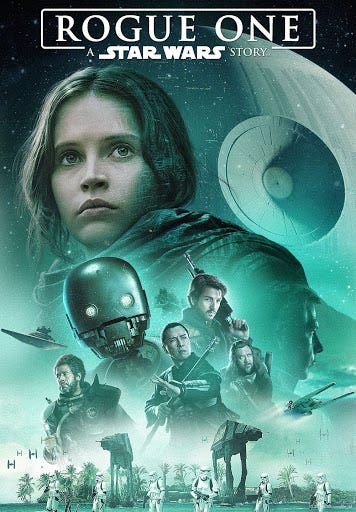
Rogue One: A Star Wars Story | List of Deaths Wiki | Fandom

Interestingly a big focus in that story, is on a young woman who is a reluctant fence-sitter at first but eventually comes around to the idea of rebellion. In fact, one of the most famous lines from the film is; "Rebellions are built on hope." 

Interestingly and just as with ‘Sunrise on the Reaping’, ‘Rogue One’ isn’t a kittens-and-rainbows happy-ending. It can’t be, because of what we know about what is to come in this universe and the story we’ve already been told. Schrödinger's cat is dead, so to speak, and we know that.

Much like Collins, it’s also a film that plays and pays fan-service, delightedly so.

It’s not surprising that ‘Rogue One’ is my favourite of the new Star Wars stories, and that I loved ‘Sunrise on the Reaping.’ Maybe for the same reasons, I loved them both; when you’re writing stories supporting just war theory and how messy revolutions can be, it’s not a bad thing to put a little sting in the tail and make them hurt, a little.

But I loved this. It resonated and moved me, and that's the Rorschach test that matters.

4/5

Friday, November 21, 2014

'The Hunger Games: Mockingjay Part 1' movie review


When Katniss destroys the games, she goes to District 13 after District 12 is destroyed. She meets President Coin who convinces her to be the symbol of rebellion, while trying to save Peeta from the Capitol.

We’re coming into the homestretch with this, the first part of the final movie adaptation of Suzanne Collins’ incredibly popular YA Dystopia ‘Hunger Games’ series (now franchise).


The movie begins some time after ‘Catching Fire’ – Katniss (the luminous Jennifer Lawrence) is physically recovered from her daring stunt during the ‘Quarter Quell’, having used her bow and arrow to direct a current of lightning at the force field that contains the Hunger Games arena, destroying the arena and resulting in her temporary paralysis.

Interestingly though, the opening scene of ‘Mockingjay’ highlights Katniss’s mental state – physically recovered she may be, but ever since she volunteered for the 74th Hunger Games she has been mentally eviscerated. She is suffering from Post-traumatic stress disorder (PTSD), what was coined ‘shell shock’ in the World Wars.

Not helping her mental state is her current location in District 13 – thought to be destroyed by the Capitol during the first rebellion, they have in fact been secretly militarizing themselves underground – and their President Alma Coin (Julianne Moore, with freaky contact lenses) organized to save Katniss, and now she needs to use her to fuel a rebellion against the Capitol. The rebellion needs their ‘Mockingjay’ symbol – for propaganda, and hope (arguably the most powerful form of propaganda). Katniss agrees, but only to save the Victors who remain prisoner of the Capitol and President Snow (creeeeeepy Donald Sutherland) – among them, Katniss’s fellow tribute and Hunger Games ‘winner’ Peeta Mellark (a transformed Josh Hutcherson).

Propaganda does not deceive people; it merely helps them to deceive themselves.
—Eric Hoffer

Let me start by saying that I liked this movie, but I didn’t love it – certainly not as much as its two predecessors. And I think a lot of that comes down to the fact that I wasn’t convinced that it needed to be broken into two parts.

I know, I know – it’s a money-maker and since Harry Potter broke ‘The Deathly Hallows’ and the Twilight Saga broke ‘Breaking Dawn’ into two parts, it was a given that ‘The Hunger Games’ YA adaptation franchise would do the same. But Rowling’s ‘Deathly Hallows’ was a whopping 759-pages, and Meyer’s ‘Breaking Dawn’ came in at 756. Suzanne Collins’ ‘Mockingjay’ was 390, in keeping with the page-count of the first two books. And, if I’m being perfectly honest, the page-to-screen adaptation suffers from injecting filler story that wasn’t in the book … and arguably, didn’t really need to be in the movie.


Most of the filler story is based around strategist Plutarch Heavensbee (in a stunning, bittersweet performance by the late, great Philip Seymour Hoffman) and President Alma Coin. There are quite a few scenes included that establishes their political machinations for Katniss as the symbol of their rebellion. Gale Hawthorne (Liam Hemsworth) is also pushed into the spotlight in this third movie, in an attempt to better round out the love triangle that so captivated readers.

The truth is the best picture, the best propaganda.
—Robert Capa

The political back-story does work, in one sense. It’s a mirror image that harks back to the scenes between President Snow and Gamemaker Seneca Crane (Wes ‘mustachioed’ Bentley) in the first ‘Hunger Games’ movie. They establish that Katniss is still a puppet, even though she’s now out of the arena – and the business of rebellion is as technical and political as Game-making. And while that’s all very fascinating and philosophical, it’s not terribly riveting. Sometimes all that saves the scenes between Plutarch and President Coin is Philip Seymour Hoffman’s captivating, nuanced performance. Injecting Jennifer Lawrence into these moments also works – a scene in which she’s being filmed for a propaganda ad is particularly artful, if only for Lawrence’s comedic timing.

When this storyline of Katniss as the Mockingjay symbol really works, is when Jennifer Lawrence is given a chance to shine in scenes of dramatic tension, rather than political maneuvering. Her visit to District 8 is especially heart wrenching – the camera stays on Lawrence’s face for most of this scene, and no wonder. She is a force to be reckoned with.


Other moments in the film that felt a drag, to me at least (and I will say that many in the audience started to fidget, becoming physically restless towards the end) concerned military operations. Scenes depicting other Districts rising up and joining the rebellion were heart-palpitating and often distressing, but powerful. But scenes in which District 13 carried out military operations felt a little too ‘Zero Dark Thirty’ for my liking. It leaves me concerned/hesitant for ‘Mockingjay Part 2’ … which we all know includes lengthy scenes of such operations.

It's so easy for propaganda to work, and dissent to be mocked.
—Harold Pinter

Something that did impress me in this book were the performances by supporting cast. Aforementioned Philip Seymour Hoffman, but also Elizabeth Banks as Effie Trinket. She has really made this role her own, and she provides some much-needed comedic relief in an otherwise fairly bleak installment (that’s only going to get bleaker in Part 2). Woody Harrelson continues to prove every nay-sayer (who wanted Robert Downey Jr.) wrong, in his role as Haymitch Abernathy – I love that in this movie, we see how much Haymitch has come to know and respect Katniss.


One cast member who maybe doesn’t shine quite so bright is Liam Hemsworth. He’s given some potentially great scenes to work with, but when he’s opposite Jennifer Lawrence he doesn’t rise to the challenge of her performance, and he often left me feeling cold. Likewise Sam Claflin as Finnick Odair who so impressed me in ‘Catching Fire’ – he seemed to get lost in this movie.


By contrast, Josh Hutcherson is fairly incredible in a very reduced role. He’s undergone a very physical transformation for this movie – he’s clearly lost a lot of weight as the role demanded, and the change is scary. I have to give him kudos too, right when I was whispering “I’m bored” to my seat-mate towards the end of the movie, Josh Hutcherson’s performance pulled me back in with his menacing turn. Costumer designer Kurt and Bart should also be praised for Hutcherson’s wardrobe, which included slick Capitol suits that seemed to physically choke and collar him.

 
Loud peace propaganda makes war seem imminent.—D. H. Lawrence

All in all, I didn’t LOVE this ‘Hunger Games’ installment but I enjoyed it – and mostly because I know where the story is going and I’m keen to race to the end. I mostly loved the scenes of District rebellion – particularly those that were soundtracked to Jennifer Lawrence’s ‘The Hanging Tree’ song (which I understand will not be on the movie soundtrack?! TRAVESTY!) There’s an escalation of violence in this movie that’s different from the killing featured in ‘Hunger Games’ and ‘Catching Fire’ – it’s disturbing and powerful, but most importantly it sends a message that has roots in today’s society, from Syria to Iraq and so much more …. Which is what Suzanne Collins intended in the first place. And maybe it's just the sentiments of the movie that I enjoyed most of all - fire is catching, after all. 

4/5

Wednesday, November 27, 2013

'The Hunger Games: Catching Fire' movie review


 Every revolution begins with a spark.


I had the great pleasure last night, of (finally!) seeing ‘Hunger Games: Catching Fire’ at IMAX Cinema. It was, of course, spectacular – and not just because between movie #1 and #2 Jennifer Lawrence (Katniss) has become an Oscar-winning, GIF-giving megastar of epic proportions … it was a wonderful film in its own right, and in keeping with the faithful adaptation of first book by director Gary Ross, ‘Catching Fire’ director Francis Lawrence has likewise delivered an extraordinary retelling of the second instalment in everyone’s favourite YA Dystopian series.

Remember who the enemy is.

Much like Suzanne Collins’ book, the first half of ‘Catching Fire’ focuses on Katniss and Peeta’s (Josh Hutcherson) lives in District 12 after their unprecedented double-“victory” in the 74th Hunger Games.


Katniss and Peeta are living in the Victor’s Village and suffering survivor’s guilt and post-traumatic stress disorder. They’re also not the happily-ever-after romance story the world thinks they are, and it’s apparent that shortly after returning home, Peeta figured out Katniss’s true feelings for him; not ambivalence, but not the love story he thought they were either. Katniss’s best friend and hunting partner, Gale (Liam Hemsworth) isn’t quite as convinced as Peeta that their Hunger Games romance was entirely fake, but he lets Katniss know where he’d like to stand in her life regardless.


When the film begins Katniss and Peeta are about to go on another whirlwind Victor’s tour of the Districts, culminating in a splashy Capitol party before the 75th Hunger Games are reaped.  This beginning of the film not only sets up Katniss’s post-Hunger Games life, but focuses on the over-arcing villains that carry the series to its conclusion. In the first film, scenes with President Snow were added to make it clear he was the bad guy – but in the book, Katniss and readers get their first real taste of him in ‘Catching Fire’. But what’s lost from Snow’s surprise visit, Donald Sutherland makes up with dripping menace and calculated threats in this second film.


The first-half of the movie also introduces us to the circumstances of the Districts. Previously confined to Katniss and Peeta’s 12, the Victor’s tour allows audiences to see that grey-tinged poverty and downtrodden citizens are not unique to Katniss’s home town, but all of Panem (barring The Capitol). This tour also hints at the sheer overwhelming depravity of Snow and the concept behind The Hunger Games. Forced to give speeches set out on cards, Katniss and Peeta address citizens, as the families of deceased contestants from said District stand on raised platforms. This is especially traumatic when they arrive in District 11, and Katniss is forced to look upon the faces of Rue’s family – it’s a heartbreaking scene that quickly delves into high-octane horror, in a perfect encapsulation of the entire Victor’s Tour.

While on tour Katniss and Peeta come face-to-face with the fallout of their Hunger Games win. There is disquiet and discontent in the Districts, and people are starting to fight back –it’s clear from the spray-painted Mockingjay symbol that abound, and the three-fingered District silent salute that is constantly raised … President Snow realises something must be done to quash Katniss’s unintentional rebellion.


Upon recommendation of new Game Maker, Plutarch Heavensbee (Phillip Seymour Hoffman – already so well-suited to the Capitol that the costume department decided to give him a sash and little else to define his character… so he’s pretty much just Phillip Seymour Hoffman, plus sash) President Snow decided that to celebrate the 75th Quarter Quell Hunger Games … all previous winners will be reaped. Which means, Katniss and Peeta are back in the arena.

The sun persists in rising, so I make myself stand.

When the film shifts back into preparation mode for Katniss and Peeta in this, the Quarter Quell, it’s a weird combination of fun and doom. On the one hand, this is a “best of” past Hunger Games contestants, and as those who’ve read the book know, ‘Catching Fire’ provides a wealth of interesting new secondary characters. There’s fan-favourite Finnick Odair (Sam Claflin – with a smile to rival Heath Ledger’s) and slyly outspoken Johanna Mason (Jena Malone – all ferocity and humour). All the contestants are PISSED. OFF at having to compete for their lives again, and they’re holding nothing back on stage with Caesar Flickerman (Stanley Tucci). On the one hand it is quite fun – Katniss is back and determined, if not to see herself survive, then to at least see Peeta through to the end. She’s in warrior-woman mode, and while it’s fun for the audience (more so than in ‘The Hunger Games’ when all contestants were children) … there’s no mistaking how horrendous it is to ask these (many of them damaged) survivors to re-enter the cause of their nightmares.  


The Arena is great. My mind was a little fuzzy on book details, but director Francis Lawrence never lets up once contestants enter the jungle arena. I jumped out of my skin so many times (the monkeys! THE MONKEYS!), but Francis Lawrence also does well to tease out these characters in-between the edge-of-your-seat escapes from poisoned fog and electrifying accidents.

Remember, girl on fire, I'm still betting on you.

Something that really came through in the movie for me – and it’s down to a great script, Jennifer Lawrence’s goddam beautiful portrayal and, I think, the fact that Francis Lawrence is at the helm for the two-part finale of ‘Mockingjay’ – is Katniss’s overall story-arc in this series. She goes from being an unwilling puppet in The Hunger Games for Capitol and President Snow’s amusement, to a sort of unwilling figurehead in the upcoming Revolution. That really hit home for me in this movie, even more so than it did in the books … to the point that I think the ending of ‘Mockingjay’ will make a lot more sense and not seem like such a cop-out to people.


And I think because of that I also, somehow, find myself firmly on Team Peeta. I don’t know what it was specifically (Hutcherson’s suddenly chiselled jaw, cute cowlick or the fact that I started to see Peeta as the only other person in the world to truly understand Katniss) but suddenly not even the steely-gaze of a Hemsworth could deter me from my Team Peeta banner waving.

I really, thoroughly enjoyed ‘Hunger Games: Catching Fire’. I know a lot was left out (mostly to do with getting-to-know the fellow Quarter Quell tributes) but Francis Lawrence did well to raise the energy and high-stakes in this second film, in a very honest adaptation of Suzanne Collins’s book. Jennifer Lawrence was, as always, perfection; a great combination of suffering survivor, loving sister and determined warrior. Josh Hutcherson seems to have suddenly found his leading-man shoes and even Sam Claflin (who initially underwhelmed me in advance photos, and broke my heart when he announced, almost proudly, that he “doesn’t read”) had me on-board.

Now, gimme ‘Mockingjay: Part 1’!

5/5

Thursday, March 22, 2012

'The Hunger Games' movie review

  ** It goes without saying that there are SPOILERS in this review, of all the books in Suzanne Collins’s series **

24 tributes enter.
Only one will survive.
Let the games begin.

This is it. The moment fans have been waiting for since they first read about The Capitol, District 12 and Katniss Everdeen back in 2008. The adaptation of Suzanne Collins’s first book in her ‘Hunger Games’ trilogy is here, and it’s bloody spectacular.
Great Expectations

I was lucky enough to win tickets to an advanced screening of the film (Thank you, Empire Magazine!) last night. I went to the film in two minds… being a HUGE fan of the book series I did have my reservations about an adaptation. I ashamedly admit I was one of those people who scoffed at the announced casting of Jennifer Lawrence in the epic role of Katniss. I can admit it now (with hanging head) that I was rooting for Kaya Scodelario and couldn’t imagine Jennifer, blonde bombshell and Oscar nominee, as everybody’s beloved volunteer tribute. Oh, how wrong I was!

I was also concerned, like many fans, about the supposed PG+13 rating of the film. I couldn’t imagine how director Gary Ross could do Collins’s book series justice with a PG leash, when violence and glorified blood sport is not only the backbone of the plot but an intricate reflection of the distorted dystopian society. Luckily the film ended up with an M-rating, recommended for mature audiences… And in the film Ross proves that the violence can be impacting and justifiably horrifying, without being overtly bloody or gratuitous.


And, finally, I was most concerned by the casting of Josh Hutcherson as Katniss’s fellow District 12 contribute, and potential love interest, Peeta Mellark. Josh is 20 to Jennifer Lawrence’s 22, but his short stature and baby-face make him appear even younger… especially when compared to Liam Hemsworth who plays Gale Hawthorne, Katniss’s friend and eventual rival for her affections in the next two books. My worries about Hutcherson were not helped when I started perusing the premiere photos of him with his co-stars. The height and age difference in real-life seemed a (laughably) too big hurdle to overcome, and I wondered if the awkward red-carpet poses would translate to the big screen….
A World Away

First of all, the look of ‘The Hunger Games’ is fantastic! I think Gary Ross was doing a bit of a head-nod to the fact that Collins’s books have been compared to George Orwell’s ‘1984’… while watching I did think that parts of the District 12 and Capitol worlds were reminiscent of the 1984 film adaptation. It was in the ‘fancy’ blue clothing that the District 12 children wore to their Reaping, and the smooth granite façade of the Capitol’s stadium.

District 12 will feature more prominently in the next two adaptations, but the glimpse we got in this first movie was exactly what I wanted. It’s like a time-warp, made all the more noticeable when compared to the glitz and glamour of the Capitol. And it was here that Ross’s adaptive vision really excelled…

I said in my book review of ‘The Hunger Games’ that the look of the Capitol and its residents all leaked into the Dystopian theme… District 12 is the coal district, and its residents are hard done by - they’re all a little ragged and dirty and in a 1950’s depression era look, whereas the Capitol is full of outlandish abundance. Women dye their skin fanciful colours and men wear gravity-defying hair dos. There’s no doubt that this fictional future dystopia is our current society in a fun-house mirror – embellished and ruined. But Gary Ross’s Capitol has the feel of Marie Antoinette’s Versailles – for all the pompous wigs and garish colour schemes. Marvelous!

My one complaint with costume design had to do with Katniss and Peeta’s all-important fire costume (which gives Katniss the nickname, ‘The Girl on Fire’). I know this was a tall order, costume-wise, but the flames were underwhelming and too fake looking. I liked their coal-black costumes, but the flames were a bit of a CGI giggle. What worked better, I thought, was Katniss’s twirling flames number, when she’s interviewed by Caesar Flickerman. Now *that* looked cool!
All the Men and Women, Merely Players

What really stood out for me in this movie was the absolute spot-on perfection of the secondary characters.

The smaller players in the books actually come to mean a great deal as Katniss’s story progresses… and for some of them, their roles gain weight in the next two books. So I was pleased-as-punch to discover that the casting of secondary characters was absolutely nailed! There were three stand-outs for me...

Elizabeth Banks as Effie Trinket, Katniss and Peeta’s Capitol-assigned escort. Banks could have been swamped by the outlandishness of her character, and furthermore by her gloriously over-the-top costume. But she really, truly excelled in this role (small as it may be). She was funny, while managing to remain a Capitol darling who doesn’t quite gain our sympathy just yet…


Stanley Tucci as Caesar Flickerman was PERFECTION! Caesar is the host of the Hunger Games televised event; he interviews the tributes and narrates the goings-on of the actual arena games. I’m a big Tucci fan anyway (coolest dad ever in ‘Easy A’!) but I thought he outdid himself and fan expectation in this role. Even without garish prosthetics (there was rumour of false teeth) he managed to convey the disturbing hilarity of Caesar’s role to narrate the bloodthirsty games for the viewers at home. Tucci’s smile alone was totally Caesar – through and through.


Finally, Amandla Stenberg as Rue, the young District 11 Tribute. Now, Rue’s book character has a big fan-following, and was always going to be favourite. So I do wonder if part of my being impressed by Stenberg was just the fact that she had a great character to play (courtesy of Suzanne Collins), but upon reflection I just think she was another example of hit-the-nail-on-the-head casting. Rue’s early scenes drew some sweet giggles from the audience (particularly her antics during Tribute training) but it was her climactic death that really proved she was a force to be reckoned with. It’s a pivotal scene for a lot of reasons – Katniss’s first close quarters kill, among them. But the scene was just heartbreaking and both Stenberg and Lawrence did a wonderful job. The sound editing in this scene, and switched-perspective were also masterful.


One of the more contentious secondary character castings in the movie was Woody Harrelson as Haymitch Abernathy, previous District 12 winner, now Katniss and Peeta’s mentor. I know everybody wanted Robert Downey Jnr (me included!) to play the alcoholic curmudgeon. But Harrelson did a surprisingly good job (distracting blonde, straggly locks aside). Something I liked in this adaptation was how Gary Ross showed the behind-the-scenes workings of the Hunger Games. He takes viewers out of the arena on occasion, to show Haymitch schmoozing with Capitol sponsors and getting people on the outside onside with Katniss and Peeta. This was brilliant, and a very important component to the Games! I also liked Haymitch’s interactions with Games coordinator, Seneca Crane (Wes Bentley – with a FANTASTIC beard!), which illustrated just how badly the odds are, and not always in anyone’s favour because much of the Games is scripted. Likewise, Seneca’s scenes with President Snow (Donald Sutherland – again, more brilliant casting) are a nice leeway into the next two books…

Probably the worst casting was Lenny Kravitz as Cinna (Katniss’s designer). He pretty much just played Lenny Kravitz (tight leather pants, but no sunglasses – thankfully!). His scenes illicited a few giggles, only because of the absurdity of Lenny Kravitz dishing out deep and meaningful’s.
Heroes and Legends

Now, to the most important casting of all… Katniss and Peeta.

I won’t comment on Liam Hemsworth as Gale. As fans of the books know, Gale’s role in the first novel is absurdly small and it’s impossible to say anything about Hemsworth’s role beyond “he did good”. If I was Josh Hutcherson I might be mildly ticked off at having to share the red-carpet with an co-star who had a diminished role in comparison to my own… but, hey, Gale’s importance lies in book’s two and three.

I bow down before Jennifer Lawrence and take back every single negative thing I ever said about her casting. She was perfection. I always think that with ‘Twilight’, fans are smitten with the series because of love interests, Edward and Jacob (nobody actually likes Bella, do they?). But with ‘Hunger Games’ it seems like all fans have a bit of a crush on Katniss. We want to be her and we want the best for her… so much so that her character has taken on a cult-like following, akin to her role in the District revolution. But fans forget that while she kicked butt in ‘Catching Fire’ and ‘Mockingjay’, she started out as just another scared tribute in ‘Hunger Games’. Jennifer Lawrence bought such a fantastic, steely vulnerability to the character – she was sublime, and I think she will have exceeded many fan’s expectations.


Josh Hutcherson as Peeta, I’m a little more on-the-fence about. I admit, I went in with low expectations and came away pleasantly surprised… but not totally convinced. I still think that in the romance stakes, there’s no competition between him and Liam Hemsworth, and knowing the outcome of the love triangle I’m afraid lots of people will be wondering a big WTF? when it comes time for Katniss to choose. So I didn’t feel much sizzle between Peeta and Katniss (admittedly though, we’re meant to be constantly questioning and double-guessing Peeta’s affections for Katniss… so maybe that worked well in hindsight?). I just didn’t take Peeta seriously enough, I don’t think. I mean, there was one camouflage scene that had me (and the entire audience) cracking up in hysterics, but I still don’t know if that was actually meant to be serious (instead I was left to wonder why the Capitol included a M.A.C. cosmetics counter in the arena?). I think Josh Hutcherson will really be given an opportunity to show his mettle in ‘Catching Fire’, and I really hope he doesn’t botch it up. It could go either way at this stage.
The Sound and the Fury

Finally, I feel like I have to mention the violence. I really, truly think that the violence was necessary in this adaptation, because it’s intricate to the books. The unnatural violence of kids killing kids for sport and entertainment is so viscerally wrong, it’s part of how Collins framed this as a Dystopian world.

Gary Ross does bring the violence in this movie. It’s not overly bloody, and it’s not unnecessary and does stay true to the books… but I know that at the advanced screening there were people wincing and flinching, gasping at certain death scenes. And you know what? – good! It’s meant to impact. It’s mean to provoke a feeling of horror and wrongness – juxtaposed with the scenes of Capitol viewers going crazy with blood-lust as they watch the big screen.
May the Odds be Ever in Your Favour

All in all this is a superb adaptation – and a befitting tribute to Suzanne Collins’s wonderful series. If you loved the books, rest assured they have been adapted with the upmost care, respect and craft. I can’t wait for the next two films – bring it on!

| More