Search This Blog

Showing posts with label Charlaine Harris. Show all posts

Tuesday, February 23, 2021

'The Russian Cage' Gunnie Rose #3 by Charlaine Harris


From the BLURB: 

No.1 New York Times and USA Today bestselling author Charlaine Harris is at her best in this alternate history of the United States where magic is an acknowledged but despised power in this third instalment of the Gunnie Rose series. 

Picking up right where A Longer Fall left off, this thrilling third instalment follows Lizbeth Rose as she takes on one of her most dangerous missions yet: rescuing her estranged partner, Prince Eli, from the Holy Russian Empire. Once in San Diego, Lizbeth is going to have to rely upon her sister Felicia, and her growing Grigori powers to navigate her way through this strange new world of royalty and deception in order to get Eli freed from jail where he's being held for murder. 

Russian Cage continues to ramp up the momentum with more of everything Harris' readers adore her for with romance, intrigue, and a deep dive into the mysterious Holy Russian Empire.

* 

'The Russian Cage' is the third book in Charlaine Harris' alternate-history urban fantasy series, in which the Holy Russian Empire rules over a portion of America after influenza wiped out a majority of US politicians and left a power-vacuum that was filled by the escaped royal family of the Romanovs.

'Russian Cage' picks up a little down the ways from second book 'A Longer Fall', after which our 'gunnie' (gun-for-hire, strictly protection not assassination) Lizbeth Rose parted ways with magical grigori Eli, who returned to the Holy Russian Empire and left Lizbeth in Texoma ('Texas') - even though they'd established a powerful romantic entanglement. Eli had family and business to settle back home, and that side of the country is tricky for Lizbeth to enter into - because she's a descendent of Rasputin, and her blood is of great value to the Tsar for healing purposes.

But it's no surprise that Book 3 kicks off with Lizbeth getting word that Eli is in trouble - imprisoned and accused of a crime nobody will reveal - and she promptly decides it's finally time to visit the mysterious Holy Russian Empire (which roughly makes up the entirety of California) to save Eli.

Now, my heart kinda sunk once I realised that a chunk of this book would be Lizbeth and Eli separated and following Lizbeth as she tries to break him out and save him. I get it, I get it - it's way more interesting if she has to navigate Eli's territory solo and raises stakes if his freedom is her motivator. But I've come to really appreciate the Lizbeth and Eli romance, and a big basic part of me just wanted to read them together again (I know, I know - stories need 'tension' and 'plot' and all that jazz!)

It is really interesting finally seeing the oft-spoke-about Holy Russian Empire through Lizbeth's eyes for the first time. The story is mostly situated in San Diego, and involves Lizbeth meeting Eli's family (his mother, sisters, brother and stepbrothers) and getting up close to the monarchy and high-society. She also gets to reconnect with her sister, Felicia, who is situated at the Grigori School where she's learning magic and also subterfuge, as becomes apparent to a fairly proud Lizbeth.

I did really enjoy this story, *even though* the Holy Russian Empire was kind of a let-down after being so built-up in the previous two books? I think it's mostly that the plot is very focused on political intrigue and savagery, so the scenery kinda passes us by? But also speaking of the intricate machinations of the plot - I also found some really Big Events just whizzed by me and it wasn't until characters were recounting what happened that I even realised where we'd moved to in the story? I think it's because lots of these finer-points happen off-page, and it's hard to keep up when there's so many major and minor characters that fill out the Russian Monarchy coming and going.

I am usually a big fan of Charlaine's ability to pace and build tension, but honestly and compared to the finely-detailed and edge-of-your-seat finesse to be found in her 'Harper Connelly', 'Lily Bard' and 'Aurora Teagarden' books (I will concede that sometimes 'Southern Vampire' plots were *a trip* ... especially during the damn faerie instalments) - I just don't have the same admiration for the crime and thriller details of the plot in 'The Russian Cage'. It's not working like a well-oiled machine, and I think it's mostly down to a particularly bloated cast and too many layers of off-scene political infighting. Which - to be fair - previously Charlaine has focused on small-town intrigue and very insular-type stories (even Sookie mostly dealt with low-level vampire bureaucracy of Louisiana, and tried hard to stay off the radar of the higher-ups). 'Gunnie Rose' is Charlaine trying to fold in alternate histories, reconfigured politics, and all playing out on a much bigger stage of how an unstable Holy Russian Empire fits into this new America - with Lizbeth as a possibly lynchpin amidst it all too. It's a LOT.

I will also flag that I kinda read 'The Russian Cage' assuming it was closing out what would be a trilogy. But as I got closer to the end I started thinking; "Hmmmm, feels like there's more to come," and then LO! - I check and there's a fourth book due now too, for 2022. Which makes me nervous. Because Charlaine Harris is notorious in many of her series for totally and tragically upending her protagonist's lives once they get a *little bit* settled. And 'Gunnie Rose' has been the darkest in tone of all Charlaine's series so far, so I'm not holding my breath for everything to continue to be smooth-ish sailing for all involved.

But, I am excited to see where else this story goes. There's a real trend now for alternate American-history Western Dystopia's (see also: 'Outlawed' by Anna North, and 'Upright Women Wanted' by Sarah Gailey) that I am *so intrigued by* and wonder if its a byproduct of the Trump era to imagine all the sliding-doors ways that America avoided catastrophe throughout history (certainly in Charlaine's series, the question of what would have happened if Russia had a foothold in America, and a deadly pandemic was mismanaged to the point of fracturing the United States is ... *pointed*. And she started this series in 2016, in 'Unfettered II: New Tales By Masters of Fantasy' Anthology!)

4/5

Monday, July 13, 2020

'A Longer Fall' Gunnie Rose #2 by Charlaine Harris


From the BLURB:

In this second thrilling installment of the GUNNIE ROSE series, Lizbeth Rose is hired onto a new crew for a seemingly easy protection job, transporting a crate into Dixie, just about the last part of the former United States of America she wants to visit. But what seemed like a straight-forward job turns into a massacre as the crate is stolen. Up against a wall in Dixie, where social norms have stepped back into the last century, Lizbeth has to go undercover with an old friend to retrieve the crate as what's inside can spark a rebellion, if she can get it back in time.

‘A Longer Fall’ is the second book in Charlaine Harris’ Western Paranormal ‘Gunnie Rose’ series – set in an alternate world-history timeline in which the Romanov family escape Russia and revolution with their lives, and would go on a land-grab of America after the influenza pandemic wiped out most of the powerful men in Washington and left a power-vacuum.

So … I read the first book ‘An Easy Death’ way back in 2018 and when I went to continue the series with ‘A Longer Fall’ I’d evidently forgotten a lot of the world-building because it hit me like a brick. That Harris – back in 2018 – was writing a skewed world-history in which the trajectories of revolution and pandemic skewed slightly and totally remade the world? Yah. Reading the second book in 2020, it slaps hard.

‘A Longer Fall’ picks up a while after ‘Death’ when our protagonist, Lizbeth (a gun-runner with companies-for-hire) is helping transport precious cargo on a train that suddenly explodes and is derailed, then raided by masked bandits. What follows is an ‘Indiana Jones’-esque storyline of trying to get a trunk to where it needs to be, and along the way grigori wizard Eli reappears when it so happens that the trunk Lizbeth and Co. were carrying, is of great significance to the Holy Russian Empire …

Someone recently asked me if they’d enjoy this series, given their only other Charlaine Harris read was the entire ‘Sookie Stackhouse/Southern Vampire’ series and the way that ended left an (understandably) sour taste. I warned that ‘Gunnie Rose’ is perhaps the straight-up darkest of all Harris’s works; and even though all her books get there eventually, ‘Gunnie’ starts out dark in tone and then it’s a matter of brief glimpses of light getting in. One of those glimpses is the Russian wizard Eli, and his strange relationship with Lizbeth that’s built around their chance-encounters and clear sexual chemistry… but also a shared secret that Lizbeth has grigori blood in her veins.

Even though ‘Gunnie’ is the darkest in tone of all Harris’s books (beating out the previous ‘Midnight, Texas’ that I would have said had much more sinister southern gothic tones) I am so enjoying this ride. And ‘A Longer Fall’ especially – reading in 2020… it has HBO’s ‘Watchmen’ vibes meets ‘Indiana Jones’ for its vigilante, racial upheaval and culture-war undertones. I’m really impressed that Harris pulling on this one thread of history has unravelled so much of present-day society which is exactly what the best of fantasy and sci-fi should always do; hold a mirror up to the present world and make commentary through various mechanisms of almost absurdity.

I really enjoyed ‘A Longer Fall’, and can’t wait for ‘The Russian Cage’ coming in February 2021, which promises to send Lizbeth to the Holy Russian Empire (finally!). I really can’t see this series wrapping up in 3 books though, when the weight of the real world seems to be increasingly impressing on its relevance. I’m hoping for a full-blown multi-book series that continues to build this universe.

5/5

Tuesday, November 6, 2018

'An Easy Death' Gunnie Rose #1 by Charlaine Harris


From the BLURB:
From the No. 1 New York Times bestselling author of the Sookie Stackhouse series and the inspiration behind HBO's True Blood, comes an electrifying new thriller centered on a young gunslinging mercenary, Lizbeth Rose.

Set in a fractured United States, in the southwestern country now known as Texoma, this is a world where magic is acknowledged but mistrusted. Battered by a run across the border to Mexico, gunslinger Lizbeth Rose takes a job offer from a pair of Russian wizards.

She may be young, but Gunnie Rose has acquired a fearsome reputation and the wizards are at a desperate crossroads, even if they won't admit it. They're searching frantically to locate the only man whose blood they believe can save their tsar's life.

As the trio journey through an altered America, they're set upon by enemies. It's clear that a powerful force does not want them to succeed in their mission. Lizbeth Rose is a gunnie who has never failed a client, but her oath will test all of her skills and resolve to get them all out alive.

The Dark Tower meets True Blood in this gritty and wildly entertaining tale of Gunnie Rose. A woman fighting unimaginable odds to keep her people alive after the disintegration of America, this is a surefire hit for fans of The Walking Dead or Westworld.

‘An Easy Death’ is the first book in a historical-paranormal series by American author Charlaine Harris, called ‘Gunnie Rose’.

If you’ve been reading my book blog for a while now, then you would have figured out that Charlaine is easily one of my all-time favourite authors – and certainly the one I own the most books of. I inevitably fall in love with all her new series (whether they’re gritty small-town mystery noir, or paranormal-noir) I always get hooked, and I’m thrilled to say that ‘An Easy Death’ first book in this new series is no exception.

For one thing, Charlaine Harris has her finger on the pulse of American society. It’s little wonder that ‘Dead Until Dark’ – the first book in her ‘Southern Vampire’ series – came out in 2001, the time of September-11 and the most deadly terrorist attack on American soil. What followed in that series (at first very successfully, and then towards the end – less so) was a paranormal story focused on vampires that unlike Stephenie Meyer’s ‘Twilight’ a few years later, was not solely focused on vampirism as a metaphor for lust, but rather as an ongoing metaphor for “othering” in American society. Which remained especially timely when HBO and Alan Ball adapted the books into the mega-successful (again, more in the beginning than the end) television series ‘True Blood’, that used vampirism as an allegory for the gay rights movement in America. The final and seventh season of the show aired in 2014, and the following year in America the U.S. Supreme Court struck down all state bans on same-sex marriage, legalized it in all fifty states.

So, yes – you can see that Charlaine Harris often has a canny ability to take a long view of the present situation in America and write some fabulously quirky and timely allegory and metaphors. Which is especially true here, in ‘An Easy Death’ and post-2016 Trumpism but especially Russian interference in Western democracy. Because ‘An Easy Death’ and the ‘Gunnie Rose’ series is essentially a historical-paranormal Western mash-up, set in a fractured America that broke apart after President Roosevelt and half the nation died in the wake of an influenza epidemic.

As the protagonist, Lizbeth Rose’s, teacher mother explains to her daughter one day;

A lot of people didn’t want to talk about the past, because it was painful. But Mom thought I should know how things had gotten to be the way they were: the dead president, the dead vice president (influenza), the banks crashing, the drought, and the influenza … again. 
The population had dropped, the government could not protect itself, and other countries had grabbed pieces of America.“USA got big bites takes out of it: by Canada from the north, by Mexico from the south, and by the Holy Russian Empire from the west, where the Russian tsar settled when he fled his own country. To the east, the thirteen original colonies – all but Georgia – voted to form a bond with England, to keep from becoming part of Canada. They picked the name Britannia. The southern states banded together as Dixie. Georgia went with them.” She was pointing out the new countries on the map. 
“So what about us?” I asked, looking at the old map. She pointed to the place where we lived. “Texas and Oklahoma and New Mexico and a bit of Colorado became Texoma, where we live. We live in Segundo Mexia, in Texoma. And this big area north of us, the plains, that’s New America.”

Yes, especially interesting that in this version of human history – the Romanov Dynasty was not ended in a basement execution by Bolshevik rebels, but rather the tsar and his family (yes, all four daughters and son) were rescued by his British cousin, and were royal refugees for a time until they swooped in on a weakened America and created the Holy Russian Empire (HRE).

When ‘An Easy Death’ begins – Lizbeth says that following Nicholas’s death, the young Tsarevich of Russia Alexei Nikolaevich has taken over as tsar (though rumours abound that he has a blood disease that keeps him perilously close to losing control of his reign).

And while at first all of this big moving around of human history like jigsaw pieces feels like Charlaine Harris just world-building, it’s actually surprising how much all of the above soon comes to directly affect Lizbeth Rose and the trajectory of this gun-slinging story – when she’s offered a job to bodyguard two grigoris from the HRE as they hunt down one of their own …

Now, as is often the case with the first book in a Charlaine Harris series – there is a lot of laying the land here, and possibly more than usual because there’s a historical component to this story (that as far as I can tell, takes place some times in the 60s?) and has to go over some rewriting of the 20th century to explain a few things;

And bandits were everywhere, especially in Texoma, New America, and Dixie. I had heard that in Britannia, the area that had knelt to England, there was so much law that bandits were caught and hung quickly. The same for Canada, which had expanded to take in a lot of northern America. Canada had its horseback police, who were supposed to be crackerjack at their jobs. The Holy Russian Empire had a squad of grigoris and militia whose job it was to track highway robbers and kill them on the spot. 
But in Texoma and New America, formal justice was scarce on the ground.

I can imagine that people who come into this hoping for all the Western gun-slinging and paranormal fun (of which there is – since grigoris in this universe do possess magical abilities) may get frustrated with how slow-going this is.

But I personally loved everything about ‘An Easy Death’ – right down to the very sparse romance that could well grow into more with the series, or be a one-off (something else Charlaine Harris is very fond of, is a sort of “red-herring” romance in the first book and a completely new contender appearing down the track). Certainly ‘Gunnie Rose’ feels like classic Westerns, tipping into enclosed mysteries – in which every book could be a completely new adventure with a whole new cast of characters. I have learnt to be somewhat patient with Charlaine Harris, especially in the romance department (hello, Harper Connelly and Tolliver!) so while there's not a lot to go on here, I have hope and confidence that that will become more of a focus down the track ...

Either way, I am onboard! And given the comparisons to ‘The Walking Dead’ and ‘Westworld’ especially (I’d also throw ‘Wynona Earp’ in the mix) I’m also not surprised that this is yet another Charlaine Harrris book being optioned for television (her series ‘Midnight, Texas’ is also a seriously decent paranormal show!)

But mostly I am very impressed by Charlaine building an entire series on the premise of how precarious American history has been – that it all could have been so very different give or take a few influential players dropping off the scene … and talk about Russian interference in modern US-politics, here’s a new series in which the Russian Empire has embedded itself in the American heartland. I can’t wait to sit back and see how all of this unfolds, indeed.

-->
5/5

Monday, August 7, 2017

‘All the Little Liars’ Aurora Teagarden #9 by Charlaine Harris


From the BLURB:

Aurora Teagarden is basking in the news of her pregnancy when disaster strikes her small Georgia town: four kids vanish from the school soccer field in an afternoon. Aurora's 15-year-old brother Phillip is one of them. Also gone are two of his friends, and an 11-year-old girl who was just hoping to get a ride home from soccer practice. And then there's an even worse discovery at the kids' last known destination, a dead body.

While the local police and sheriff's department comb the county for the missing kids and interview everyone even remotely involved, Aurora and her new husband, true crime writer Robin Crusoe, begin their own investigation. Could the death and kidnappings have anything to do with a group of bullies at the middle school? Is Phillip's disappearance related to Aurora's father's gambling debts? Or is Phillip himself, new to town and an unknown quantity, responsible for taking the other children? But regardless of the reason, as the days go by, the most important questions remain. Are the kids still alive? Who could be concealing them? Where could they be?

With Christmas approaching, Aurora is determined to find her brother . . . if he's still alive.

‘All the Little Liars’ is the ninth book in Charlaine Harris’ recently-rebooted ‘Aurora Teagarden’ cozy-mystery series, about a sleuthing librarian and her little town of Lawrenceton, Missouri (the first few books of the series have also recently been adapted into a bunch of quite-okay but much tamer than the books, Hallmark Movies starring Candace Cameron Bure).

I say this series has been “rebooted”, because the last we saw of Aurora was the 2003 book ‘Poppy Done to Death’. Harris wrapped up (or so we thought) the Aurora Teagarden mystery series, just as her ‘Sookie Stackhouse: Southern Vampire’ series (which would eventually become the ‘True Blood’ TV series) was really taking off … around book three, ‘Club Dead’.

I know Charlaine often gets asked which of her backlist mystery series she’s most likely to revisit with new books – and her answer has long been ‘Aurora Teagarden’, purely because that’s the universe where she still has story-ideas. I, personally, would give *anything* for more books in ‘Lily Bard’ which is my go-to “Must Read Charlaine Harris” rec, but I was fine to have new-anything from Ms Harris. However … the rebooted Aurora is a little odd.

For one thing – you definitely can’t come to ‘All The Little Liars’ without having read all previous eight books in the series. I assume though, that part of the reason Aurora ‘Roe’ has been revisited is because Charlaine has nabbed a whole bunch of new readers in the time since ‘True Blood’ and the Hallmark movie adaptations – the covers have been redesigned, there are omnibus editions out now … so certainly, I think there are new readers coming to these books and her entire backlist. Charlaine Harris has been revisiting and rebooting a few of her series lately, in general. ‘Midnight, Texas’ (which is now also a TV show, and not half bad) was Charlaine bringing together a bunch of random secondary characters from all her past series.

But for those of us who stuck with Aurora from the very beginning, it’s hard to forget the weird transition the series went through around book 6, ‘A Fool and His Honey’ which is when (SPOILER ALERT) – Aurora’s husband, Martin, was killed off. This was undoubtedly a shock, and Charlaine tried to reign in a happy ending in books 7 & 8 by reintroducing a love interest from book 1 in crime-mystery writer, Robin to pair off with Auroa at the 2003-conclusion of the series. But it was a little clunkily done. While also not surprising in the least – because if there’s anything I’ve learnt from reading every single Charlaine Harris book, ever – it’s that she does not like traditional pairings for her heroines. She likes to pull the rug out from under readers … she’s very much of the Louisa May Alcott school of ‘Professor Bhaer + Jo’ romancing, more so than the Team ‘Laurie + Jo’ thinking. Fair warning for anyone wanting to get stuck into her backlist books (which you totally should!) but she likes to serve her readers spoonfuls of salt with their happily-ever-after’s

So ‘All The Little Liars’ picks up where 2003 Aurora left off – married to Robin, and expecting a baby while also being guardian to her little half-brother.

The mystery in book nine, pivots around the disappearance of Aurora’s brother, Phillip, two of his friends and 11-year-old daughter to the local priest. The case was interesting enough – and certainly provided an opportunity to seamlessly revisit all of Roe’s family members and townsfolk friends (to rejig a few reader-memories, I’m sure). But it got a little boring.

Now, I’ve always been a big fan of how Charlaine Harris – in her cozy mysteries – actually teases out how boring and mundane violence and crime are, and she’ll often observe a whodunit over the course of, say, a week and really show how boots-on-the-ground grinding an investigation can be (interspersed with tense interactions and repercussions on the lives of those waiting for a culprit to be found). But this mystery was missing kids, and even if it’s not accurate, I felt like there should have been higher-levels of tension and panic from everyone involved.

I also struggled with this one because I wasn’t getting much from the Aurora/Robin relationship. I really liked Martin (though weirdly, in this book Roe makes quite a few throwaway comments about how overbearing and tricky he was as a husband?) … but Martin and Roe’s relationship was intense and hot, and a sexy harmonising to the gritty crime-of-the-week being explored. Robin, while more sedate and solid for Roe – is not so fiery and passionate as Martin, and therefore bought that balance of crime/family down a couple notches.

All in all this one was … a disappointment. I’m still here for the next book in the rebooted series, ‘Sleep Like a Baby’ coming September this year. But I’ll keep my expectations a little more in check.

2/5


Tuesday, May 3, 2016

'Night Shift' Midnight, Texas #3 by Charlaine Harris

Received via NetGalley

From the BLURB:

Welcome to the most intriguing mystery you'll read this year.

Welcome to Midnight, Texas.

At Midnight's local pawnshop, weapons are flying off the shelves-only to be used in sudden and dramatic suicides right at the main crossroads in town.

Who better to figure out why blood is being spilled than the vampire Lemuel, who, while translating mysterious texts, discovers what makes Midnight the town it is. There's a reason why witches and werewolves, killers and psychics, have been drawn to this place.

And now they must come together to stop the bloodshed in the heart of Midnight. For if all hell breaks loose-which just might happen-it will put the secretive town on the map, where no one wants it to be...

‘Night Shift’ is the third book in Charlaine Harris’ ‘Midnight, Texas’ urban fantasy series.

I must admit that I went into ‘Night Shift’ a little bit wary. I really, really disliked Harris’ sophomore effort in a series that brings minor and beloved characters from all her other series together … But second book ‘Day Shift’ lacked emotional heart for me, and largely because two of my favourite characters established in book #1 were inexplicably cut down. But I was quickly buoyed by ‘Night Shift’, because those two favourites – Fiji and Bobo – and their unrequited love affair was touched upon quickly, hinting that it’d be a lodestone for this instalment. And lo and behold, it was;
 Bobo had seemed a little broody for days, though no one was sure why. Fiji who was always aware of Bobo, was a little hyped by the fact that she was almost certain that he was staring at her even when she wasn’t speaking. She didn’t know why; she sadly suspected it was not for the same reason she liked to look at him. In fact, looking at Bobo was one of her favourite things to do.

Something is stirring underneath the town of Midnight, Texas. Strangers are being pulled to the town to commit suicide at the crossroads, and everyone in town is aware that this is just the prelude to a bigger bad waking … The best way to describe the action of ‘Night Shift’ is with this exchange between witch Fiji and psychic Manfred, which I loved because it speaks to a more menacing and intriguing “big bad” that’s plaguing the town of Midnight, and just because I love how meta it is that Charlaine Harris gives some love to ‘Buffy’ when she herself is the creator of what has become another iconic vampire series (there’s also mention of Fiji reading some Anne Rice, which also tickled my meta);

“Maybe you’re right, Manfred. Did you ever watch Buffy the Vampire Slayer?” 
The change of subject left him teetering. 
“Ah … sure. My grandmother loved it.” 
“Do you ever wonder if Midnight’s on the Hellmouth? Like Sunnydale?” 
Manfred laughed. “That’s exactly what it feels like,” he said. “You must be Willow, and Olivia must be Buffy. And Lemuel is Angel.” 
That brought a smile to Fiji’s face, too. “I would classify Olivia more as Faith,” she said. “Bobo can be Xander.” 
“So Diedrik would be Oz.” 
For a reason Manfred couldn’t fathom, Fiji flushed.
 
I loved the mystery at the heart of ‘Night Shift’, both because it’s more satisfying than the more human mysteries of the past two books and because Fiji very much gets to be at the centre of things. For this reason also, Bobo doesn’t get a lot of page time which I didn’t love … but I can appreciate this book being more Fiji’s show, Bobo had to remain a bit of a mystery to her (and therefore, to readers). I adore Fiji and any time Charlaine Harris chooses her as the series focus, the plot is vastly improved.

I also appreciated that Harris at least touched on a little mystery for Manfred, by mentioning the young woman he crushed on in book #1, but who has all but vanished from the series since; 

Manfred wondered how Creek Lovell was faring. He’d had a crush on her the size of a boulder, and he’d never figured out if it was returned.
 
I can’t find anything on the internet about whether or not ‘Midnight, Texas’ will continue beyond ‘Night Shift’ – but I sure hope so, for this little emotional nugget about Manfred and Creek, and also because my old favourite from Sookie’s world – Quinn, the weretiger – has hope in his heart by the end of ‘Night Shift’, and I’d love to see how it works out for him.

I really, really loved ‘Night Shift’ – even as things got a little ridiculous towards the end, I just found it great fun and really thought Harris hit her stride juggling all these characters and their relations against a menacing big bad. ‘Midnight, Texas’ is currently filming as a TV-movie, which I’m also ridiculously excited about (not least because Dylan Bruce – who played Paul in ‘Orphan Black’ is onboard to play Bobo!), and the IMDB description has it billed as “Twin Peaks meets True Blood” which is just so on-the-money I can’t stand it, and my hopes are up high.

‘Night Shift’ is Charlaine Harris at her tangled, paranormal-noir best – with beloved witch Fiji as the emotional centre of this instalment, plus a good subplot about Olivia and Lemuel and enough kernels of complication to leave fans hoping for more instalments … ‘Night Shift’ is the high of this series so far, and I want more.

5/5

Saturday, October 31, 2015

'True Blood' TV series review


Yes, yes – it’s Halloween in Australia (which should be an oxymoron but: capitalism). I can’t bring myself to read any horror-anthologies let alone review any book to theme. But these past few weeks I have binge-watched all seven seasons of True Blood and have things I need to get off my chest, so I may as well capitalise and blog on the apropos Samhain.

I was moved to re-watch True Blood – and so soon after the last season aired in August 2014 – because it was only this month that I finally read the 13th and final book in Charlaine Harris’s Sookie Stackhouse series that True Blood was based on. Dead Ever After was okay, but it really reminded me how amazing that series was in the beginning, and how impressed I was with the early seasons of its HBO adaptation. So I took a little binge-watch down memory-lane …

Charlaine Harris’s Sookie Stackhouse series debuted in 2001 at a time before “urban fantasy” was a recognised genre and Harris’s strange mash-up of vampires, humour, romance and mystery-solving was all but unheard of (though she has credited Laurell K. Hamilton’s early 90’s series Anita Blake in helping to position the Sookie books).

Harris used the Sookie series to explore “otherness”, and that all her books are based in the Deep South of Bible-belt territory added a certain allegory to the explorations of a “disabled” telepath waitress encountering the world of outed vampires and shifters in Louisiana.

Charlaine Harris’s series was extremely popular, even before the HBO adaptation. The first book Dead Until Dark won the Anthony Award for Best Paperback Mystery, not to mention Harris had made a name for herself writing two previous popular and critically-acclaimed mystery series in Aurora Teagarden and Lily Bard.

But I think what really had Alan Ball (of Six Feet Under and American Beauty fame) and HBO sitting up and taking notice of Charlaine Harris’s series was that vampires were back in vogue … Stephenie Meyer’s Twilight hit shelves and made waves in 2005, with the film adaptation due for release in November 2008. But pop-culture was definitely ready for more grown-up explorations into bloodlust-as-regular-lust metaphors. Thus, True Blood premiered on HBO in September 2008 (the CW would release The Vampire Diaries TV series based on LJ Smith’s YA series the following year). And a couple of things happened in 2008 that were note-worthy for the series: one was the Great Financial Crisis, the worst since the Great Depression of 1929, and the 44th United States presidential election was won by Democrat Barack Obama over Republican John McCain.

True Blood definitely revelled in a post-George Bush era, even as the series’ timeline seemed to be set during his Presidency;


Alan Ball took Harris’s “otherness” explorations and more closely aligned them to the fight for marriage equality and gay rights in modern-day America. The series was always praised for this allegory, no matter how over-the-top and fantastical the subversion of using vampires to have the discussion was. This remains a powerful connection in the series, even upon re-watch in 2015 when the Supreme Court has declared same-sex marriage legal in all 50 States. I will say that real-life bigots like Kim Davis seem all the more caricature for how well I can imagine them living somewhere like Bon Temps, gossiping with the likes of Maxine Fortenberry at Merlotte’s about those damn “fang-bangers” and “vampire fuckers.” The only time the show’s gay rights allegory became problematic was in the final season, in a storyline about a vampire virus called ‘Hep V’, the spread of which was meant to mirror the AIDS epidemic. I think by the seventh season the show had become so blood-and-gore over-the-top, that it wasn’t the best place to have serious discussions about the devastation of AIDS, and the long unfair moral/social persecution of its sufferers.


But True Blood really was an exploration of general “otherness” as perceived by society too – and didn’t shy away from discussing race relations in America (a topic that is more relevant than ever before, sadly). Re-watching the show with Ta-Nehisi Coates’s Between The World and Me ringing in my heart was also really eye-opening, particularly this line: "But race is the child of racism, not the father. And the process of naming 'the people' has never been a matter of genealogy and physiognomy so much as one of hierarchy." Thus after watching all seven seasons I decided that Tara Thornton, played by the incomparable Rutina Wesley (next seen on the new season of Arrow as Liza Warner/Lady Cop – OMG!) was one of the show’s best creations.

Tara was a minor character in Charlaine Harris’s book series, but Alan Ball not only gave her a meatier role in the HBO show, he also changed her from white to black – a bold and brilliant move that gifted audiences one of the angriest and most brilliant women on TV. It was just a shame that as the series went on (and indeed, Alan Ball left as showrunner after season five) Tara’s character was left to fall by the wayside in a particularly clumsy vampire-turning arc. I really agree with this Autostraddle article on ‘The Trials, Tribulations & Turning of True Blood’s Tara Thornton’, particularly this assertion: “But as the seasons progressed, and we got to know Tara more and more, a disturbing pattern emerged: the more complex her character became, the more she was punished. As her insecurities were revealed one by one, a supernatural creeper would show up to take advantage of her based on whatever weakness had just been revealed.” That’s very true and was so disheartening that by the end I completely understood why Wesley maybe wanted to leave the series early, or at least have her role drastically reduced.

Ball also chose to veer from the book series by not killing off a minor character by the name of Lafayette (played by Nelsan Ellis – one of the best talent finds of the whole series) by instead giving him a much bigger role and making him Tara’s cousin. Lafeyette would go on to not only explore race relations, but seriously subvert clichés about gay men. Lafayette also had a seriously interesting arc and one of the best, most tragic romances with Jesus Velasquez (Kevin Alejandro) not to mention slowly discovering he was a spirit-medium … but, again, by the last season his character was seriously reduced and his sole arc came down to being part of a love triangle between vampire Jessica (Deborah Ann Woll) and her lover, James (Nathan Parsons) – after being such an interesting and subversive presence, Lafayette was left in the last season to be defined by his sexuality and a half-baked romance. Ugh.
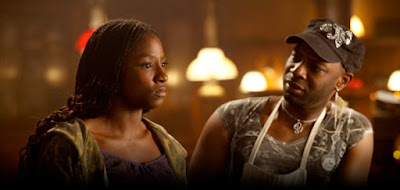

Another minor book character who was given a more integral role in the TV show was Terry Bellefleur (played by Todd Lowe) – as in the books, Terry was a war veteran ravaged by PTSD. He was always an interesting character for Sookie’s being able to see the kindness in his heavy heart. That he also got to play most of his role opposite Carrie Preston’s Arlene, was nothing short of spectacular. She was evil in the book series, but turned into a surprisingly well-developed character in the show, eventually coming full-circle by the finale. Preston was another real great talent find of this series, and she’d go on to make impacting guest appearances in shows like The Good Wife (as the brilliant lawyer Elsbeth Tascioni … and I’m not alone in hoping for a spin-off show with Elsbeth and Kyle MacLachlan’s Josh Perotti happens one day!)


The other characters to tip my hat to in the show are all the villains – the best of which had to be Steve and Sarah Newlin, played with gospel-goodwill enthusiasm by Michael McMillian and Anna Camp as religious anti-vamp campaigners. Denis O'Hare’s Russell Edgington was also a theatrical treat as a thousands-year-old anti-mainstreaming vampire with werewolf flunkies. And James Frain’s turn as the seriously creepy and lonely vampire Franklin Mott was inspired casting. And perhaps one of the downfalls of the finale season was the lack of real bad guys to give the season direction – especially after we’d been so spoiled for core baddies in all other seasons, right from season one’s human serial killer, René Lenier (Michael Raymond-James).


So now I’ve come this far and have yet to mention the “core” characters of book and TV series. *Sigh*. Okay, let’s do this – Sookie Stackouse, played by Anna Paquin.

It’s always the case that the main character of a series inevitably becomes the most annoying, right? Like, there’s an algorithm that proves this I’m pretty sure. They’re the person we spend the most time with, and every new season-arc depends on them doing repeatedly stupid shit to keep finding themselves in perilous situations. The one good thing about Sookie Stackhouse in True Blood though, was that the show seemed painfully self-aware of how annoying she was. I mean, they gifted audiences with this line from Pam De Beaufort (played by the goddamn glorious, Kristin Bauer van Straten): “I am so over Sookie and her precious fairy vagina and her unbelievably stupid name. Fuck Sookie!” She was speaking for all of us then.


Basically Sookie was as problematic in the TV series as she became in the books – and it’s important to note that ‘Dead Ever After’ was released in 2013, while True Blood finished in August 2014 – so by that time the TV audience were as frustrated with Sookie’s trajectory as the book audience were and perhaps fed one another’s displeasure.

Certainly Sookie started out as a bit of a contradiction – she was at once a busty blonde Southern belle, but also a serious outsider in her own community for her telepathic powers. A 20-something virgin wise beyond her years, partly for having a window into the minds of those around her, she was outwardly the archetypal (even quite boring) heroine, but below the surface there was a lot more going on which was a recurring theme of the series as a whole, which also featured shifter characters who were so far from what they seemed.

But Anna Paquin’s Sookie did suffer just as book-Sookie did when her genealogy was revealed to be fairy. This was a confusing storyline, not exactly helped by the conflicting-Disney connotations of faeries that audiences (and Sookie) had to contend with, so different from the Gothicism of vamps and werewolves.


And just as in Charlaine Harris’s books, the faerie storyline rarely worked – but where it was convoluted and just plain lame in the books, in the HBO show it became tacky and laughable;


Sookie’s love-life also became a sore point for book fans, who were all rooting for tall, blonde and Viking Eric Northman (played – deliciously – by Alexander Skarsgård in True Blood) to somehow win Sookie’s heart … even though that was never, ever going to happen with the Sookie Charlaine Harris had consistently presented.

The show found a real winner in Alexander Skarsgård as Eric, not least because he is of Swedish descent and Alan Ball struck gold with the actors’ chemistry opposite Kristin Bauer van Straten’s Pam (Eric and Pam were, in my mind, the ultimate power couple of True Blood, the one true love story of seven seasons).


However; a lot of Eric’s brilliance was a little undone by seventh season showrunner Brian Buckner – right down to a 1980s flashback that suggested for all of Eric’s wonder and astonishment at having developed feelings for the human Sookie, he’d actually had a similar relationship with another human woman called Sylvie. Ugh. The nicest thing I can say about season seven is that it gave us 80’s Eric (plus 80’s Eric and Pam running a videostore). But that’s it … well, and possibly his throne-romp with Fangtasia staffer, Ginger (Tara Buck).

The other vampire vying for Sookie’s heart was Bill Compton (Stephen Moyer, who would go on to become Anna Paquin’s husband in 2010). Look, Bill was always going to be a hard character to portray … he was a dubious first boyfriend in the books, and when his true motivations in loving Sookie were revealed fans pretty much wrote him off. Moyer was given a lot more material to work with in True Blood but as with so many characters in the show, his role became ever more ridiculous – to go from a genuinely interesting Civil War soldier with a tragic turning (and a brilliant evil maker in Lorena, played by Mariana Klaveno – who should be in more, better things) to a vampire-God reincarnation of Lilith (leading to endless Bilith jokes) just covered in fake goo blood. Ugh. It’s weird that his end on True Blood was so tragic, when in the books (according to Harri’s coda) Bill actually became … cool? – a successful video-game developer and King of Louisiana.

Speaking of Lilith … contrary to popular belief, I don’t think the show started going seriously downhill after Alan Ball left. Rather, I think it was Alan Ball’s fifth season Swan Song that left the writers with a heaping mess. This season went seriously off the rails, and probably partly because the show completely diverted from Sookie’s storyline in the book series. As such, Sookie was taken out of vampire politics, just as the vampire politics was bought to the fore by letting viewers see behind the Vampire Authority. Fifth season also seriously dropped the ball by not having more of a focus on Tara’s turning into a vampire, at Sookie’s bequest. That should have been the whole pivot-point for Sookie, but instead became a footnote in the wider political arc.


But back to Sookie’s “precious fairy vagina” … season six saw her paired with a vampire/faerie hybrid who killed her parents, called Warlow. Now, when I first watched this season I remember thinking Warlow was kinda the perfect solution for Sookie – she could become a vampire who walks in the daylight and still gets to eat food, plus Rob Kazinsky is fairly easy on the eyes. But upon re-watch it’s hard not to resent Warlow for taking up a lot of Sookie’s time (that probably should have been spent repairing her relationship with Tara, tbh) and also Warlow’s belief that he somehow owns Sookie is a serious exploration of intimate partner violence, and men who think that what they’re doing is somehow a sick form of love. I really thought Sookie’s parting line to Warlow – “I do not complete you!” – was spot-on too.


Alcide Herveaux was always a step out of time with Sookie in the books, but True Blood became the show that launched Joe Manganiello’s thousand abs and finally saw this fictional pairing happen. But it was pretty “meh” by the time Alcide and Sookie got round to hooking up (and it was so brief). Overwhelmingly what I’m left thinking about the whole shifter storyline (and this goes for Sam, played by the oh-so-loveable Sam Trammell too) was something that Kelly Link and Holly Black mused on at Brisbane Writers Festival this year … that vampires have traditionally read as “aristocracy”, while werewolf/shapeshifters have always been interpreted as “blue collar/working class”. That was so painfully true throughout True Blood – and how all the freakin’ werewolf scenes took place in either a barn or a dive-bar … both True Blood and Twilight (the whole Team Edwards VS. Team Jacob can totally be read as class-warfare) have succeeded in imbedding this unspoken “rule” further into the supernatural lexicon … which is kinda boring. Especially for a show that used vampires to discuss gay rights, they didn’t think to subvert discussions around class divide with these characters who have always been lumped into the same role?

Which brings me to some final thoughts on True Blood … while Charlaine Harris’ book series went a long way to helping create the urban fantasy/paranormal romance genre, there really wasn’t a whole lot of new ground trod in True Blood, though the series started out with the potential to do so much. I still maintain that it was a good show, and the first three or four seasons bought injections of fun back into the horror/slasher TV genre. But in the end it was more the sum of its parts that stand out in memory – characters like Tara and Lafeyette who were more unique and special than the show itself. Even the finale episode, which sees heroine Sookie stake and kill her first true love, Bill – you can’t say that was original either (since Buffy had once done the same to her true love, Angel – though nowhere near as gory).

I’ve heard Alan Ball summarise the show as “the horrors of intimacy”, and that is true. Admittedly, sometimes that intimacy was so ludicrous that it (literally) turned heads, and towards the end it did feel like the show was trying to out-do itself in the extreme-sex stakes … but at the end of the day it was a show about love, and getting your heart ripped out. Sometimes literally. And that’s kinda awesome.


... did I forget to mention Jason Stackhouse? (played by Vinnie Patterson ... I mean Ryan Kwanten!). Look, loveable fool Jason was pretty one-note, but by-golly did Ryan Kwanten play that note exceptionally well! 


| More